. 2014 Jun;51(6):375-87.
doi: 10.1136/jmedgenet-2013-102248. Epub 2014 Apr 8.

Comprehensive genotyping and clinical characterisation reveal 27 novel NKX2-1 mutations and expand the phenotypic spectrum

Affiliations

Comprehensive genotyping and clinical characterisation reveal 27 novel NKX2-1 mutations and expand the phenotypic spectrum

Anne Thorwarth et al. J Med Genet. 2014 Jun.

Abstract

Background: NKX2-1 encodes a transcription factor with large impact on the development of brain, lung and thyroid. Germline mutations of NKX2-1 can lead to dysfunction and malformations of these organs. Starting from the largest coherent collection of patients with a suspected phenotype to date, we systematically evaluated frequency, quality and spectrum of phenotypic consequences of NKX2-1 mutations.

Methods: After identifying mutations by Sanger sequencing and array CGH, we comprehensively reanalysed the phenotype of affected patients and their relatives. We employed electrophoretic mobility shift assay (EMSA) to detect alterations of NKX2-1 DNA binding. Gene expression was monitored by means of in situ hybridisation and compared with the expression level of MBIP, a candidate gene presumably involved in the disorders and closely located in close genomic proximity to NKX2-1.

Results: Within 101 index patients, we detected 17 point mutations and 10 deletions. Neurological symptoms were the most consistent finding (100%), followed by lung affection (78%) and thyroidal dysfunction (75%). Novel symptoms associated with NKX2-1 mutations comprise abnormal height, bouts of fever and cardiac septum defects. In contrast to previous reports, our data suggest that missense mutations in the homeodomain of NKX2-1 not necessarily modify its DNA binding capacity and that this specific type of mutations may be associated with mild pulmonary phenotypes such as asthma. Two deletions did not include NKX2-1, but MBIP, whose expression spatially and temporarily coincides with NKX2-1 in early murine development.

Conclusions: The high incidence of NKX2-1 mutations strongly recommends the routine screen for mutations in patients with corresponding symptoms. However, this analysis should not be confined to the exonic sequence alone, but should take advantage of affordable NGS technology to expand the target to adjacent regulatory sequences and the NKX2-1 interactome in order to maximise the yield of this diagnostic effort.

Keywords: CNV; NKX2-1; array CGH; choreoathetosis; hypothyroidism.


Conflict of interest statement

None.

Figures
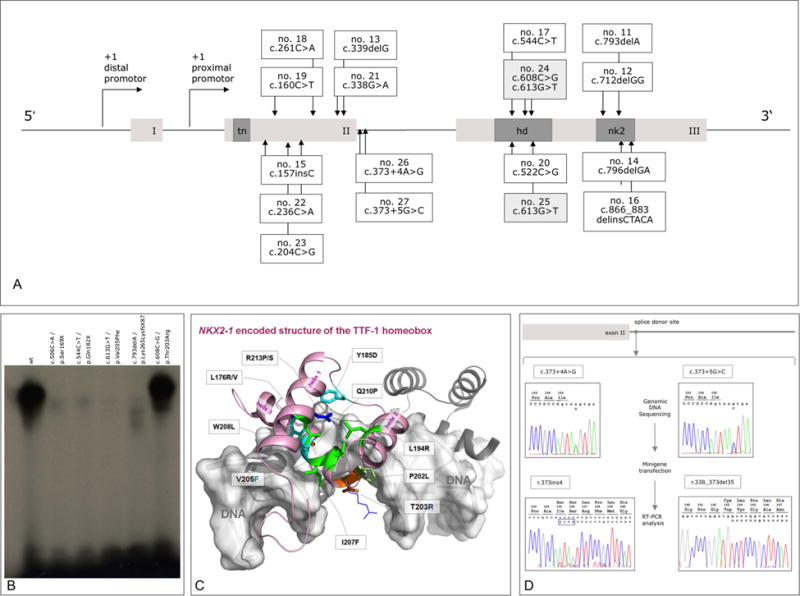
Figure 1
Figure 1
Position and functional consequences of NKX2-1 mutations. (A) Distribution of 17 novel point mutations with respect to the functional domains of NKX2-1 isoform 2 (REFSEQ NM_003317.3). Distal and proximal promoters are indicated by arrows; functional domains are shown in dark grey (tn, tin domain; hd, homeodomain; nk2, NK2 domain). (B) DNA binding characteristics of mutant NKX2-1. Electromobility shift assay testing wild-type and mutant NKX2-1 binding to a labelled probe corresponding to the NKX2-1 binding site of the TPO promoter. wt (lane 1); c.506C>A/p.Ser169X ( lane 2); c.544C>T/p.Gln182X (no. 17, lane 3); c.613G>T/p.Val205Phe (nos. 24/1 and 25, lane 4); c.793delA/p. Lys265LysfsX87 (no. 11, lane 5); c.608C>G/p.Thr203Arg (no. 24/2, lane 6); see text for details. (C) Structural homology model. Visualisation of the putative mode of binding between a human NKX2-1 homeobox (light-magenta backbone) and a fragment of DNA (white, translucent surface). The wild-type positions of known naturally occurring mutations are shown as sticks (colour code: green, hydrophobic side chain properties; cyan, aromatic; orange, hydrophilic; blue, positively charged; light green, proline). The side chains and potential orientations of two mutations described in this study—at positions 203 (p. T203R) and 205 (p. V205F)—are additionally visualised as lines. (D) Splicing defects caused by intronic point mutations. Mutant nos. 26 and 27 were analysed by mini gene reporter assays. Sequencing chromatograms of genomic DNA (c.373+4A>G/c.373 +5G>C variants) and RNA after CHO cell transfection and reverse transcription (r.373ins4/r.338_373del35) are depicted in the upper and lower two boxes, respectively.
Figure 2
Figure 2
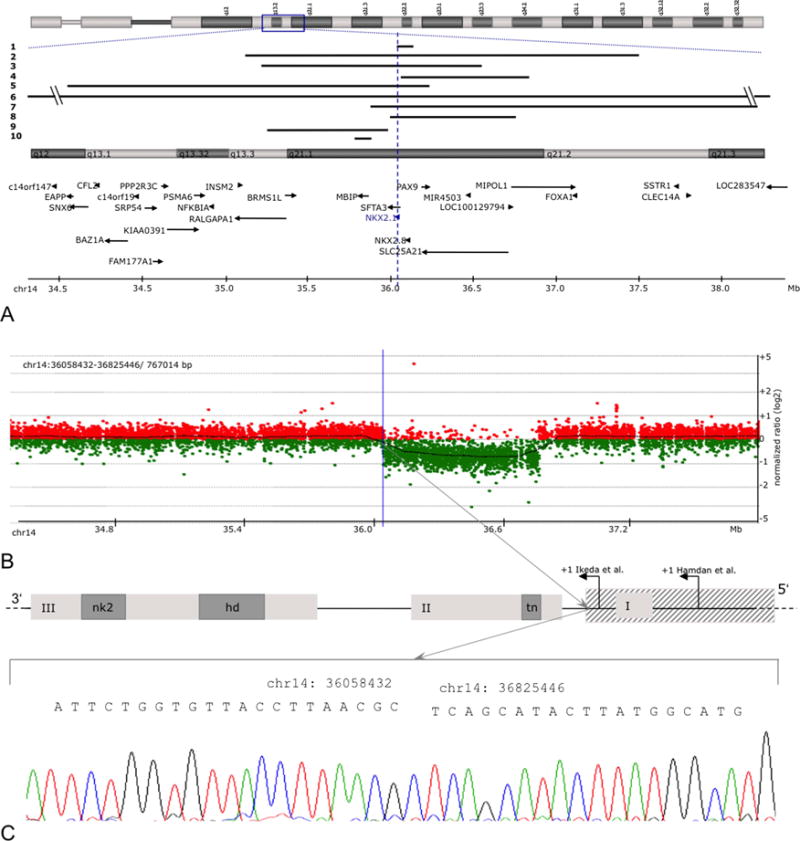
Disease-associated copy number variants (CNVs). (A) Localisation of all CNVs reported in this study. The vertical line highlights the position of NKX2-1 on chromosome 14q13.3. (B) Array CGH profile of deletion no. 4 encompassing chr14: 35989750-36754641 (array CGH results of all other cases are summarised in online supplementary figure 2). (C) CNV verification by breakpoint spanning PCR and amplicon sequencing on the example of the proximal border of deletion no. 4 (hatched box).
Figure 3
Figure 3
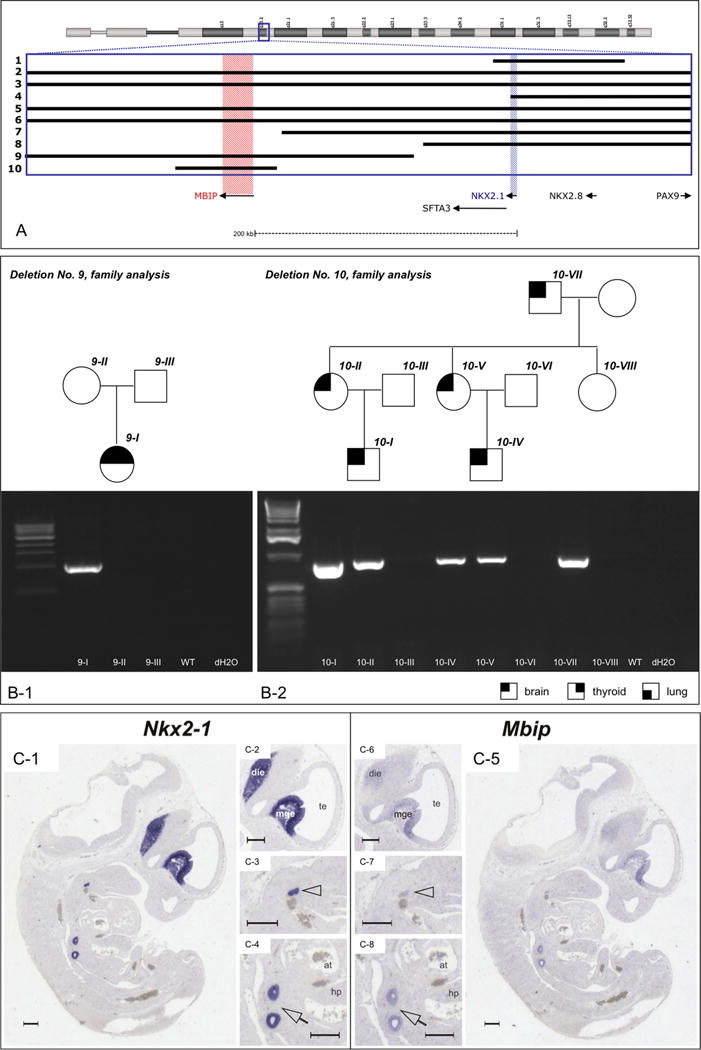
Copy number variants (CNVs) not including NKX2-1. (A) Close-up of chr14: 35,739,446-36,221,024 (Hg18). The positions of NKX2-1 and MBIP are highlighted in blue and red, respectively. Note that CNVs nos. 9 and 10 do not affect NKX2-1. (B) Breakpoint spanning PCR verifying the deletion in index patients nos. 9 and 10 and their relatives; see legend at the bottom for phenotype symbols. All genomic coordinates are given for Hg18. (C) Nkx2-1 and Mbip co-expression in mouse embryonic tissues. Nkx2-1 and Mbip in situ hybridisations on adjoining sagittal sections of an E11.5 wild-type embryo. Nkx2-1 and Mbip have common expression domains in the diencephalon, the median ganglionic eminence, the lung anlage and the thyroid primordium. C1–C4, Nkx2.1; C5–C8, Mbip in situ hybridisation. Panels C2–C4 and C6–C8 represent enlargements of C1 and C5, respectively. Arrowheads, thyroid primordium; arrows, lung anlage; die, diencephalon; mge, median ganglionic eminence; te, telencephalic vesicle; at, atrium; hp, hepatic primordium. Scale bars represent 250 μm.
Figure 4
Figure 4
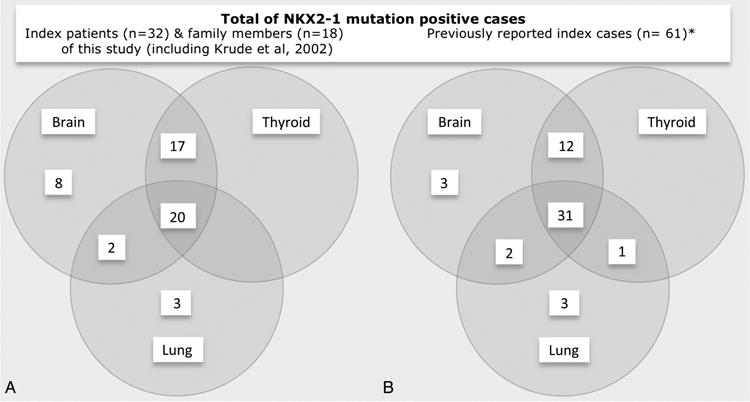
Brain, thyroid and lung involvement in patients with and without NKX2-1 mutations. Venn diagrams demonstrating that the triad of symptoms is enriched in mutation-positive patients. (A) Symptoms in patients with NKX2-1 deficiency (27/101). (B) Symptoms in patients without NKX2-1 deficiency (74/101). Two further Venn diagrams, one focusing on the phenotype of 18 family members and another one including also the 5 index patients of our previous study, are given in online supplementary figure S3. Two further Venn diagrams demonstrating that symptom involvement is identical in index cases (n=32, including also the five index patients of our previous study to that of family members (n=18), except three patients with isolated asthma phenotype) are given in online supplementary figure S3.
Figure 5
Figure 5
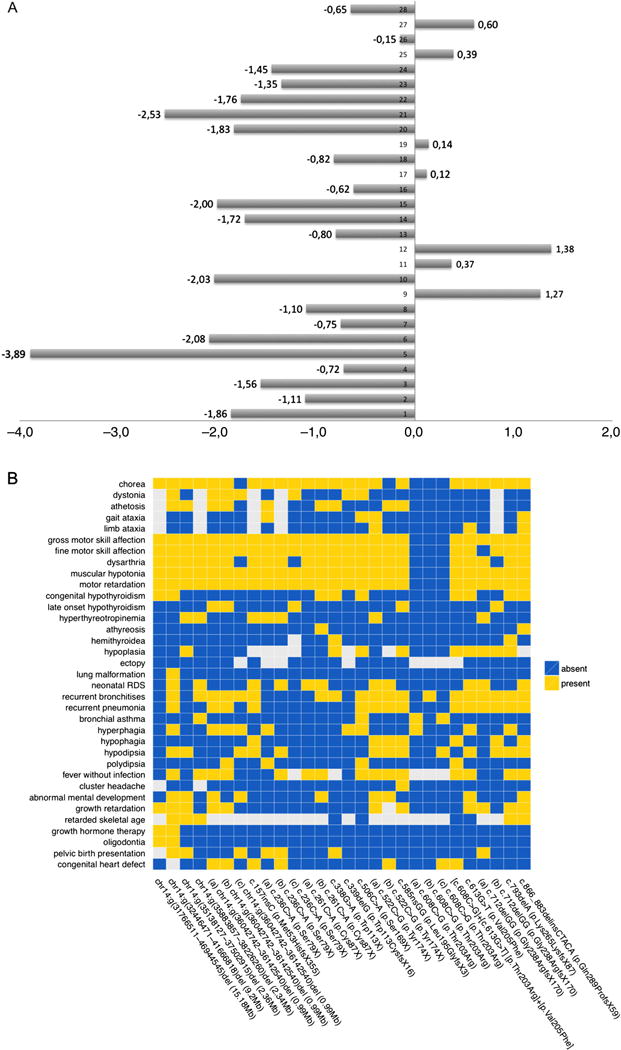
Additional symptoms in patients with NKX2-1 mutations. (A) Body height standard deviation score (SDS) values of detailed phenotype cohort. Median value −0.84 SDS; patients 1–18 carrying NKX2-1 mutations: 1, chr14:g (36042742_36142540)del; 2, chr14:g (36042742_36142540)del; 3, chr14:g (36042742_36142540)del; 4, chr14:g (35138127_37502915)del; 5, chr14:g (32446471_41666818)del; 6, chr14:g (31766511_46944545)del; 7, chr14:g (35883857_38226260)del; 8, c.522C>G_p.Tyr174X; 9, c.522C>G_p. Tyr174X; 10, c.585nsGG_p. Leu195GlyfsX3; 11, c.613G>T_p. Val205Phe; 12, [c.608C>G] +[c.613G>T]_[p.Thr203Arg]+[p. Val205Phe]; 13, c.608C>G_p. Val205Phe; 14, c.608C>G_p. Val205Phe; 15, c.608C>G_p. Val205Phe; 16, c.338G>A_p.Trp113X; 17, c.261C>A_p.Cys87X; 18, c.261C>A_p.Cys87X; 19, c.506C>A_p. Ser169X; 20, c.157insC_p. Met53HisfsX355; 21, c.236C>A_p. Ser79X; 22, c.236C>A_p.Ser79X; 23, c.236C>A_p.Ser79X; 24, c.866_883delinsCTACA_p. Gln289ProfsX59; 25, c.793delA_p. Lys265LysfsX87;26, c.712delGG_p. Gly238ArgfsX170; 27, c.712delGG_p. Gly238ArgfsX170; 28, c.339delG_p. Trp113CysfsX16. (B) Heatmap summarising the results of detailed phenotyping in 18 index patients and 10 relatives with NKX2-1 deficiency. The presence and absence of symptoms is indicated by yellow and blue boxes, respectively. Missing values are shown in grey. The first seven columns to the left depict the phenotypes of the patients affected by a copy number variant. Point mutations are sorted according to their genomic position. The letters (a), (b) and (c) heading the description of the mutation indicate family members sharing the same mutation.

References

    1. Kim Y, Nirenberg M. Drosophila NK-homeobox genes. Proc Natl Acad Sci USA. 1989;86:7716–20. - PMC - PubMed
    1. Guazzi S, Price M, De Felice M, Damante G, Mattei MG, Di Lauro R. Thyroid nuclear factor 1 (TTF-1) contains a homeodomain and displays a novel DNA binding specificity. EMBO J. 1990;9:3631–9. - PMC - PubMed
    1. Mizuno K, Gonzalez FJ, Kimura S. Thyroid-specific enhancer-binding protein (T/EBP): cDNA cloning, functional characterization, and structural identity with thyroid transcription factor TTF-1. Mol Cell Biol. 1991;11:4927–33. - PMC - PubMed
    1. Kimura S, Hara Y, Pineau T, Fernandez-Salguero P, Fox CH, Ward JM, Gonzalez FJ. The T/ebp null mouse: thyroid-specific enhancer-binding protein is essential for the organogenesis of the thyroid, lung, ventral forebrain, and pituitary. Genes Dev. 1996;10:60–9. - PubMed
    1. Sussel L, Marin O, Kimura S, Rubenstein JL. Loss of Nkx2.1 homeobox gene function results in a ventral to dorsal molecular respecification within the basal telencephalon: evidence for a transformation of the pallidum into the striatum. Development. 1999;126:3359–70. - PubMed