


Lactate dehydrogenase 5 isoenzyme overexpression defines resistance of prostate cancer to radiotherapy
- PMID: 24714743
- PMCID: PMC4007238
- DOI: 10.1038/bjc.2014.158
Lactate dehydrogenase 5 isoenzyme overexpression defines resistance of prostate cancer to radiotherapy
Abstract
Background: Radiotherapy provides high-cure rates in prostate cancer. Despite its overall slow clinical growth, high proliferation rates documented in a subset of tumours relate to poor radiotherapy outcome. This study examines the role of anaerobic metabolism in prostate cancer growth and resistance to radiotherapy.
Methods: Biopsy samples from 83 patients with prostate cancer undergoing radical hypofractionated and accelerated radiotherapy were analysed for MIB1 proliferation index and for lactate dehydrogenase isoenzyme LDH5, a marker of tumour anaerobic metabolism. Ninety-five surgical samples were in parallel analysed. Correlation with histopathological variables, PSA and radiotherapy outcome was assessed. Dose-response experiments were performed in PC3 and DU145 cancer cell lines.
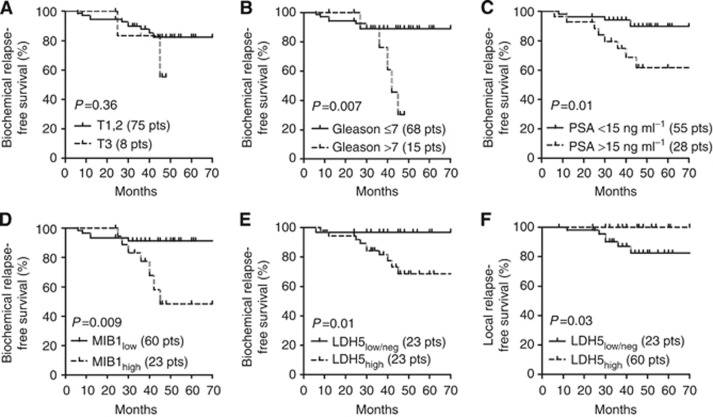
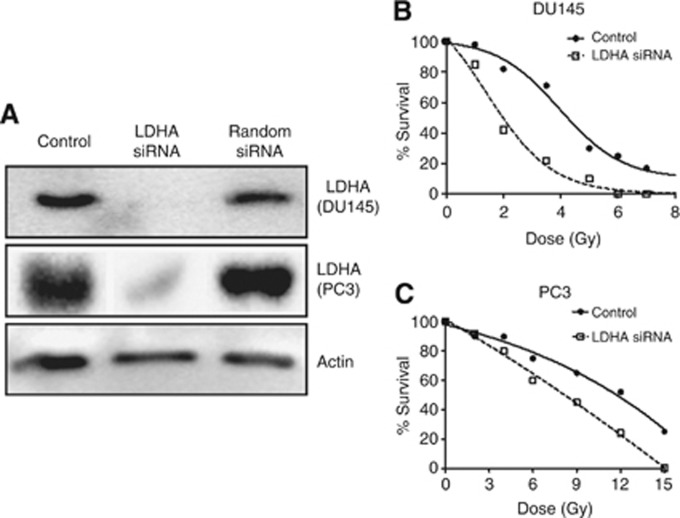
Results: High MIB1 index (noted in 25% of cases) was directly related to Gleason score (P<0.0001), T3-stage (P=0.0008) and PSA levels (P=0.03). High LDH5 (noted in 65% of cases) was directly related to MIB1 index (P<0.0001), Gleason score (P=0.02) and T3-stage (P=0.001). High Gleason score, MIB1, LDH5 and PSA levels were significantly related to poor BRFS (P=0.007, 0.01, 0.03 and 0.01, respectively). High Gleason score (P=0.04), LDH5 (P=0.01) and PSA levels (P=0.003) were significantly related to local recurrence. MIB1 and T-stage did not affect local control. Silencing of LDHA gene in both prostate cancer cell lines resulted in significant radiosensitisation.
Conclusions: LDH5 overexpression is significantly linked to highly proliferating prostate carcinomas and with biochemical failure and local relapse following radiotherapy. Hypoxia and LDHA targeting agents may prove useful to overcome radioresistance in a subgroup of prostate carcinomas with anaerobic metabolic predilection.
Figures
References
-
- Abatzoglou I, Zois CE, Pouliliou S, Koukourakis MI. Establishment and validation of a method for multi-dose irradiation of cells in 96-well microplates. Biochem Biophys Res Commun. 2013;431:456–459. - PubMed
-
- Baccala A, Jr, Reuther AM, Bianco FJ, Jr, Scardino PT, Kattan MW, Klein EA. Complete resection of seminal vesicles at radical prostatectomy results in substantial long-term disease-free survival: multi-institutional study of 6740 patients. Urology. 2007;69:536–540. - PubMed
-
- Cheng L, Sebo TJ, Cheville JC, Pisansky TM, Slezak J, Bergstralh EJ, Pacelli A, Neumann RM, Zincke H, Bostwick DG. p53 protein overexpression is associated with increased cell proliferation in patients with locally recurrent prostate carcinoma after radiation therapy. Cancer. 1999;85:1293–1299. - PubMed
-
- Dearnaley D, Syndikus I, Sumo G, Bidmead M, Bloomfield D, Clark C, Gao A, Hassan S, Horwich A, Huddart R, Khoo V, Kirkbride P, Mayles H, Mayles P, Naismith O, Parker C, Patterson H, Russell M, Scrase C, South C, Staffurth J, Hall E. Conventional versus hypofractionated high-dose intensity-modulated radiotherapy for prostate cancer: preliminary safety results from the CHHiP randomised controlled trial. Lancet Oncol. 2012;13:43–54. - PubMed
-
- Fleischmann A, Huland H, Mirlacher M, Wilczak W, Simon R, Erbersdobler A, Sauter G, Schlomm T. Prognostic relevance of Bcl-2 overexpression in surgically treated prostate cancer is not caused by increased copy number or translocation of the gene. Prostate. 2012;72:991–997. - PubMed
Publication types
MeSH terms
Substances
LinkOut - more resources
Full Text Sources
Other Literature Sources
Medical
Research Materials
Miscellaneous
