


Does perceived control predict Complementary and Alternative Medicine (CAM) use among patients with lung cancer? A cross-sectional survey
- PMID: 24715092
- PMCID: PMC4119556
- DOI: 10.1007/s00520-014-2220-5
Does perceived control predict Complementary and Alternative Medicine (CAM) use among patients with lung cancer? A cross-sectional survey
Abstract
Purpose: Scant literature exists on the use of complementary and alternative medicine (CAM) among patients with lung cancer. Preliminary data indicates that perceived control is an important factor leading patients to CAM. This study aimed to evaluate the relationship between perceived control and CAM use in patients with lung cancer.
Methods: We performed a cross-sectional survey in patients with lung cancer under active treatment and follow-up at the oncology clinic of an academic medical center. Self-reported CAM use was the primary outcome. Multivariate logistic regression was performed to determine the relationship between perceived control and CAM use, controlling for other factors.
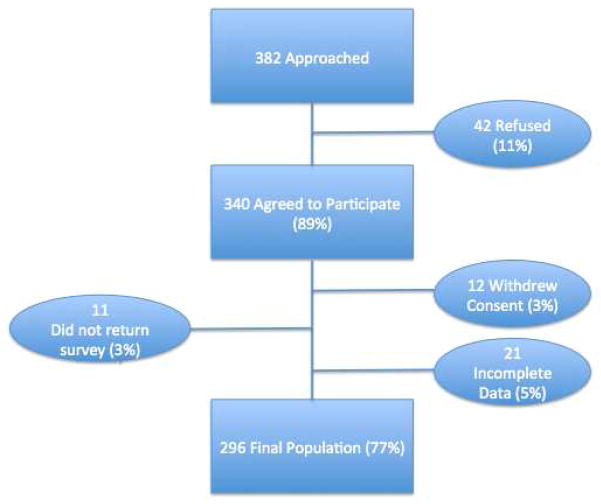
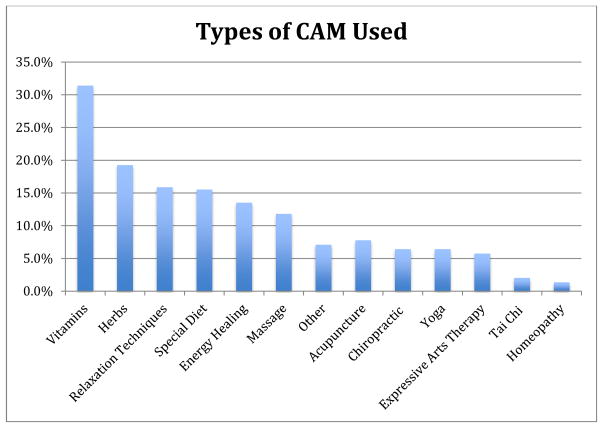
Results: Among 296 participants, 54.4 % were female, 83.5 % were Caucasian, 57.6 % were ≤65 years old, 52.4 % were in stage IV, and 86.4 % had non-small cell lung cancer; 50.9 % of patients had used CAM, most commonly vitamins (31.5 %), herbs (19.3 %), relaxation techniques (16 %), and special diets (15.7 %). In multivariate analysis, CAM use was associated with having greater perceived control over the cause of cancer (adjusted odds ratio (AOR) 2.27, 95 % confidence interval (CI) 1.35-3.80), age ≤ 65 (AOR 1.64, 95 % CI 1.01-2.67), higher education (AOR 2.17, 95 % CI 1.29-3.64), and never having smoked tobacco (AOR 2.39, 95 % CI 1.25-4.54). Nearly 60 % of patients who used CAM were receiving active treatment.
Conclusion: Over half of lung cancer patients have used CAM since diagnosis. Greater perceived control over the cause of cancer was associated with CAM use. Given the high prevalence of CAM, it is essential that oncologists caring for patients with lung cancer discuss its use.
Conflict of interest statement
Conflict of Interest: This study is partially funded by the Penn Institute of Aging Pilot Fund. Dr. Mao is supported National Institutes of Health [1K23 AT004112-05]. The content is solely the responsibility of the authors and does not necessarily represent the official views of the National Institutes of Health. The authors have full control of the primary data, which is available to the journal at their request for review.
Figures
References
-
- Amichai T, Grossman M, Richard M. Lung cancer patients’ beliefs about complementary and alternative medicine in the promotion of their wellness. European journal of oncology nursing : the official journal of European Oncology Nursing Society. 2012;16:520–527. - PubMed
-
- Balneaves LG, Kristjanson LJ, Tataryn D. Beyond convention: describing complementary therapy use by women living with breast cancer. Patient education and counseling. 1999;38:143–153. - PubMed
-
- Barez M, Blasco T, Fernandez-Castro J, Viladrich C. A structural model of the relationships between perceived control and adaptation to illness in women with breast cancer. Journal of psychosocial oncology. 2007;25:21–43. - PubMed
-
- Boon H, Stewart M, Kennard MA, Gray R, Sawka C, Brown JB, McWilliam C, Gavin A, Baron RA, Aaron D, Haines-Kamka T. Use of complementary/alternative medicine by breast cancer survivors in Ontario: prevalence and perceptions. J Clin Oncol. 2000;18:2515–2521. - PubMed
Publication types
MeSH terms
Grants and funding
LinkOut - more resources
Full Text Sources
Other Literature Sources
Medical
