Review
. 2014 Apr;4(2):805-26.
doi: 10.1002/cphy.c130026.

Dysautonomia in Parkinson disease

Affiliations
Review

Dysautonomia in Parkinson disease

David S Goldstein. Compr Physiol. 2014 Apr.

Abstract

Dysautonomias are conditions in which altered function of one or more components of the autonomic nervous system (ANS) adversely affects health. This review updates knowledge about dysautonomia in Parkinson disease (PD). Most PD patients have symptoms or signs of dysautonomia; occasionally, the abnormalities dominate the clinical picture. Components of the ANS include the sympathetic noradrenergic system (SNS), the parasympathetic nervous system (PNS), the sympathetic cholinergic system (SCS), the sympathetic adrenomedullary system (SAS), and the enteric nervous system (ENS). Dysfunction of each component system produces characteristic manifestations. In PD, it is cardiovascular dysautonomia that is best understood scientifically, mainly because of the variety of clinical laboratory tools available to assess functions of catecholamine systems. Most of this review focuses on this aspect of autonomic involvement in PD. PD features cardiac sympathetic denervation, which can precede the movement disorder. Loss of cardiac SNS innervation occurs independently of the loss of striatal dopaminergic innervation underlying the motor signs of PD and is associated with other nonmotor manifestations, including anosmia, REM behavior disorder, orthostatic hypotension (OH), and dementia. Autonomic dysfunction in PD is important not only in clinical management and in providing potential biomarkers but also for understanding disease mechanisms (e.g., autotoxicity exerted by catecholamine metabolites). Since Lewy bodies and Lewy neurites containing alpha-synuclein constitute neuropathologic hallmarks of the disease, and catecholamine depletion in the striatum and heart are characteristic neurochemical features, a key goal of future research is to understand better the link between alpha-synucleinopathy and loss of catecholamine neurons in PD.


Figures

Figure 1
Figure 1
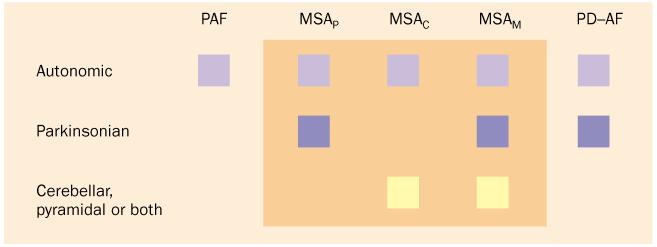
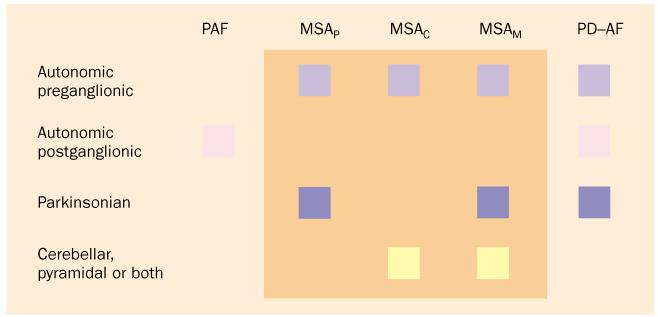
Clinical classification of primary chronic autonomic failure. Pure autonomic failure (PAF) features autonomic failure without evidence of central neurodegeneration. Multiple system atrophy (MSA) has parkinsonian, cerebellar, and mixed forms. PD with autonomic failure (PD-AF) can be difficult to distinguish clinically from the parkinsonian form of MSA.
Figure 2
Figure 2
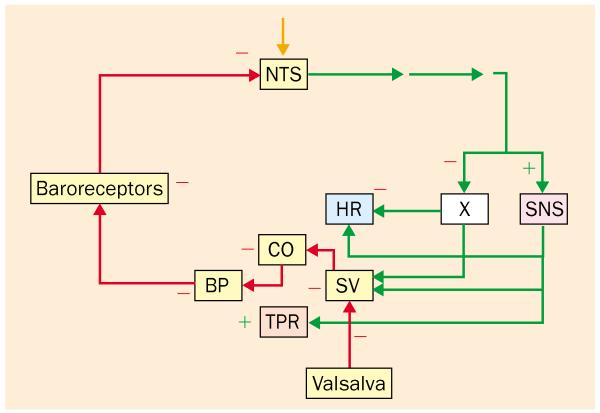
Reflexive responses to the Valsalva manoeuvre. Afferents are shown in red and efferents in green. During the manoeuvre, venous return to the heart decreases, and cardiac stroke volume (SV) and output (CO) fall as does blood pressure (BP). Afferent nerve traffic to the nucleus of the solitary tract (NTS) from arterial and cardiopulmonary baroreceptors declines. Efferent activity in the vagus nerve (X) decreases reflexively, increasing heart rate (HR), and efferent activity in the sympathetic nervous system (SNS) increases reflexively, increasing total peripheral resistance (TPR). −=inhibition; +=stimulation.
Figure 3
Figure 3
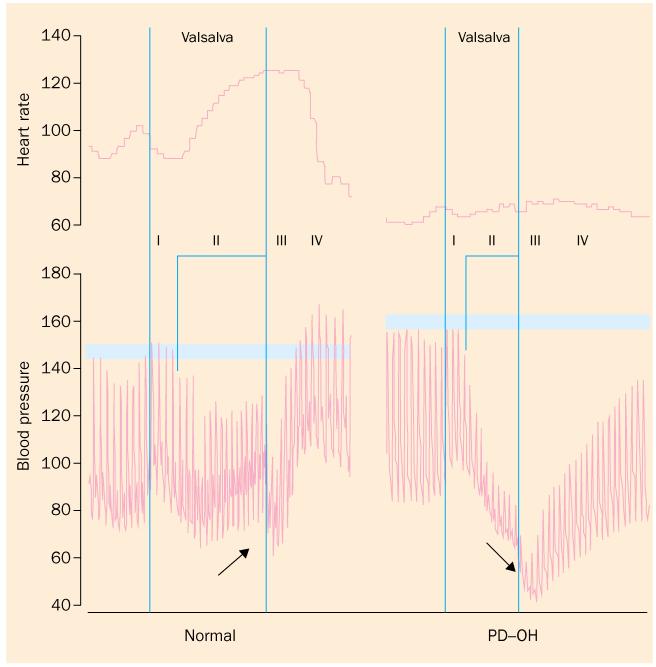
. Blood pressure and heart rate during the Valsalva manoeuvre. In phase II, blood pressure normally increases from its lowest, and in phase IV blood pressure overshoots baseline. In PD with orthostatic hypotension (PD-OH), blood pressure decreases progressively in phase II and fails to overshoot the baseline pressure in phase IV, which are signs of sympathetic neurocirculatory or baroreflex-sympathoneural failure. PD-OH also features baroreflex-cardiovagal failure, manifested by constant interbeat interval despite arterial hypotension.
Figure 4
Figure 4
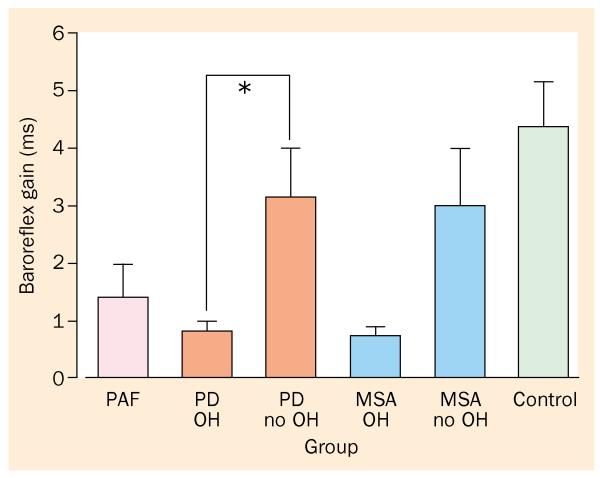
Baroreflex-cardiovagal gain in pure autonomic failure (PAF), PD with or without orthostatic hypotension (OH), and multiple system atrophy (MSA) with or without OH. All three forms of chronic primary autonomic failure feature extremely low baroreflex-cardiovagal gain.
Figure 5
Figure 5
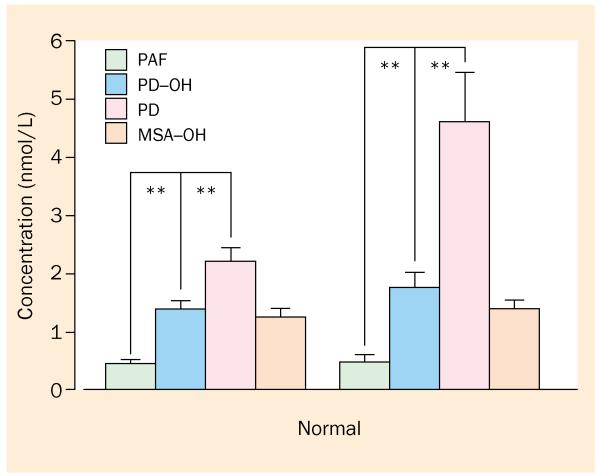
Concentrations of norepinephrine in the plasma during supine rest and after 5 min of standing in patients with pure autonomic failure (PAF), PD with or without orthostatic hypotension (OH), and multiple system atrophy (MSA) with OH. Note blunted orthostatic increment in plasma noradrenaline concentration in PAF, PD-OH, and MSA-OH but not in PD without OH.
Figure 6
Figure 6
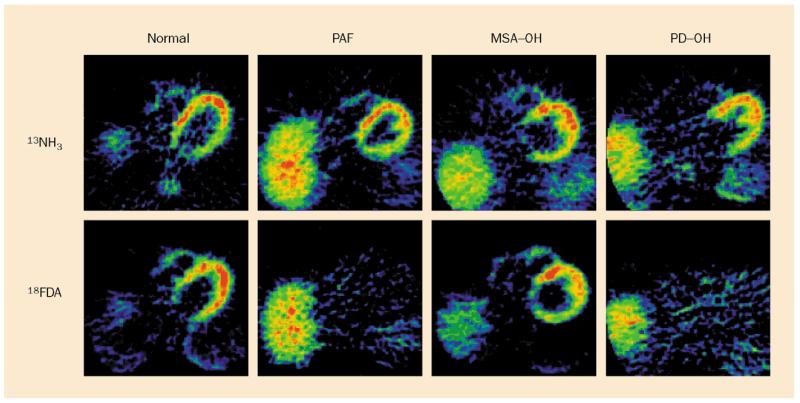
Cardiac PET scans in a control subject and in patients with pure autonomic failure (PAF), multiple system atrophy with orthostatic hypotension (MSA-OH), and PD with orthostatic hypotension (PD-OH). Top: nitrogen-13-labelled ammonia (13NH3) perfusion scans. Bottom: 18F-dopa (18FDA) sympathoneural scans in each patient. Note absence of cardiac 18F-dopa imaging in PAF and PD-OH and normal radioactivity in MSA-OH.
Figure 7
Figure 7
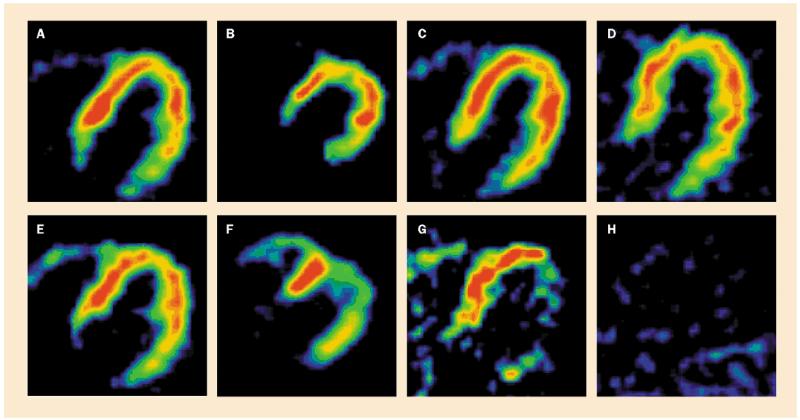
Cardiac PET scans in patients with PD without orthostatic hypotension. Top: nitrogen-13-labelled ammonia perfusion scans. Bottom: 18F-dopa sympathoneural scans. Of 27 patients very few had entirely normal 18F-dopa radioactivity (A,E). Localised decreases were common (B,F and C,G), and about half had decreased 18F-dopa radioactivity throughout the left ventricular myocardium (D,H).
Figure 8
Figure 8
. Proposed pathophysiological classification of primary chronic autonomic failure. According to this schema, PD with autonomic failure (PD-AF) features a postganglionic, sympathetic, noradrenergic lesion, whereas the parkinsonian form of multiple system atrophy (MSAP) does not.

References

    1. Goldstein D, Eisenhofer G, Robertson D, Straus R, Esler M. Dysautonomias: clinical disorders of the autonomic nervous system. Ann Intern Med. 2002;137:753–63. - PubMed
    1. Goldstein DS. The autonomic nervous system in health and disease. Marcel Dekker Inc; New York: 2001.
    1. Langley JN. The autonomic nervous system. Brain. 1903;26:1–26.
    1. Langley JN. W Heffer and Sons Ltd; Cambridge: 1921. The autonomic nervous system.
    1. Cannon WB. The emergency function of the adrenal medulla in pain and in the major emotions. Am J Physiol. 1914;33:356–72.

MeSH terms