


Enhanced removal of Enterococcus faecalis biofilms in the root canal using sodium hypochlorite plus photon-induced photoacoustic streaming: an in vitro study
- PMID: 24717113
- PMCID: PMC4010178
- DOI: 10.1089/pho.2014.3714
Enhanced removal of Enterococcus faecalis biofilms in the root canal using sodium hypochlorite plus photon-induced photoacoustic streaming: an in vitro study
Erratum in
- Photomed Laser Surg. 2014 Sep;32(9):524
Abstract
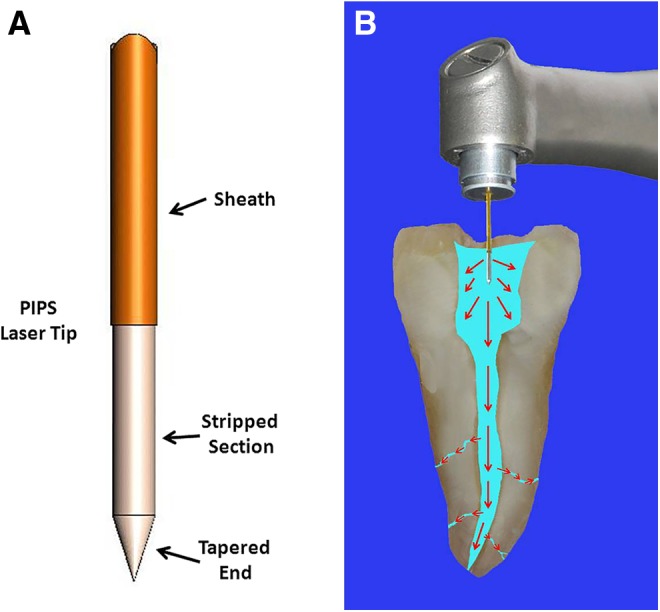
Objective: The purpose of this study was to determine the effectiveness of laser-activated irrigation by photon-induced photoacoustic streaming (PIPS) using Er:YAG laser energy in decontaminating heavily colonized root canal systems in vitro.
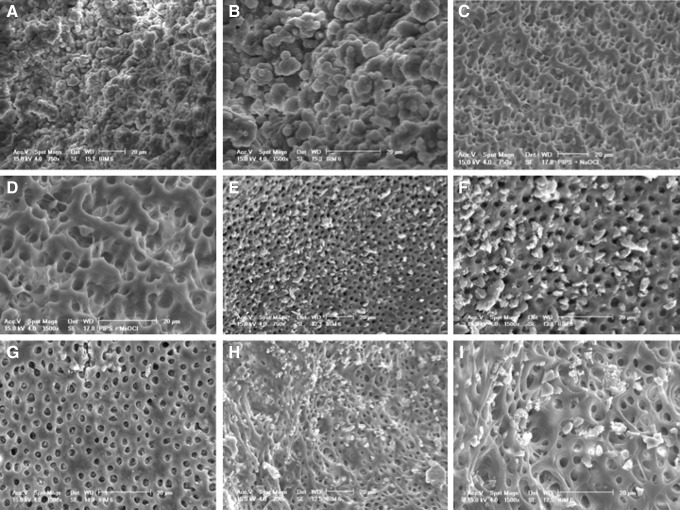
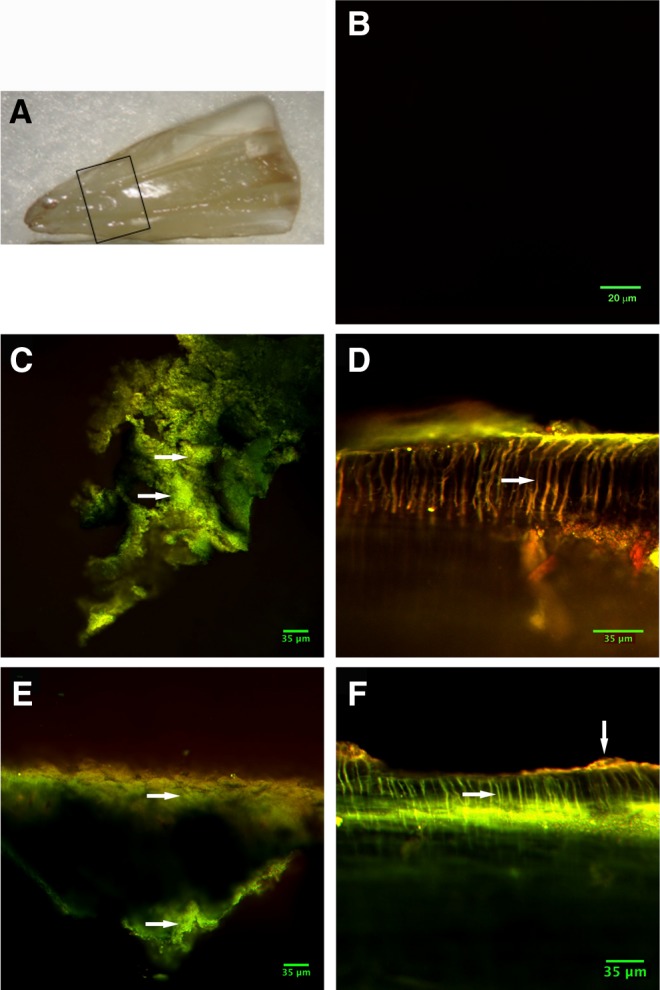
Materials and methods: Extracted single-rooted human teeth (n=60) were mechanically and chemically prepared, sterilized, inoculated with Enterococcus faecalis for 3 weeks, and randomly assigned to four groups (n=15): Group I (control, no decontamination), Group II (PIPS+6% NaOCl), Group III (PIPS+saline), and Group IV (6% NaOCl). PIPS settings were all preset to 50 μsec pulse, 20 mJ, 15 Hz, for an average power of 0.3 W. After decontamination, the remaining live microbes from all specimens were collected and recovered via plate counting of the colony-forming units (CFUs). Randomized root canal surfaces were examined with scanning electron microscopy and confocal laser microscopy. Mean variance and Dunnett's t test (post-hoc test) comparisons were used to compare mean scores for the three groups with the control group.
Results: The CFU analysis showed the following measurements (mean±SE): Group I (control), 336.8±1.8; Group II (PIPS+NaOCl), 0.27±0.21; Group III (PIPS+saline), 225.0±21; and Group IV (NaOCl), 46.9±20.29. Group II had significantly lower CFUs than any other groups (p<0.05). Both imaging analyses confirmed levels of remaining bacteria on examined root surfaces.
Conclusions: The use of the PIPS system along with NaOCl showed the most efficient eradication of the bacterial biofilm. It appears that laser-activated irrigation (LAI) utilizing PIPS may enhance the disinfection of the root canal system.
Figures
References
-
- Basmadjian-Charles C.L., Farge P., Bourgeois D.M., and Lebrun T. (2002). Factors influencing the long-term results of endodontic treatment: a review of the literature. Int. Dent. J. 52, 81–86 - PubMed
-
- Siqueira J.F., Jr., and Rocas I.N. (2008). Clinical implications and microbiology of bacterial persistence after treatment procedures. J. Endod. 34, 1291–1301 - PubMed
-
- Wong R. (2004). Conventional endodontic failure and retreatment. Dent. Clin. North Am. 48, 265–289 - PubMed
-
- Gu L.S., Kim J.R., Ling J., Choi K.K., Pashley D.H., and Tay F.R. (2009). Review of contemporary irrigant agitation techniques and devices. J. Endod. 35, 791–804 - PubMed
-
- Cameron J.A. (1987). The synergistic relationship between ultrasound and sodium hypochlorite: a scanning electron microscope evaluation. J. Endod. 13, 541–545 - PubMed
Publication types
MeSH terms
Substances
Grants and funding
LinkOut - more resources
Full Text Sources
Other Literature Sources
