


Added sugars in the diet are positively associated with diastolic blood pressure and triglycerides in children
- PMID: 24717340
- PMCID: PMC4144113
- DOI: 10.3945/ajcn.113.076505
Added sugars in the diet are positively associated with diastolic blood pressure and triglycerides in children
Abstract
Background: Hypertension and dyslipidemia have traditionally been associated with dietary sodium and fat intakes, respectively; however, they have recently been associated with the consumption of added sugars in adults and older adolescents, but there is no clear indication of how early in the life span this association manifests.
Objective: This study explored the cross-sectional association between added sugar (sugars not naturally occurring in foods) consumption in children, blood pressure (BP), and fasting blood lipids [triglycerides and total, low-density lipoprotein, and high-density lipoprotein (HDL) cholesterol].
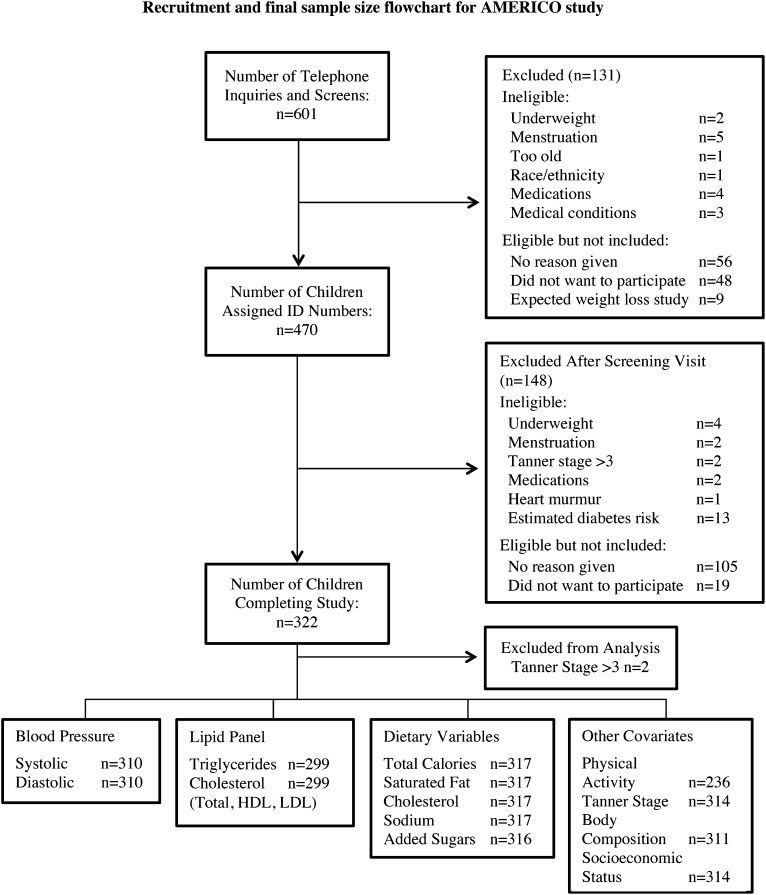
Design: BP, blood lipids, and dietary intakes were obtained in a multiethnic pediatric sample aged 7-12 y of 122 European American (EA), 106 African American (AA), 84 Hispanic American (HA), and 8 mixed-race children participating in the Admixture Mapping of Ethnic and Racial Insulin Complex Outcomes (AMERICO) study-a cross-sectional study conducted in the Birmingham, AL, metro area investigating the effects of racial-ethnic differences on metabolic and health outcomes. Multiple regression analyses were performed to evaluate the relations of added sugars and sodium intakes with BP and of added sugars and dietary fat intakes with blood lipids. Models were controlled for sex, race-ethnicity, socioeconomic status, Tanner pubertal status, percentage body fat, physical activity, and total energy intake.
Results: Added sugars were positively associated with diastolic BP (P = 0.0462, β = 0.0206) and serum triglycerides (P = 0.0206, β = 0.1090). Sodium was not significantly associated with either measure of BP nor was dietary fat with blood lipids. HA children had higher triglycerides but lower added sugar consumption than did either the AA or EA children. The AA participants had higher BP and HDL but lower triglycerides than did either the EA or HA children.
Conclusions: These data suggest that increased consumption of added sugars may be associated with adverse cardiovascular health factors in children, specifically elevated diastolic BP and triglycerides. Identification of dietary factors influencing cardiovascular health during childhood could serve as a tool to reduce cardiovascular disease risk. This trial was registered at clinicaltrials.gov as NCT00726778.
© 2014 American Society for Nutrition.
Figures
Comment in
-
Two more pieces to the 1000-piece carbohydrate puzzle.Am J Clin Nutr. 2014 Jul;100(1):4-5. doi: 10.3945/ajcn.114.090423. Epub 2014 May 28. Am J Clin Nutr. 2014. PMID: 24871474 No abstract available.
References
-
- Miniño A, Murphy S, Xu J, Kochanek K. Deaths: final data for 2008. Natl Vital Stat Rep 2011;59:1–126. - PubMed
-
- Heidenreich PA, Trogdon J, Khavjou O, Butler J, Dracup K, Ezekowitz M, Finkelstein E, Hong Y, Johnston S, Khera A, et al. Forecasting the future of cardiovascular disease in the United States: a policy statement from the American Heart Association. Circulation 2011;123:933–44. - PubMed
-
- Stary HC. Evolution and progression of atherosclerotic lesions in coronary arteries of children and young adults. Arteriosclerosis 1989;9(suppl):I19–32. - PubMed
-
- Kannel WB. Hypertension as a risk factor for cardiac events-epidemiologic results of long-term studies. J Cardiovasc Pharmacol 1993;21(suppl 2):S27–37. - PubMed
Publication types
MeSH terms
Substances
Associated data
Grants and funding
LinkOut - more resources
Full Text Sources
Other Literature Sources
Medical
