


Migratory restlessness in captive individuals predicts actual departure in the wild
- PMID: 24718095
- PMCID: PMC4013702
- DOI: 10.1098/rsbl.2014.0154
Migratory restlessness in captive individuals predicts actual departure in the wild
Abstract
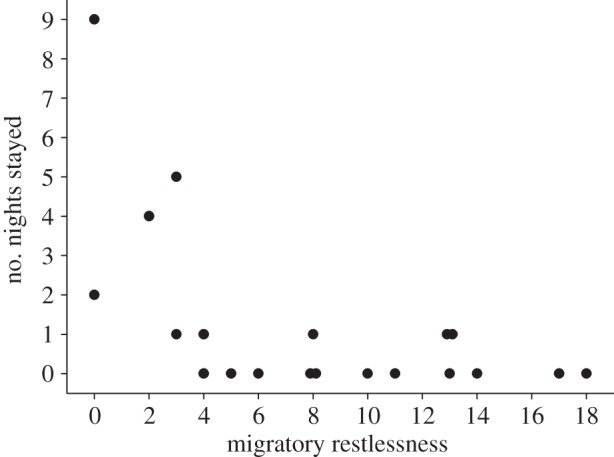
In captivity, migratory birds show increased activity during the time that they would normally migrate. The phenology and intensity of such 'migratory restlessness' has been shown to mirror species- and population-specific migration patterns observed in the wild and has consequently been used as a proxy for the motivation to migrate. Many studies doing so, however, were aiming to explain among-individual variation in migratory behaviour or traits, and not species- or population-specific traits. These studies thus assumed that, also at the level of the individual, migratory restlessness is an accurate proxy for the motivation to migrate. We tested this assumption for the first time and found that it holds; individuals showing very little migratory restlessness remained at stopover for longer than one night, whereas most individuals showing more restlessness departed sooner. This finding validates the use of migratory restlessness as a proxy for the motivation to migrate, thereby justifying the conclusions made in a large body of research on avian migration.
Keywords: Zugunruhe; migratory restlessness; proxy; radio-telemetry; stopover.
Figures
References
-
- Berthold P, Fiedler W, Querner U. 2000. Migratory restlessness or Zugunruhe in birds: a description based on video recordings under infrared illumination. J. Ornithol. 141, 285–299. ( 10.1007/BF02462238) - DOI
-
- Gwinner E. 1986. Circannual rhythms. Berlin, Germany: Springer.
-
- Berthold P. 1996. Control of bird migration. Berlin, Germany: Springer.
-
- Gwinner E. 1968. Artspezifische Muster der Zugunruhe bei Laubsängern und ihre mögliche Bedeutung für die Beendigung des Zuges im Winterquartier. Z. Tierpsychol. 25, 843–853. ( 10.1111/j.1439-0310.1968.tb00046.x) - DOI
-
- Berthold P. 1973. Relationships between migratory restlessness and migration distance in six Sylvia species. Ibis 115, 594–599. ( 10.1111/j.1474-919X.1973.tb01998.x) - DOI
MeSH terms
LinkOut - more resources
Full Text Sources
Other Literature Sources
