


High prevalence of cardiovascular risk factors in Asian Indians: a community survey - Chandigarh Urban Diabetes Study (CUDS)
- PMID: 24718400
- PMCID: PMC4001337
High prevalence of cardiovascular risk factors in Asian Indians: a community survey - Chandigarh Urban Diabetes Study (CUDS)
Abstract
Background & objectives: Studies conducted to assess the prevalence of cardiovascular (CV) risk factors among different regions of the country show variation in risk factors in different age groups and urban and rural population. We undertook this study to determine the prevalence of cardiovascular risk factors among urban adults in a north Indian city.
Methods: In a cross-sectional survey, 2227 subjects aged ≥ 20 yr were studied from April 2008 to June 2009 in Urban Chandigarh, a north Indian city. Demographic history, anthropometry and blood pressure were assessed. Fasting, and 2 h capillary plasma glucose after 75 g glucose load, HDL-C and triglycerides were estimated.
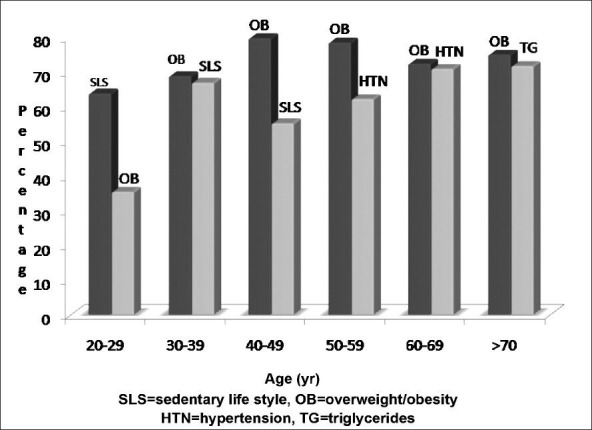
Results: The most prevalent cardiovascular risk factors in the age group of 20-29 yr was sedentary lifestyle (63%), while from fourth decade and onwards, it was overweight/obesity (59-85%). The second most common prevalent cardiovascular risk factor in the age group of 20-29 yr was overweight/obesity, in 30-49 yr sedentary lifestyle, in 50-69 yr hypertension and in subjects ≥70 yr, it was hypertriglyceridaemia. The prevalence of overweight/obesity, hypertension, dysglycaemia and smoking was almost double in subjects in the fourth decade of life, as compared to those in the third decade of life. The prevalence of CV risk factors significantly increased with age irrespective of gender and prevalence of low HDL-C was significantly more common in women as compared to men.
Interpretation & conclusions: Sedentary lifestyle, obesity and low HDL-C are the most prevalent CV risk factors in subjects in the third and fourth decade of life in this north Indian population and clustering of these cardiovascular risk factors increases with advancing age. Strategies need to be formulated to target this population to prevent the epidemic of cardiovascular disease.
Figures
Comment in
-
Self weighing & non-probability samples.Indian J Med Res. 2014 Jul;140(1):149. Indian J Med Res. 2014. PMID: 25222792 Free PMC article. No abstract available.
-
Authors’ response.Indian J Med Res. 2014 Jul;140(1):150. Indian J Med Res. 2014. PMID: 25354415 Free PMC article. No abstract available.
References
-
- King H, Aubert RE, Herman W. Global burden of diabetes, 1995-2025: prevalence, numerical estimates, and projections. Diabetes Care. 1998;21:1414–31. - PubMed
-
- Reddy KS, Yusuf S. Emerging epidemic of cardiovascular disease in developing countries. Circulation. 1998;97:596–601. - PubMed
-
- Yusuf S, Hawken S, Ounpuu S, Dans T, Avezum A, Lanas F, et al. Effect of potentially modifiable risk factors associated with myocardial infarction in 52 countries (The INTERHEART Study): Case control study. Lancet. 2004;364:937–52. - PubMed
-
- Knoflach M, Kiechl S, Kind M, Said M, Sief R, Gisinger M, et al. Cardiovascular risk factors and atherosclerosis in young males: ARMY study (Atherosclerosis Risk-Factors in Male Youngsters) Circulation. 2003;108:1064–9. - PubMed
MeSH terms
LinkOut - more resources
Full Text Sources
Medical
Miscellaneous