. 2014 Apr 11:14:47.
doi: 10.1186/1471-2261-14-47.

Possible extracardiac predictors of aortic dissection in Marfan syndrome

Affiliations

Possible extracardiac predictors of aortic dissection in Marfan syndrome

Bence Agg et al. BMC Cardiovasc Disord. .

Abstract

Background: According to previous studies, aortic diameter alone seems to be insufficient to predict the event of aortic dissection in Marfan syndrome (MFS). Determining the optimal schedule for preventive aortic root replacement (ARR) aortic growth rate is of importance, as well as family history, however, none of them appear to be decisive. Thus, the aim of this study was to search for potential predictors of aortic dissection in MFS.

Methods: A Marfan Biobank consisting of 79 MFS patients was established. Thirty-nine MFS patients who underwent ARR were assigned into three groups based on the indication for surgery (dissection, annuloaortic ectasia and prophylactic surgery). The prophylactic surgery group was excluded from the study. Transforming growth factor-β (TGF-β) serum levels were measured by ELISA, relative expression of c-Fos, matrix metalloproteinase 3 and 9 (MMP-3 and -9) were assessed by RT-PCR. Clinical parameters, including anthropometric variables - based on the original Ghent criteria were also analyzed.

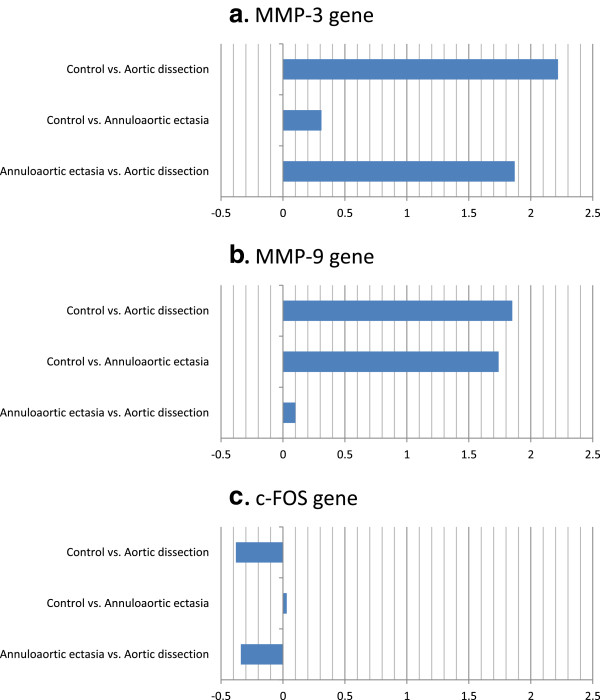
Results: Among patients with aortic dissection, TGF-β serum level was elevated (43.78 ± 6.51 vs. 31.64 ± 4.99 ng/l, p < 0.0001), MMP-3 was up-regulated (Ln2α = 1.87, p = 0.062) and striae atrophicae were more common (92% vs. 41% p = 0.027) compared to the annuloaortic ectasia group.

Conclusions: We found three easily measurable parameters (striae atrophicae, TGF-β serum level, MMP-3) that may help to predict the risk of aortic dissection in MFS. Based on these findings a new classification of MFS, that is benign or malignant is also proposed, which could be taken into consideration in determining the timing of prophylactic ARR.


Figures
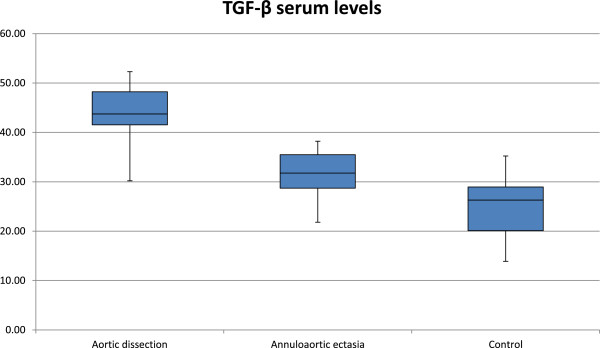
Figure 1
Figure 1
TGF-β serum levels in the aortic dissection, annuloaortic ectasia and in the control patients expressed in ng/ml.
Figure 2
Figure 2
Ln2α values describing the relative expression of the MMP-3 (a), MMP-9 (b) and c-FOS (c) genes. ΔCt is Ct(target gene) - Ct(GAPDH endogenous control gene) in the same sample, ά value is ΔCt(control sample) - ΔCt(target sample). This value is used to calculate expression fold value by the equation (expression fold value Ln 2ά). Significantly up- or down-regulated if the Ln ratio of the ά value is >1 or < −1, respectively, with p < 0.05.
Figure 3
Figure 3
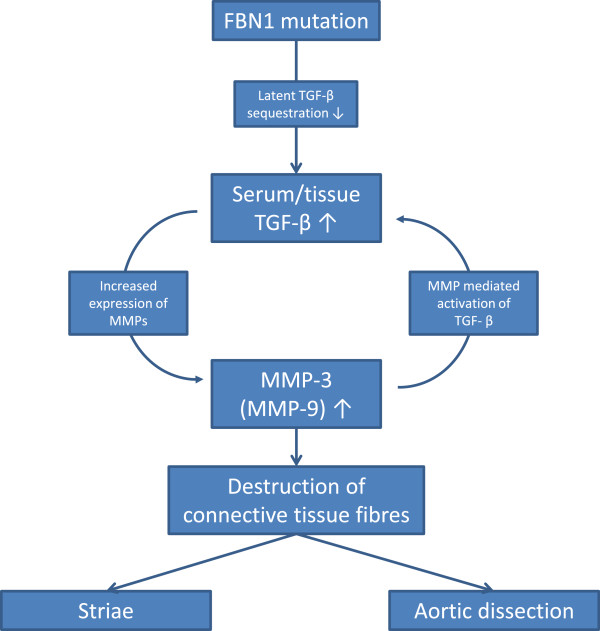
This figure depicts a hypothetical positive feedback cycle in the homeostasis of connective tissue fibres. As shown in the picture fibrillin-1 mutation leads to elevated serum and tissue Transforming Growth Factor-β levels, as the ability of fibrillin-1 protein to sequester latent TGF-β decreases. Through intracellular signal transduction active TGF-β up-regulates matrix metalloproteinases (MMP-3 and MMP-9). Increased MMP activity in the connective tissue in turn leads to the integrin dependent activation of latent TGF-β which results in further increase of the active TGF-β tissue level. Both aortic dissection and striae (stretch marks) may be the consequence of increased tissue activity of MMPs. This positive feedback cycle could provide a link between aortic dissection and the three extracardiac predictors (TGF-β serum level, MMP-3 expression and striae atrophicae) described in this article.

References

    1. Gao LG, Luo F, Hui RT, Zhou XL. Recent molecular biological progress in Marfan syndrome and Marfan-associated disorders. Ageing Res Rev. 2010;9(3):363–368. doi: 10.1016/j.arr.2009.09.001. - DOI - PubMed
    1. Colovati ME, da Silva LR, Takeno SS, Mancini TI, N Dutra AR, Guilherme RS, de Mello CB, Melaragno MI, A Perez AB. Marfan syndrome with a complex chromosomal rearrangement including deletion of the FBN1 gene. Mol Cytogenet. 2012;5:5. doi: 10.1186/1755-8166-5-5. - DOI - PMC - PubMed
    1. Holm TM, Habashi JP, Doyle JJ, Bedja D, Chen Y, van Erp C, Lindsay ME, Kim D, Schoenhoff F, Cohn RD, Loeys BL, Thomas CJ, Patnaik S, Marugan JJ, Judge DP, Dietz HC. Noncanonical TGFβ signaling contributes to aortic aneurysm progression in Marfan syndrome mice. Science. 2011;332(6027):358–361. doi: 10.1126/science.1192149. - DOI - PMC - PubMed
    1. Chung AW, Yang HH, Radomski MW, van Breemen C. Long-term doxycycline is more effective than atenolol to prevent thoracic aortic aneurysm in marfan syndrome through the inhibition of matrix metalloproteinase-2 and −9. Circ Res. 2008;102(8):e73–e85. doi: 10.1161/CIRCRESAHA.108.174367. - DOI - PubMed
    1. Ahimastos AA, Aggarwal A, Savarirayan R, Dart AM, Kingwell BA. A role for plasma transforming growth factor-beta and matrix metalloproteinases in aortic aneurysm surveillance in Marfan syndrome? Atherosclerosis. 2010;209(1):211–214. doi: 10.1016/j.atherosclerosis.2009.08.003. - DOI - PubMed

Publication types

MeSH terms