


Galloyl moieties enhance the dentin biomodification potential of plant-derived catechins
- PMID: 24721612
- PMCID: PMC4041811
- DOI: 10.1016/j.actbio.2014.03.036
Galloyl moieties enhance the dentin biomodification potential of plant-derived catechins
Abstract
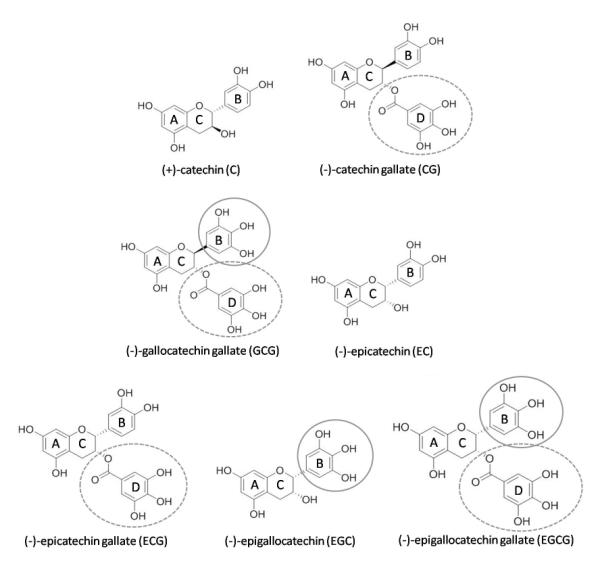
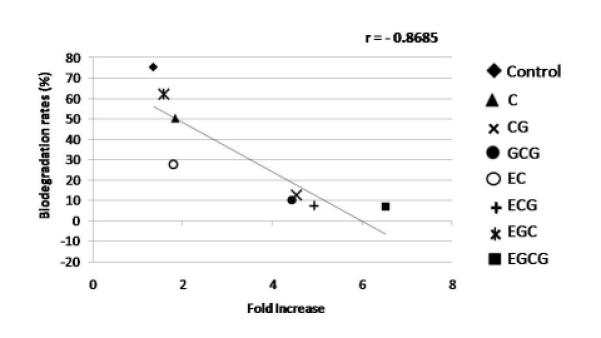
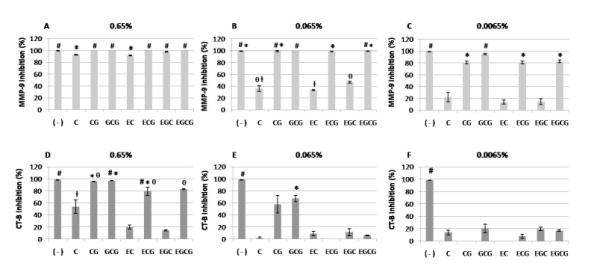
Proanthocyanidin-rich plant-derived agents have been shown to enhance dentin biomechanical properties and resistance to collagenase degradation. This study systematically investigated the interaction of chemically well-defined monomeric catechins with dentin extracellular matrix components by evaluating dentin mechanical properties as well as activities of matrix metalloproteinases (MMPs) and cysteine-cathepsins (CTs). Demineralized dentin beams (n=15) were incubated for 1h with 0.65% (+)-catechin (C), (-)-catechin gallate (CG), (-)-gallocatechin gallate (GCG), (-)-epicatechin (EC), (-)-epicatechin gallate (ECG), (-)-epigallocatechin (EGC) and (-)-epigallocatechin-3-gallate (EGCG). The modulus of elasticity (E) and the fold increase in E were determined by comparing specimens at baseline and after treatment. Biodegradation rates were assessed by differences in percentage of dry mass before and after incubation with bacterial collagenase. The inhibition of MMP-9 and CT-B by 0.65, 0.065 and 0.0065% of each catechin was determined using fluorimetric proteolytic assay kits. All monomeric catechins led to a significant increase in E. EGCG showed the highest fold increase in E, followed by ECG, CG and GCG. EGCG, ECG, GCG and CG significantly lowered biodegradation rates and inhibited both MMP-9 and CT-B at a concentration of 0.65%. Overall, the 3-O-galloylated monomeric catechins are clearly more potent than their non-galloylated analogues in improving dentin mechanical properties, stabilizing collagen against proteolytic degradation, and inhibiting the activity of MMPs and CTs. The results indicate that galloylation is a key pharmacophore in the monomeric and likely also in the oligomeric proanthocyanidins that exhibit high cross-linking potential for dentin extracellular matrix.
Keywords: Collagen; Cross-linking; Cysteine-cathepsins; MMP; Proanthocyanidins.
Copyright © 2014 Acta Materialia Inc. Published by Elsevier Ltd. All rights reserved.
Figures

References
-
- Monagas M, Gomez-Cordovés C, Bartolomé B, Laureano O, Da Silva JMR. Monomeric, oligomeric, and polymeric flavan-3-ol composition of wines and grapes from Vitis vinifera L. cv. Graciano, Tempranillo, and Cabernet Sauvignon. J Agric Food Chem. 2003;51:6475–6481. - PubMed
-
- Narotzki B, Reznick AZ, Aizenbud D, Levy Y. Green tea: a promising natural product in oral health. Arch Oral Biol. 2012;57:429–435. - PubMed
Publication types
MeSH terms
Substances
Grants and funding
LinkOut - more resources
Full Text Sources
Other Literature Sources
Research Materials
Miscellaneous
