


Self-esteem in hearing-impaired children: the influence of communication, education, and audiological characteristics
- PMID: 24722329
- PMCID: PMC3983202
- DOI: 10.1371/journal.pone.0094521
Self-esteem in hearing-impaired children: the influence of communication, education, and audiological characteristics
Abstract
Objective: Sufficient self-esteem is extremely important for psychosocial functioning. It is hypothesized that hearing-impaired (HI) children have lower levels of self-esteem, because, among other things, they frequently experience lower language and communication skills. Therefore, the aim of this study was to compare HI children's self-esteem across different domains with those of normal hearing (NH) children and to investigate the influence of communication, type of education, and audiological characteristics.
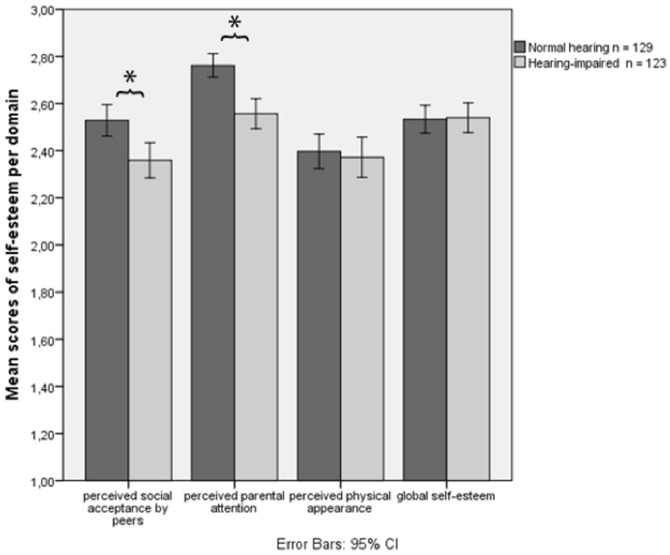
Methods: This large (N = 252) retrospective, multicenter study consisted of two age- and gender-matched groups: 123 HI children and 129 NH controls (mean age = 11.8 years). Self-reports were used to measure self-esteem across four domains: perceived social acceptance by peers, perceived parental attention, perceived physical appearance, and global self-esteem.
Results: HI children experienced lower levels of self-esteem regarding peers and parents than NH controls. Particularly HI children who attended special education for the deaf were at risk, even after correcting for their language development and intelligence. Yet, levels of global self-esteem and self-esteem involving physical appearance in HI children equalled those of NH controls. Furthermore, younger age at implantation and longer duration of having cochlear implants (CIs) were related to higher levels of self-esteem.
Conclusion: HI children experience lower levels of self-esteem in the social domains. Yet, due to the heterogeneity of the HI population, there is high variability in levels of self-esteem.
Discussion: Clinicians must always be aware of the risk and protective factors related to self-esteem in order to help individual patients reach their full potential.
Conflict of interest statement
Figures
References
-
- Rosenberg M (1965) Society and the adolescent self-image. Princeton, NJ: Princeton University Press.
-
- Baumeister RF, Campbell JD, Krueger JI, Vohs KD (2003) Does High Self-Esteem Cause Better Performance, Interpersonal Success, Happiness, or Healthier Lifestyles? Psychological science 4: 1–44. - PubMed
-
- Harter S (2006) Self-processes and developmental psychopathology. In: Cicchietti D, Cohen DJ, Developmental Psychopathology. Hoboken, NJ: Wiley & Sons. pp. 370–418.
-
- Orth U, Robins RW, Roberts BW (2008) Low self-esteem prospectively predicts depression in adolescence and young adulthood. Journal of Personality and Social Psychology 95: 695–708. - PubMed
-
- Harper JF, Marshall E (1991) Adolescents' problems and their relationship to self-esteem. Adolescence 26: 799–807. - PubMed
Publication types
MeSH terms
LinkOut - more resources
Full Text Sources
Other Literature Sources
