


Letter to the Editor: On the term 'interaction' and related phrases in the literature on Random Forests
- PMID: 24723569
- PMCID: PMC4364067
- DOI: 10.1093/bib/bbu012
Letter to the Editor: On the term 'interaction' and related phrases in the literature on Random Forests
Abstract
In an interesting and quite exhaustive review on Random Forests (RF) methodology in bioinformatics Touw et al. address--among other topics--the problem of the detection of interactions between variables based on RF methodology. We feel that some important statistical concepts, such as 'interaction', 'conditional dependence' or 'correlation', are sometimes employed inconsistently in the bioinformatics literature in general and in the literature on RF in particular. In this letter to the Editor, we aim to clarify some of the central statistical concepts and point out some confusing interpretations concerning RF given by Touw et al. and other authors.
Keywords: conditional inference trees; conditional variable importance; correlation; interaction; random forest; statistics.
© The Author 2014. Published by Oxford University Press.
Figures
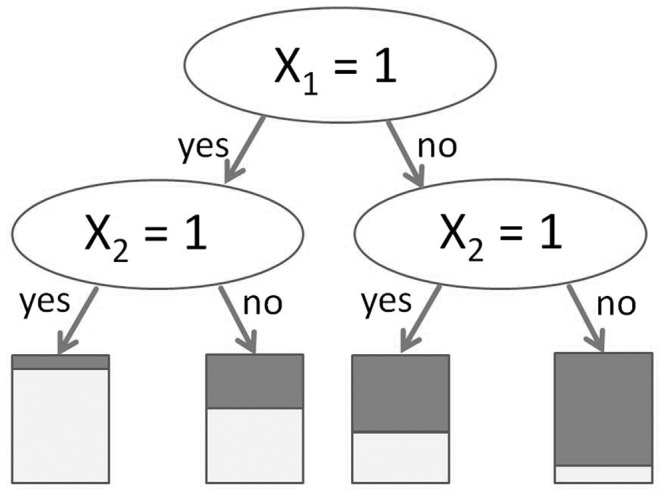
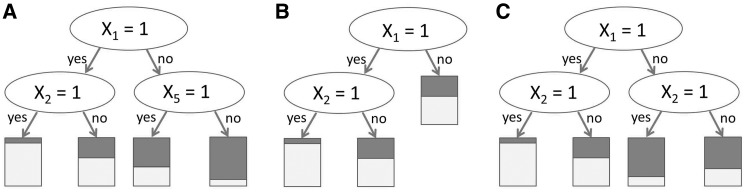
Comment on
-
Data mining in the Life Sciences with Random Forest: a walk in the park or lost in the jungle?Brief Bioinform. 2013 May;14(3):315-26. doi: 10.1093/bib/bbs034. Epub 2012 Jul 10. Brief Bioinform. 2013. PMID: 22786785 Free PMC article.
References
-
- Kelly C, Okada K. 2012. Variable interaction measures with random forest classifiers. 9th IEEE International Symposium on Biomedical Imaging (ISBI) pp. 154–7.
-
- Miettinen OS. Theoretical Epidemiology: Principles of Occurrence Research in Medicine. New York: Wiley; 1985.
-
- Grobbee DE, Hoes AW. Clinical Epidemiology: Principles, Methods, and Applications for Clinical Research. London: Jones & Bartlett Learning; 2009.
Publication types
MeSH terms
LinkOut - more resources
Full Text Sources
Other Literature Sources
