


Metabolic flux as a predictor of heart failure prognosis
- PMID: 24723654
- PMCID: PMC4556065
- DOI: 10.1161/CIRCRESAHA.114.303551
Metabolic flux as a predictor of heart failure prognosis
Abstract
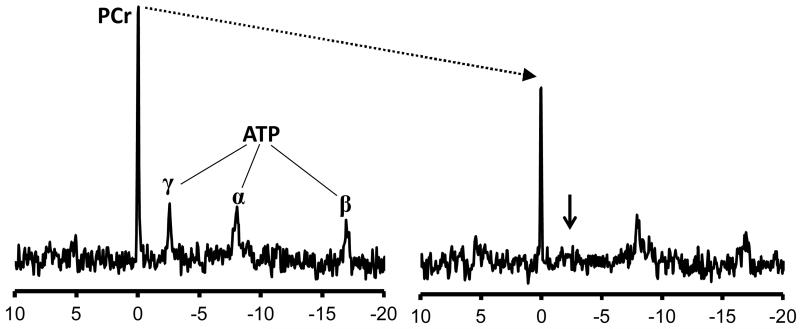
The creatine kinase (CK) system is thought to play an integral role in maintaining levels of chemical energy in the form of ATP, which is essential for normal cardiac function. In the failing heart, it has long been established that multiple components of CK energy metabolism are commonly impaired and that these correlate with disease severity. A recent study published in Science Translational Medicine adds significantly to this body of evidence by demonstrating that the rate of ATP transfer via CK, measured noninvasively by magnetic resonance spectroscopy, is an independent predictor of adverse clinical outcome in patients with nonischemic cardiomyopathy. This finding invites speculation on the future role of metabolic imaging for risk stratification in patients with heart failure. The authors further assert an implied causal role for energetics in disease progression. Although this is not supported by recent findings in loss-of-function mouse models, there is, nonetheless, a strong argument for the development of novel metabolic therapies for the failing heart.
Figures
Comment on
-
Metabolic rates of ATP transfer through creatine kinase (CK Flux) predict clinical heart failure events and death.Sci Transl Med. 2013 Dec 11;5(215):215re3. doi: 10.1126/scitranslmed.3007328. Sci Transl Med. 2013. PMID: 24337482 Free PMC article.
References
-
- Neubauer S. The failing heart--an engine out of fuel. New Engl J Med. 2007;356:1140–1151. - PubMed
-
- Herrmann G, Decherd GM. The chemical nature of heart failure. Ann Intern Med. 1939;12:1233–1244.
-
- Ingwall JS, Weiss RG. Is the failing heart energy starved? On using chemical energy to support cardiac function. Circ Res. 2004;95:135–145. - PubMed
-
- Bottomley PA. Noninvasive study of high-energy phosphate metabolism in human heart by depth-resolved 31P NMR spectroscopy. Science. 1985;229:769–772. - PubMed
-
- Neubauer S, Krahe T, Schindler R, Horn M, Hillenbrand H, Entzeroth C, Mader H, Kromer EP, Riegger GA, Lackner K, et al. 31P magnetic resonance spectroscopy in dilated cardiomyopathy and coronary artery disease. Altered cardiac high-energy phosphate metabolism in heart failure. Circulation. 1992;86:1810–1818. - PubMed
Publication types
MeSH terms
Substances
Grants and funding
LinkOut - more resources
Full Text Sources
Other Literature Sources
Medical
Research Materials
