


An increase of interleukin-33 serum levels after coronary stent implantation is associated with coronary in-stent restenosis
- PMID: 24725541
- PMCID: PMC3996548
- DOI: 10.1016/j.cyto.2014.02.014
An increase of interleukin-33 serum levels after coronary stent implantation is associated with coronary in-stent restenosis
Abstract
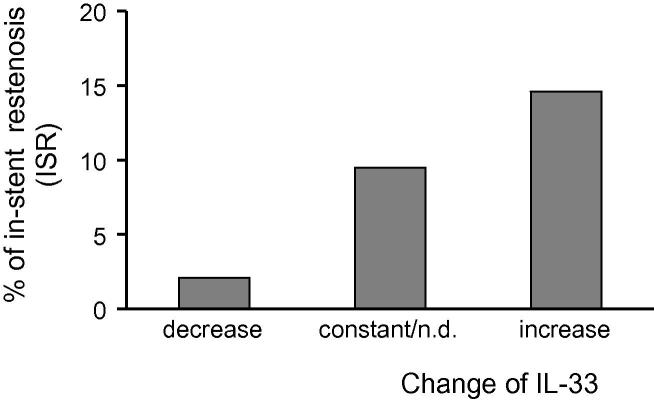
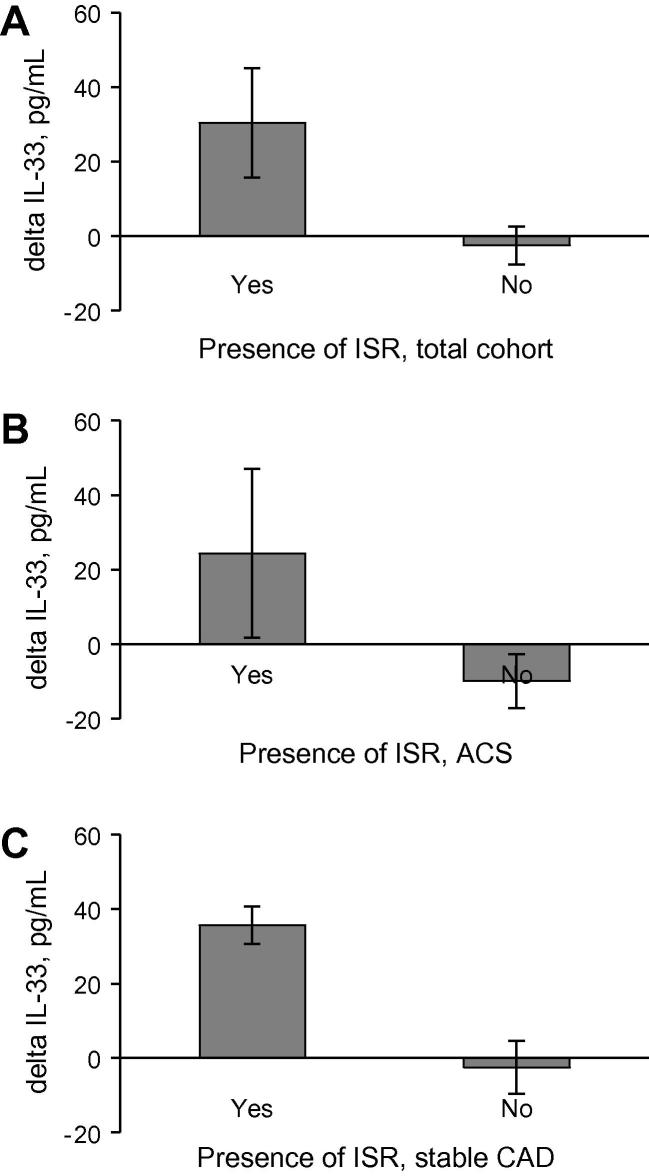
The study aim was to determine the predictive value of interleukin (IL)-33, a recently described member of the IL-1 family of cytokines, for the development of in-stent restenosis (ISR). IL-33 serum levels were measured in 387 consecutive patients undergoing percutaneous coronary intervention (PCI) of whom 193 had stable angina, 93 non-ST elevation myocardial infarction (NSTEMI), and 101 ST-elevation MI (STEMI), respectively. Blood was taken directly before and 24h after stent implantation. The presence of ISR was initially evaluated by clinical means after six to eight months. When presence of myocardial ischemia was suspected, coronary angiography was performed to confirm the suspected diagnosis of ISR. Clinical ISR was present in total in 34 patients (8.8%). IL-33 was detectable in 185 patients and was below detection limit in 202 patients. In patients with decreased IL-33 (n=95), unchanged or non-detectable levels (n=210) or increased levels of IL-33 after PCI (n=82), ISR-rate was 2.1%, 9.5% and 14.6%, respectively (p<0.05). Accordingly, patients with ISR showed a significant increase of IL-33 upon PCI (p<0.05). This association was independent from clinical presentation and risk factors as well as numbers and type of stents. In patients with both stable and unstable coronary artery disease, an increase of IL-33 serum levels after stent implantation is associated with a higher rate of in-stent restenosis.
Keywords: Coronary artery disease; Interleukin-33; Myocardial infarction; Percutaneous coronary intervention; Restenosis.
Copyright © 2014 The Authors. Published by Elsevier Ltd.. All rights reserved.
Figures
References
-
- Jukema J.W., Verschuren J.J., Ahmed T.A., Quax P.H. Restenosis after PCI. Part 1: pathophysiology and risk factors. Nat Rev Cardiol. 2012;9:53–62. - PubMed
-
- Niccoli G., Montone R.A., Ferrante G., Crea F. The evolving role of inflammatory biomarkers in risk assessment after stent implantation. J Am Coll Cardiol. 2010;56:1783–1793. - PubMed
-
- Welt F.G., Rogers C. Inflammation and restenosis in the stent era. Arterioscler Thromb Vasc Biol. 2002;22:1769–1776. - PubMed
-
- Speidl W.S., Katsaros K.M., Kastl S.P., Zorn G., Huber K., Maurer G. Coronary late lumen loss of drug eluting stents is associated with increased serum levels of the complement components C3a and C5a. Atherosclerosis. 2010;208:285–289. - PubMed
Publication types
MeSH terms
Substances
LinkOut - more resources
Full Text Sources
Other Literature Sources
Medical
Miscellaneous
