


Respiratory outcomes of the surfactant positive pressure and oximetry randomized trial (SUPPORT)
- PMID: 24725582
- PMCID: PMC4111960
- DOI: 10.1016/j.jpeds.2014.02.054
Respiratory outcomes of the surfactant positive pressure and oximetry randomized trial (SUPPORT)
Abstract
Objective: To explore the early childhood pulmonary outcomes of infants who participated in the National Institute of Child Health and Human Development's Surfactant Positive Airway Pressure and Pulse Oximetry Randomized Trial (SUPPORT), using a factorial design that randomized extremely preterm infants to lower vs higher oxygen saturation targets and delivery room continuous positive airway pressure (CPAP) vs intubation/surfactant.
Study design: The Breathing Outcomes Study, a prospective secondary study to the Surfactant Positive Airway Pressure and Pulse Oximetry Randomized Trial, assessed respiratory morbidity at 6-month intervals from hospital discharge to 18-22 months corrected age (CA). Two prespecified primary outcomes-wheezing more than twice per week during the worst 2-week period and cough longer than 3 days without a cold-were compared for each randomized intervention.
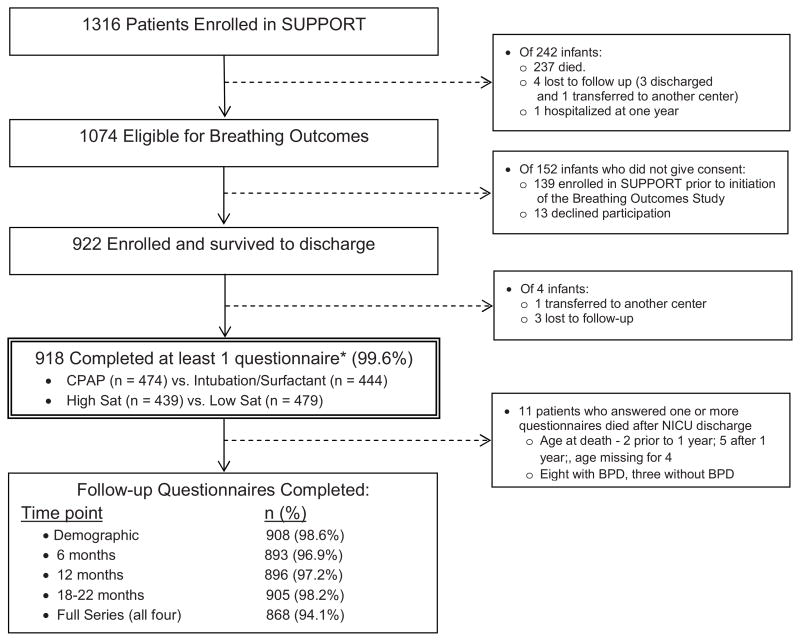
Results: One or more interviews were completed for 918 of the 922 eligible infants. The incidences of wheezing and cough were 47.9% and 31.0%, respectively, and did not differ between the study arms of either randomized intervention. Infants randomized to lower vs higher oxygen saturation targets had a similar risk of death or respiratory morbidity (except for croup and treatment with oxygen or diuretics at home). Infants randomized to CPAP vs intubation/surfactant had fewer episodes of wheezing without a cold (28.9% vs 36.5%; P<.05), respiratory illnesses diagnosed by a doctor (47.7% vs 55.2%; P<.05), and physician or emergency room visits for breathing problems (68.0% vs 72.9%; P<.05) by 18-22 months CA.
Conclusion: Treatment with early CPAP rather than intubation/surfactant is associated with less respiratory morbidity by 18-22 months CA. Longitudinal assessment of pulmonary morbidity is necessary to fully evaluate the potential benefits of respiratory interventions for neonates.
Trial registration: ClinicalTrials.gov NCT00233324.
Copyright © 2014 Elsevier Inc. All rights reserved.
Conflict of interest statement
The authors declare no conflicts of interest.
Figures
Comment in
-
Long-term respiratory morbidity in preterm infants: is noninvasive support in the delivery room the solution?J Pediatr. 2014 Aug;165(2):222-5. doi: 10.1016/j.jpeds.2014.04.018. Epub 2014 May 17. J Pediatr. 2014. PMID: 24840755 No abstract available.
References
-
- Greenough A, Giffin FJ, Yuksel B. Respiratory morbidity in preschool children born prematurely. Relationship to adverse neonatal events. Acta Paediatr. 1996;85:772–7. - PubMed
-
- Smith VC, Zupancic JA, McCormick MC, Croen LA, Greene J, Escobar GJ, et al. Rehospitalization in the first year of life among infants with bronchopulmonary dysplasia. J Pediatr. 2004;144:799–803. - PubMed
-
- Ehrenkranz RA, Walsh MC, Vohr BR, Jobe AH, Wright LL, Fanaroff AA, et al. Validation of the National Institutes of Health consensus definition of bronchopulmonary dysplasia. Pediatrics. 2005;116:1353–60. - PubMed
-
- Palta M, Sadek-Badawi M, Madden K, Green C. Pulmonary testing using peak flow meters of very low birth weight children born in the perisurfactant era and school controls at age 10 years. Pediatr Pulmonol. 2007;42:819–28. - PubMed
Publication types
MeSH terms
Substances
Associated data
Grants and funding
- U10 HD27851/HD/NICHD NIH HHS/United States
- U10 HD053124/HD/NICHD NIH HHS/United States
- U10 HD21397/HD/NICHD NIH HHS/United States
- UG1 HD027851/HD/NICHD NIH HHS/United States
- U10 HD21385/HD/NICHD NIH HHS/United States
- UL1 RR024979/RR/NCRR NIH HHS/United States
- U10 HD027856/HD/NICHD NIH HHS/United States
- U10 HD40689/HD/NICHD NIH HHS/United States
- U10 HD021373/HD/NICHD NIH HHS/United States
- UL1 RR024139/RR/NCRR NIH HHS/United States
- U10 HD021385/HD/NICHD NIH HHS/United States
- M01 RR44/RR/NCRR NIH HHS/United States
- U10 HD40492/HD/NICHD NIH HHS/United States
- U10 HD53119/HD/NICHD NIH HHS/United States
- M01 RR59/RR/NCRR NIH HHS/United States
- U10 HD053119/HD/NICHD NIH HHS/United States
- U10 HD53124/HD/NICHD NIH HHS/United States
- U10 HD21364/HD/NICHD NIH HHS/United States
- U10 HD34216/HD/NICHD NIH HHS/United States
- UL1 RR25744/RR/NCRR NIH HHS/United States
- U10 HD021364/HD/NICHD NIH HHS/United States
- U10 HD027880/HD/NICHD NIH HHS/United States
- M01 RR70/RR/NCRR NIH HHS/United States
- U10 HD36790/HD/NICHD NIH HHS/United States
- U10 HD040521/HD/NICHD NIH HHS/United States
- U10 HD053109/HD/NICHD NIH HHS/United States
- UL1 TR000042/TR/NCATS NIH HHS/United States
- UG1 HD087229/HD/NICHD NIH HHS/United States
- U10 HD40521/HD/NICHD NIH HHS/United States
- U10 HD27880/HD/NICHD NIH HHS/United States
- M01 RR125/RR/NCRR NIH HHS/United States
- UG1 HD053089/HD/NICHD NIH HHS/United States
- U10 HD27904/HD/NICHD NIH HHS/United States
- M01 RR633/RR/NCRR NIH HHS/United States
- U10 HD53109/HD/NICHD NIH HHS/United States
- U10 HD040461/HD/NICHD NIH HHS/United States
- U10 HD40498/HD/NICHD NIH HHS/United States
- U10 HD53089/HD/NICHD NIH HHS/United States
- U10 HD27871/HD/NICHD NIH HHS/United States
- M01 RR7122/RR/NCRR NIH HHS/United States
- U10 HD040689/HD/NICHD NIH HHS/United States
- U10 HD040492/HD/NICHD NIH HHS/United States
- K23 HD050646/HD/NICHD NIH HHS/United States
- M01 RR64/RR/NCRR NIH HHS/United States
- U10 HD027853/HD/NICHD NIH HHS/United States
- U10 HD027904/HD/NICHD NIH HHS/United States
- UL1 RR24979/RR/NCRR NIH HHS/United States
- U10 HD021397/HD/NICHD NIH HHS/United States
- U10 HD27856/HD/NICHD NIH HHS/United States
- U10 HD27853/HD/NICHD NIH HHS/United States
- M01 RR39/RR/NCRR NIH HHS/United States
- M01 RR30/RR/NCRR NIH HHS/United States
- U10 HD40461/HD/NICHD NIH HHS/United States
- UG1 HD034216/HD/NICHD NIH HHS/United States
- UL1 TR000454/TR/NCATS NIH HHS/United States
- U10 HD027871/HD/NICHD NIH HHS/United States
- UL1 RR025744/RR/NCRR NIH HHS/United States
- K23 HD50646/HD/NICHD NIH HHS/United States
- UL1 TR000142/TR/NCATS NIH HHS/United States
- UL1 TR001085/TR/NCATS NIH HHS/United States
- U10 HD027851/HD/NICHD NIH HHS/United States
- RR25008/RR/NCRR NIH HHS/United States
- UG1 HD040492/HD/NICHD NIH HHS/United States
- UG1 HD027880/HD/NICHD NIH HHS/United States
- M01 RR80/RR/NCRR NIH HHS/United States
- M01 RR16587/RR/NCRR NIH HHS/United States
- M01 RR750/RR/NCRR NIH HHS/United States
- M01 RR8084/RR/NCRR NIH HHS/United States
- M01 RR54/RR/NCRR NIH HHS/United States
- M01 RR997/RR/NCRR NIH HHS/United States
- U10 HD21373/HD/NICHD NIH HHS/United States
- M01 RR32/RR/NCRR NIH HHS/United States
- U10 HD034216/HD/NICHD NIH HHS/United States
- U10 HD036790/HD/NICHD NIH HHS/United States
- UL1 RR24139/RR/NCRR NIH HHS/United States
- U10 HD040498/HD/NICHD NIH HHS/United States
- UG1 HD068278/HD/NICHD NIH HHS/United States
LinkOut - more resources
Full Text Sources
Other Literature Sources
Medical
Molecular Biology Databases
