. 2014 Nov 15;76(10):794-801.
doi: 10.1016/j.biopsych.2014.02.012. Epub 2014 Feb 26.

Cell-type specific expression of p11 controls cocaine reward

Affiliations

Cell-type specific expression of p11 controls cocaine reward

Margarita Arango-Lievano et al. Biol Psychiatry. .

Abstract

Background: The high rate of comorbidity between depression and cocaine addiction suggests shared molecular mechanisms and anatomical pathways. Limbic structures, such as the nucleus accumbens (NAc), play a crucial role in both disorders, yet how different cell types within these structures contribute to the pathogenesis remains elusive. Downregulation of p11 (S100A10), specifically in the NAc, elicits depressive-like behaviors in mice, but its role in drug addiction is unknown.

Methods: We combined mouse genetics and viral strategies to determine how the titration of p11 levels within the entire NAc affects the rewarding actions of cocaine on behavior (six to eight mice per group) and molecular correlates (three experiments, five to eight mice per group). Finally, the manipulation of p11 expression in distinct NAc dopaminoceptive neuronal subsets distinguished cell-type specific effects of p11 on cocaine reward (five to eight mice per group).

Results: We demonstrated that p11 knockout mice have enhanced cocaine conditioned place preference, which is reproduced by the focal downregulation of p11 in the NAc of wild-type mice. In wild-type mice, cocaine reduced p11 expression in the NAc, while p11 overexpression exclusively in the NAc reduced cocaine conditioned place preference. Finally, we identified dopamine receptor-1 expressing medium spiny neurons as key mediators of the effects of p11 on cocaine reward.

Conclusions: Our data provide evidence that disruption of p11 homeostasis in the NAc, particularly in dopamine receptor-1 expressing medium spiny neurons, may underlie pathophysiological mechanisms of cocaine rewarding action. Treatments to counter maladaptation of p11 levels may provide novel therapeutic opportunities for cocaine addiction.

Keywords: Cocaine reward; conditional knock down; nucleus accumbens; p11 (s100a10); striatonigral pathway; striatopallidal pathway.


Conflict of interest statement

Authors report no biomedical financial interest or potential conflict of interest.

Figures
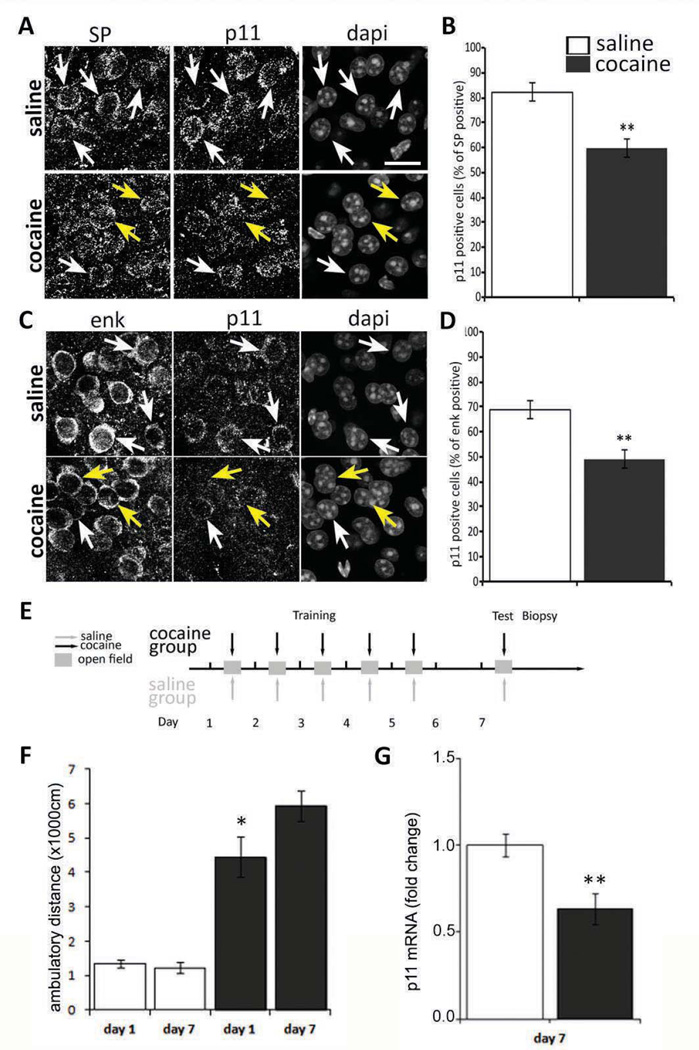
Figure 1
Figure 1. Chronic cocaine treatment reduces the expression of p11 in the NAc
Chronic cocaine treatment reduces p11 expression on substance P (SP) expressing D1 MSN (A) Representative immunohistochemistry of SP and p11 expression in NAc of saline and cocaine treated C57BL/6 mice. The white arrows indicate MSN co-expressing SP and p11, the yellow arrows indicate cells expressing SP and no detectable p11. (B) Quantification of cells expressing detectable levels of p11 among SP positive cells. Data are presented as mean ± SEM and analyzed using a two tailed paired T test (p<0.01) scale bar represents 10 µm. Chronic cocaine treatment reduces p11 expression on enk expressing D2 MSN (C) Representative immunohistochemistry of enk and p11 expression in NAc of saline and cocaine treated mice. White arrows indicate MSN co-expressing enk and p11, yellow arrows indicate cells expressing SP and no detectable p11. (D) Quantification of cells expressing detectable levels of p11 among enk positive cells. Data are presented as mean ± SEM and analyzed using a two tailed paired T test (p<0.01). (E) Experimental timeline. Adult C57BL/6 mice (n=10) were treated for 5 days with IP injections of 10 mg/kg of cocaine or saline in an open field arena and challenged on day 7 with cocaine or saline in the same context. (F) Cocaine treated mice display classical locomotor sensitization during the first 10 minutes of exposition to the drug contrary to saline treated mice. Data are presented as mean ± SEM and analyzed using a two tailed paired T test (p<0.05). (G) Cocaine treated mice decrease mRNA expression levels of p11 in the NAc when compared to saline treated mice as measured by qPCR (p<0.01).;
Figure 2
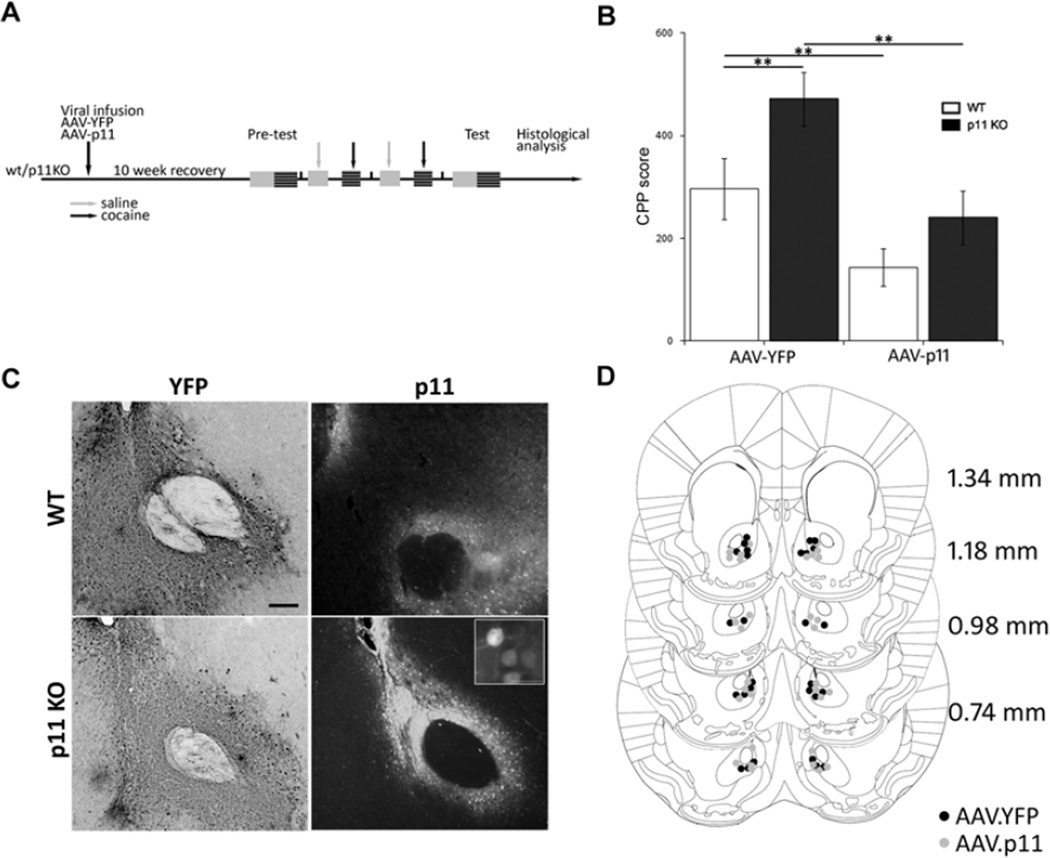
Figure 2. P11 in NAc modulates cocaine CPP
(A) Experimental timeline. P11 KO and wt littermates were injected in the NAc with AAV2.p11 or AAV2.YFP, 10 weeks later mice were submitted to cocaine (7.5 mg/kg) CPP as described in the materials and methods section. (B) Control injected p11KO show increased CPP compared to control injected wt littermates. Focal restoration of p11 in the NAc of p11 KO normalizes cocaine CPP scores. Focal overexpression of p11 in the NAc of wt mice reduces their CPP score compared to control injected wt. Data (means ±SEM n=6–8 per group) were analyzed using 2 way ANOVA. Effect of genotype F(1, 27)= 6.87, p=0.015; effect of injected virus F(1, 27)=13.65, p=0.0011; interaction F(1, 27)=0.65, NS. Post hoc comparison (Tukey HSD test) **p<0.01. (C) Representative histological analysis of injection sites. Black scale bar, 1mm. Insert is a magnification showing p11 expression on AAV.p11 injected p11KO. (D) Cartoon shows the location of the viral injection sites at the indicated coordinates from Bregma according to Franklin and Paxinos (2008).
Figure 3
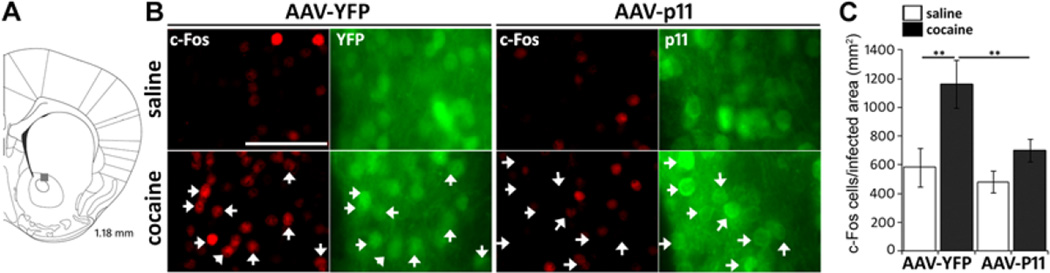
Figure 3. P11 overexpression prevents cocaine induced c Fos activation in the NAc
(A) The position of the NAc region used for quantification is indicated by grey square at 1.18 mm from Bregma according to Franklin and Paxinos (2008). (B) c-Fos immunoreactivity in the NAc core of control (AAV-YFP) or AAV-p11 infected mice 2 hrs after the last saline or cocaine injection of a 10 day treatment. White arrows indicate infected cells, note strong c-Fos induction after cocaine treatment in YFP infected cells, and decreased c-Fos induction by cocaine in p11 infected neurons. Scale bar 50 µm. (C) quantification of c-Fos positive cells within the infected area. Data (means ±SEM n=6–10 per group) were analyzed using two way ANOVA. Effect of injected virus F(1, 28)= 9.23, p=0.0055; effect of drug treatment F(1, 28)= 11.46, p=0.0024; interaction F(1, 28)= 0.16, NS. Post hoc comparison (Tukey HSD test) **p<0.01.
Figure 4
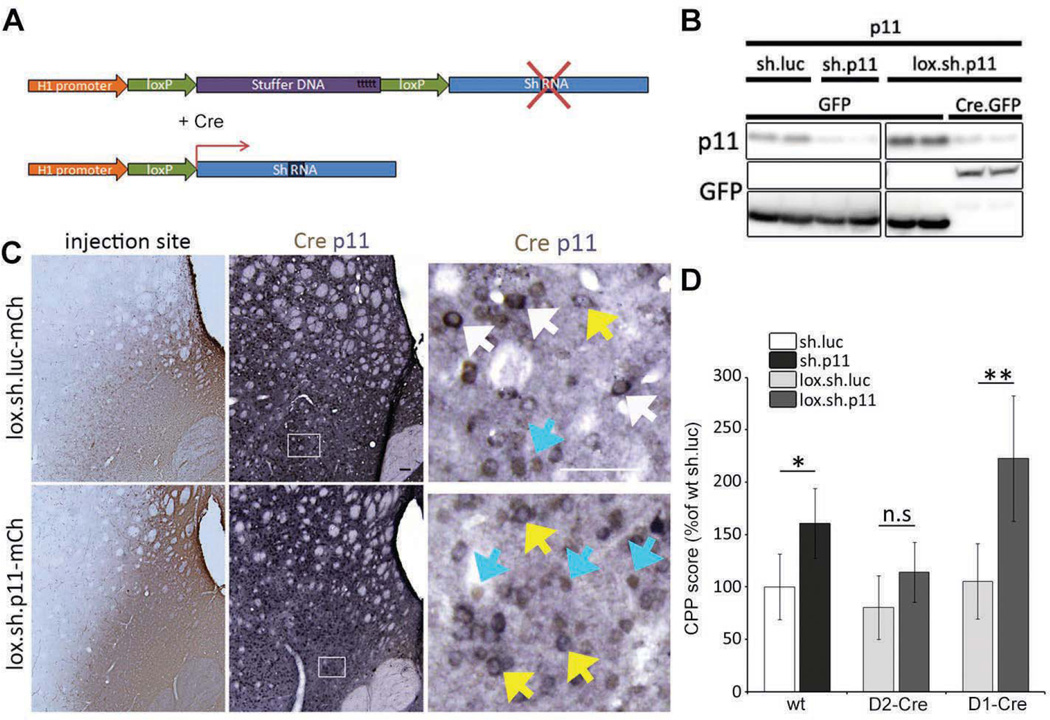
Figure 4. D1 receptor expressing MSNs mediate the effect of NAc p11 on cocaine CPP
(A) Scheme of the Cre inducible shRNA expression system used to selectively silence p11 expression. (B) HEK 293 cells were transfected with the indicated constructs and probed for p11 expression 72hrs later. In the presence of Cre lox.sh.p11 construct silences p11 with a similar efficiency than the constitutively active sh.p11. (C) D1-Cre mice injected in the NAc with Cre inducible AAV2-lox.sh.p11 or control AAV2-lox.sh.luc, viral spread at the site of the injection was determined by RFP staining, an adjacent slice was stained for Cre in brown, and p11 in blue. Right panel is a magnification of the double staining in the infected area (white square), white arrows indicate cells expressing Cre and p11 in control injected mice, yellow arrows indicate cells expressing p11 alone and blue arrows indicate cells expressing Cre alone. Scale bar is 50 µm. (d) Ten week old D1-Cre or D2-Cre mice were injected in the NAc with Cre inducible AAV2-lox.sh.p11 or control AAV2-lox.shluc, wt littermates were injected with AAV2-sh.p11 or AAV2-sh.luc 10 weeks later mice were submitted to cocaine (7.5mg/kg) place conditioning as described in the materials and methods section. Data (means ±SEM n=5–10 per group) were analyzed using two way ANOVA. Effect of injected virus F(1, 45)= 5.06, p=0.0301; effect of genotype F(2, 45)= 1.45, NS; interaction F(2, 45)= 0.42, NS. Post hoc comparison (Tukey HSD test) *p<0.05; **p<0.01.

Comment in

References

    1. Der-Avakian A, Markou A. The neurobiology of anhedonia and other reward-related deficits. Trends Neurosci. 2012;35:68–77. - PMC - PubMed
    1. Kalivas PW, Volkow ND. The neural basis of addiction: a pathology of motivation and choice. Am J Psychiatry. 2005;162:1403–1413. - PubMed
    1. Hyman SE, Malenka RC, Nestler EJ. Neural mechanisms of addiction: the role of reward-related learning and memory. Annu Rev Neurosci. 2006;29:565–598. - PubMed
    1. Covington HE, 3rd, Maze I, Sun H, Bomze HM, DeMaio KD, Wu EY, et al. A role for repressive histone methylation in cocaine-induced vulnerability to stress. Neuron. 2011;71:656–670. - PMC - PubMed
    1. Kessler RC, Berglund P, Demler O, Jin R, Koretz D, Merikangas KR, et al. The epidemiology of major depressive disorder: results from the National Comorbidity Survey Replication (NCS-R) Jama. 2003;289:3095–3105. - PubMed

Publication types

MeSH terms

LinkOut - more resources