


Appropriateness of primary prevention implantable cardioverter-defibrillators at the time of generator replacement: are indications still met?
- PMID: 24727249
- PMCID: PMC6007855
- DOI: 10.1016/j.jacc.2014.03.025
Appropriateness of primary prevention implantable cardioverter-defibrillators at the time of generator replacement: are indications still met?
Abstract
Objectives: This study sought to determine how often patients with primary prevention implantable cardioverter-defibrillators (ICDs) meet guideline-derived indications at the time of generator replacement.
Background: Professional societies have developed guideline criteria for the appropriate implantation of an ICD for the primary prevention of sudden cardiac death. It is unknown whether patients continue to meet criteria when their devices need replacement for battery depletion.
Methods: We performed a retrospective chart review of patients undergoing replacement of primary prevention ICDs at 2 tertiary Veterans Affairs Medical Centers. Indications for continued ICD therapy at the time of generator replacement included a left ventricular ejection fraction (LVEF) ≤35% or receipt of appropriate device therapy.
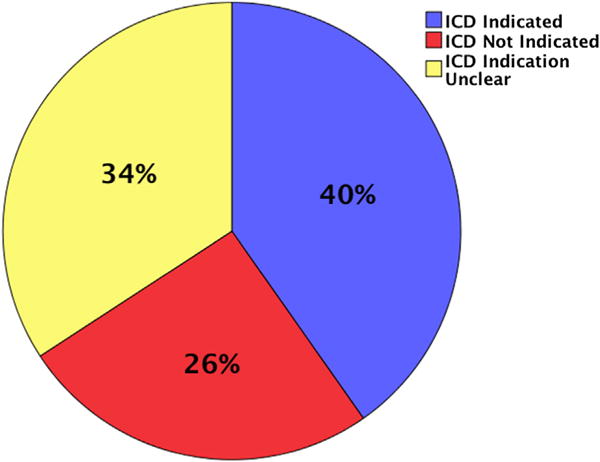
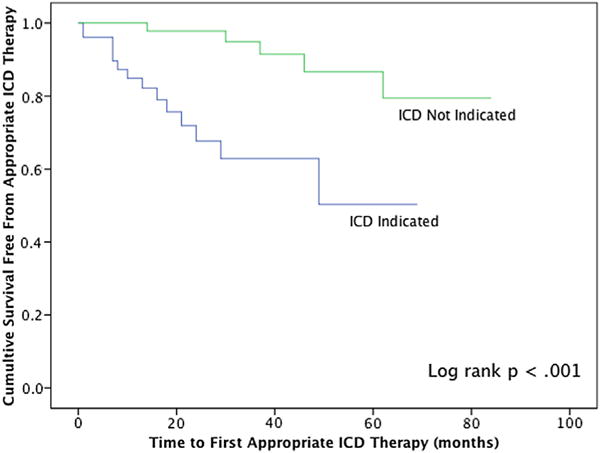
Results: In our cohort of 231 patients, 59 (26%) no longer met guideline-driven indications for an ICD at the time of generator replacement. An additional 79 patients (34%) had not received any appropriate ICD therapies and had not undergone reassessment of their LVEF. Patients with an initial LVEF of 30% to 35% were less likely to meet indications for ICD therapy at the time of replacement (odds ratio: 0.52; 95% confidence interval: 0.30 to 0.88; p = 0.01). Patients without ICD indications subsequently received appropriate ICD therapies at a significantly lower rate than patients with indications (2.8% vs. 10.7% annually, p < 0.001). If ICD generator explantations were performed instead of replacements in the patients without ICD indications, the cost savings would be $1.6 million.
Conclusions: Approximately 25% of patients who receive primary prevention ICDs may no longer meet guideline indications for ICD use at the time of generator replacement, and these patients receive subsequent ICD therapies at a significantly lower rate.
Keywords: ICD generator replacement; implantable cardioverter-defibrillator; sudden cardiac death.
Copyright © 2014 American College of Cardiology Foundation. Published by Elsevier Inc. All rights reserved.
Figures
Comment in
-
Is it time for a new approach to implantable cardioverter-defibrillator replacement?J Am Coll Cardiol. 2014 Jun 10;63(22):2395-7. doi: 10.1016/j.jacc.2014.03.023. Epub 2014 Apr 9. J Am Coll Cardiol. 2014. PMID: 24727251 No abstract available.
-
Ejection fraction may improve but the scar still exists! The risk may be lower but not zero.J Am Coll Cardiol. 2014 Sep 9;64(10):1069-70. doi: 10.1016/j.jacc.2014.05.053. J Am Coll Cardiol. 2014. PMID: 25190248 No abstract available.
-
Reply: Ejection fraction may improve but the scar still exists! The risk may be lower but not zero.J Am Coll Cardiol. 2014 Sep 9;64(10):1070. doi: 10.1016/j.jacc.2014.06.1164. J Am Coll Cardiol. 2014. PMID: 25190249 No abstract available.
References
-
- Buxton AE, Lee KL, Fisher JD, et al. A randomized study of the prevention of sudden death in patients with coronary artery disease (MUSTT) N Engl J Med. 1999;341:1882–90. - PubMed
-
- Moss AJ, Zareba W, Hall WJ, et al. Prophylactic implantation of a defibrillator in patients with myocardial infarction and reduced ejection fraction (MADIT-II) N Engl J Med. 2002;346:877–83. - PubMed
-
- Bardy GH, Lee KL, Mark DB, et al. Amiodarone or an implantable cardioverter-defibrillator for congestive heart failure (SCD-HeFT) N Engl J Med. 2005;352:225–37. - PubMed
-
- Epstein AE, Dimarco JP, Ellenbogen KA, et al. ACC/AHA/HRS 2008 guidelines for device-based therapy of cardiac rhythm abnormalities. J Am Coll Cardiol. 2008;51:e1–62. - PubMed
-
- Sharpe DN, Murphy J, Coxon R, Hannan SF. Enalapril in patients with chronic heart failure: a placebo-controlled, randomized, double-blind study. Circulation. 1984;70:271–8. - PubMed
MeSH terms
Grants and funding
LinkOut - more resources
Full Text Sources
Other Literature Sources
Medical
Miscellaneous
