


Mediator, TATA-binding protein, and RNA polymerase II contribute to low histone occupancy at active gene promoters in yeast
- PMID: 24727477
- PMCID: PMC4031549
- DOI: 10.1074/jbc.M113.529354
Mediator, TATA-binding protein, and RNA polymerase II contribute to low histone occupancy at active gene promoters in yeast
Erratum in
-
Mediator, TATA-binding protein, and RNA polymerase II contribute to low histone occupancy at active gene promoters in yeast.J Biol Chem. 2016 May 6;291(19):9938. doi: 10.1074/jbc.A113.529354. J Biol Chem. 2016. PMID: 27197204 Free PMC article. No abstract available.
Abstract
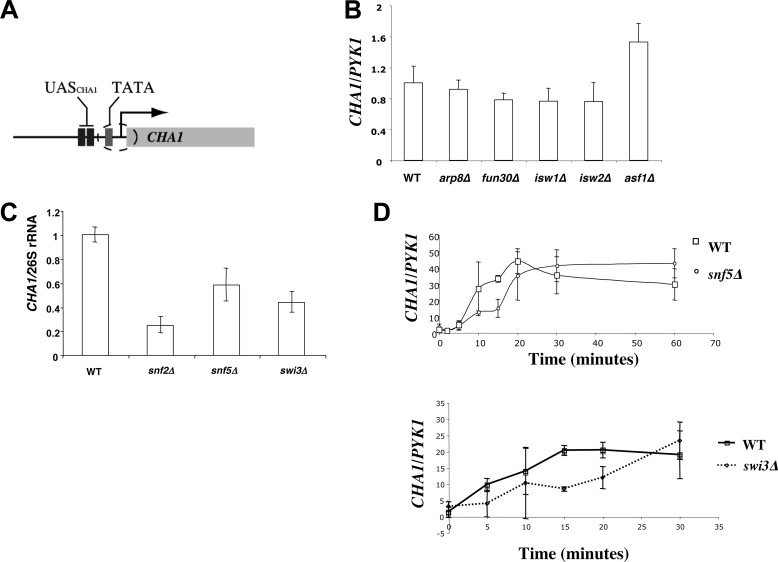
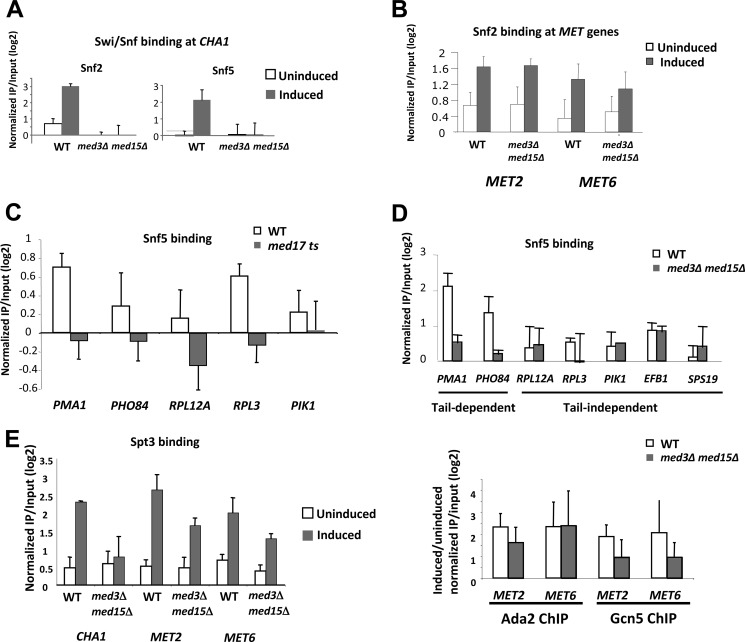
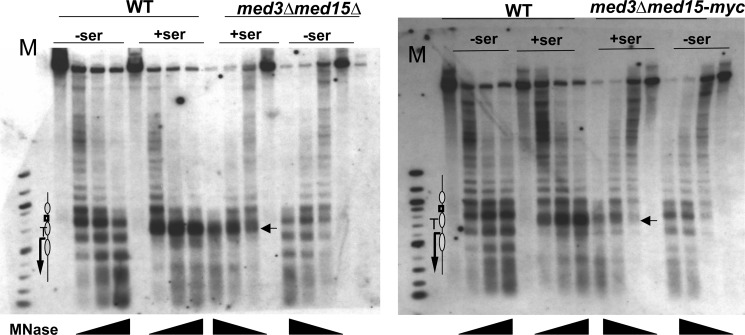
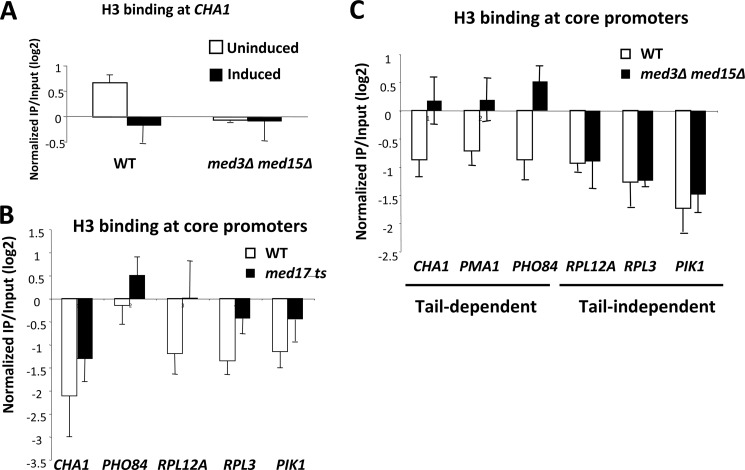
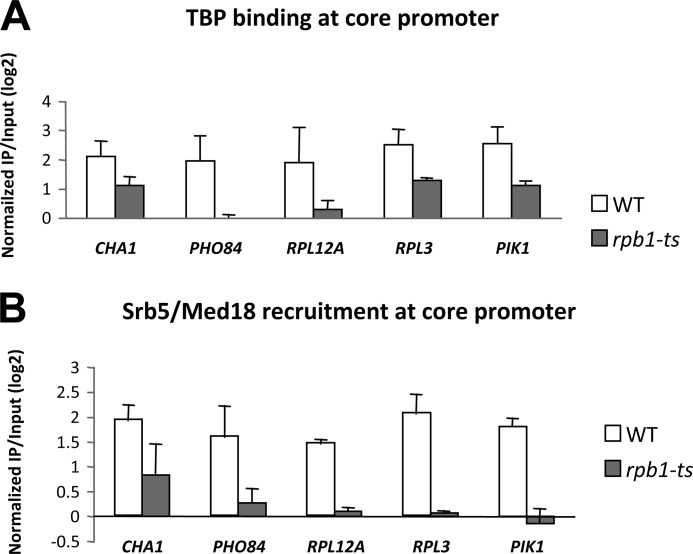
Transcription by RNA polymerase II (Pol II) in eukaryotes requires the Mediator complex, and often involves chromatin remodeling and histone eviction at active promoters. Here we address the role of Mediator in recruitment of the Swi/Snf chromatin remodeling complex and its role, along with components of the preinitiation complex (PIC), in histone eviction at inducible and constitutively active promoters in the budding yeast Saccharomyces cerevisiae. We show that recruitment of the Swi/Snf chromatin remodeling complex to the induced CHA1 promoter, as well as its association with several constitutively active promoters, depends on the Mediator complex but is independent of Mediator at the induced MET2 and MET6 genes. Although transcriptional activation and histone eviction at CHA1 depends on Swi/Snf, Swi/Snf recruitment is not sufficient for histone eviction at the induced CHA1 promoter. Loss of Swi/Snf activity does not affect histone occupancy of several constitutively active promoters; in contrast, higher histone occupancy is seen at these promoters in Mediator and PIC component mutants. We propose that an initial activator-dependent, nucleosome remodeling step allows PIC components to outcompete histones for occupancy of promoter sequences. We also observe reduced promoter association of Mediator and TATA-binding protein in a Pol II (rpb1-1) mutant, indicating mutually cooperative binding of these components of the transcription machinery and indicating that it is the PIC as a whole whose binding results in stable histone eviction.
Keywords: Chromatin Immunoprecipitation (ChiP); Chromatin Remodeling; Gene Transcription; Mediator; Nucleosome; Saccharomyces Cerevisiae; Swi/Snf Complex; Transcription; Transcription Coactivators; Yeast Genetics.
© 2014 by The American Society for Biochemistry and Molecular Biology, Inc.
Figures
References
-
- Larivière L., Seizl M., Cramer P. (2012) A structural perspective on Mediator function. Curr. Opin. Cell Biol. 24, 305–313 - PubMed
Publication types
MeSH terms
Substances
LinkOut - more resources
Full Text Sources
Other Literature Sources
Molecular Biology Databases
