


The relationship between serum insulin-like growth factor I levels and ischemic stroke risk
- PMID: 24728374
- PMCID: PMC3984250
- DOI: 10.1371/journal.pone.0094845
The relationship between serum insulin-like growth factor I levels and ischemic stroke risk
Retraction in
-
Retraction: The Relationship between Serum Insulin-Like Growth Factor I Levels and Ischemic Stroke Risk.PLoS One. 2022 Mar 30;17(3):e0266411. doi: 10.1371/journal.pone.0266411. eCollection 2022. PLoS One. 2022. PMID: 35353848 Free PMC article. No abstract available.
Abstract
Objective: The aim of the study was to assess the relationship between insulin-like growth factor I (IGF-I) serum levels and acute ischemic stroke (AIS) in a Chinese population.
Methods: All consecutive patients with first-ever AIS from August 1, 2011 to July 31, 2013 were recruited to participate in the study. The control group comprised 200 subjects matched for age, gender, and conventional vascular risk factors. IGF-I serum levels were determined by chemiluminescence immunoassay. The National Institutes of Health Stroke Scale (NIHSS) score was assessed on admission blinded to serum IGF-I levels.
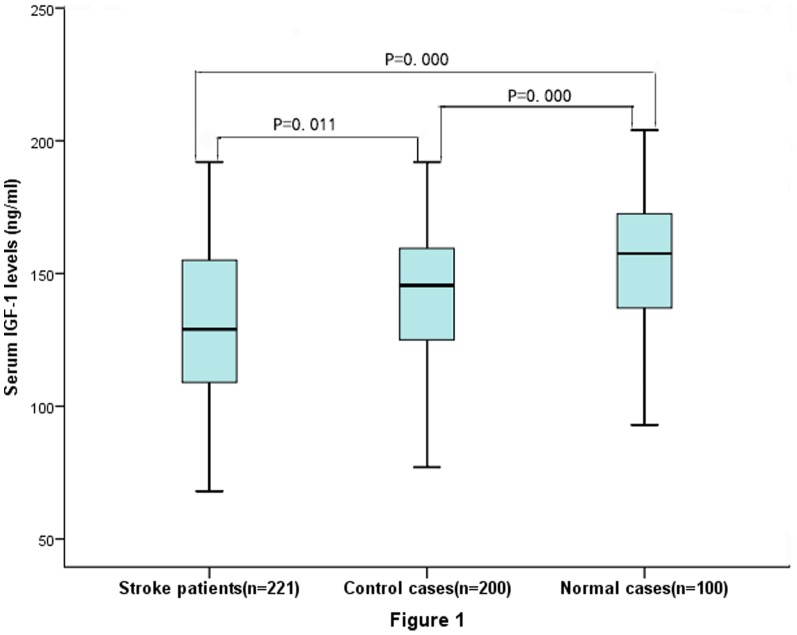
Results: The median serum IGF-1 levels were significantly (P = 0.011) lower in AIS patients (129; IQR, 109-153 ng/mL) compared with control cases (140; IQR, 125-159 ng/mL). We found that an increased risk of AIS was associated with IGF-I levels ≤135 ng/mL (unadjusted OR: 4.17; 95% CI: 2.52-6.89; P = 0.000). This relationship was confirmed in the dose-response model. In multivariate analysis, there was still an increased risk of AIS associated with IGF-I levels ≤135 ng/mL (OR: 2.16; 95% CI:1.33-3.52; P = 0.002) after adjusting for possible confounders.
Conclusion: Lower IGF-I levels are significantly related to risk of stroke, independent from other traditional and emerging risk factors, suggesting that they may play a role in the pathogenesis of AIS. Thus, strokes were more likely to occur in patients with low serum IGF-I levels in the Chinese population; further, post-ischemic IGF-I therapy may be beneficial for stroke.
Conflict of interest statement
Figures
References
-
- Bayes-Genis A, Conover CA, Schwartz RS (2000) The Insulin-Like Growth Factor Axis A Review of Atherosclerosis and Restenosis. Circulation research 86: 125–130. - PubMed
-
- Benarroch EE (2012) Insulin-like growth factors in the brain and their potential clinical implications. Neurology 79: 2148–2153. - PubMed
-
- Juul A (2003) Serum levels of insulin-like growth factor I and its binding proteins in health and disease. Growth Horm IGF Res 13: 113–170. - PubMed
-
- van Bunderen CC, van Nieuwpoort IC, van Schoor NM, Deeg DJ, Lips P, et al. (2010) The association of serum insulin-like growth factor-I with mortality, cardiovascular disease, and cancer in the elderly: a population-based study. J Clin Endocrinol Metab 95: 4616–4624. - PubMed
-
- Pollak MN, Schernhammer ES, Hankinson SE (2004) Insulin-like growth factors and neoplasia. Nature Reviews Cancer 4: 505–518. - PubMed
Publication types
MeSH terms
Substances
LinkOut - more resources
Full Text Sources
Other Literature Sources
Miscellaneous
