


Hippo/YAP-mediated rigidity-dependent motor neuron differentiation of human pluripotent stem cells
- PMID: 24728461
- PMCID: PMC4051885
- DOI: 10.1038/nmat3945
Hippo/YAP-mediated rigidity-dependent motor neuron differentiation of human pluripotent stem cells
Abstract
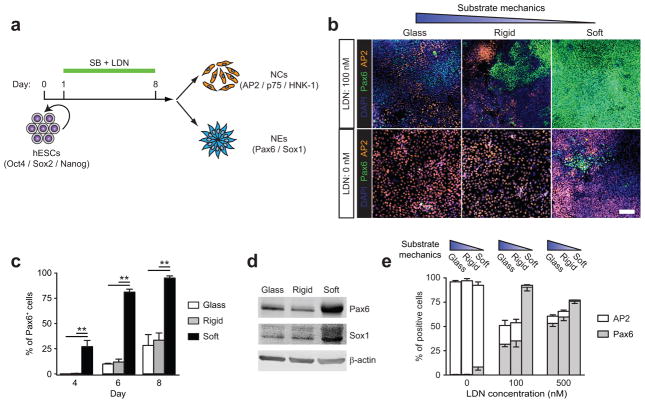
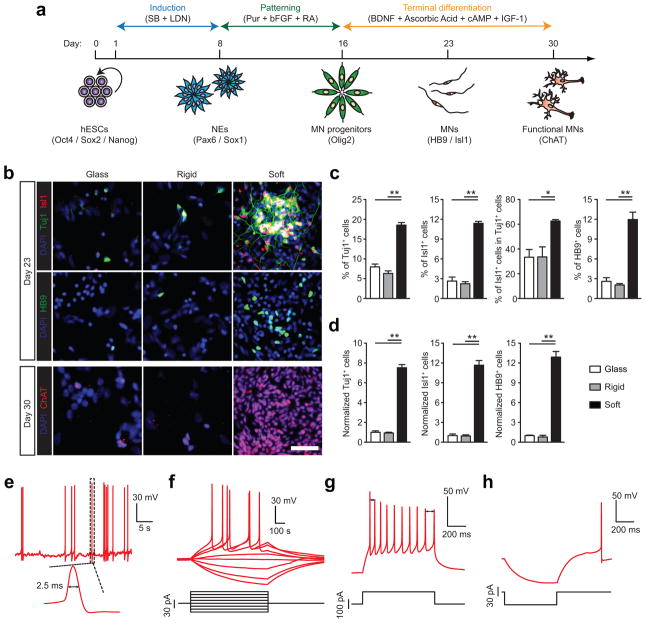
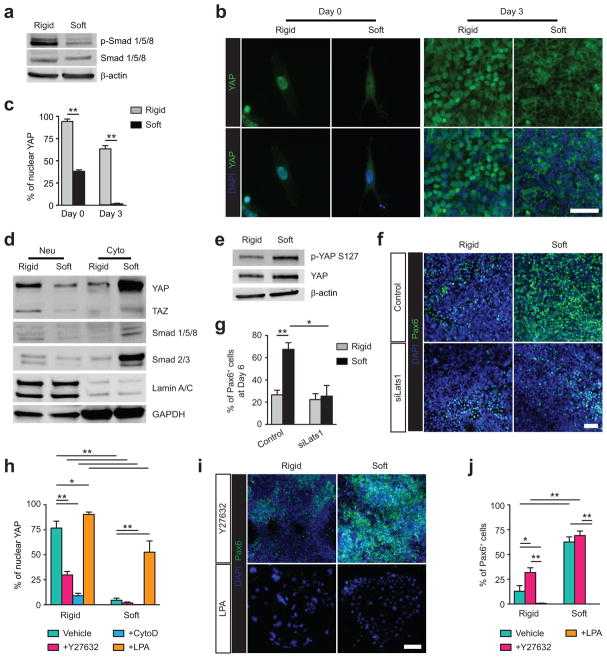
Our understanding of the intrinsic mechanosensitive properties of human pluripotent stem cells (hPSCs), in particular the effects that the physical microenvironment has on their differentiation, remains elusive. Here, we show that neural induction and caudalization of hPSCs can be accelerated by using a synthetic microengineered substrate system consisting of poly(dimethylsiloxane) micropost arrays (PMAs) with tunable mechanical rigidities. The purity and yield of functional motor neurons derived from hPSCs within 23 days of culture using soft PMAs were improved more than fourfold and tenfold, respectively, compared with coverslips or rigid PMAs. Mechanistic studies revealed a multi-targeted mechanotransductive process involving Smad phosphorylation and nucleocytoplasmic shuttling, regulated by rigidity-dependent Hippo/YAP activities and actomyosin cytoskeleton integrity and contractility. Our findings suggest that substrate rigidity is an important biophysical cue influencing neural induction and subtype specification, and that microengineered substrates can thus serve as a promising platform for large-scale culture of hPSCs.
Conflict of interest statement
The authors declare no competing financial interests.
Figures
Comment in
-
Stem cell differentiation: yielding substrates for neurons.Nat Mater. 2014 Jun;13(6):543-4. doi: 10.1038/nmat3992. Nat Mater. 2014. PMID: 24845991 No abstract available.
-
Stem cells go soft: pliant substrate surfaces enhance motor neuron differentiation.Cell Stem Cell. 2014 Jun 5;14(6):701-3. doi: 10.1016/j.stem.2014.05.007. Cell Stem Cell. 2014. PMID: 24905160 Free PMC article.
References
-
- Li XJ, et al. Specification of motoneurons from human embryonic stem cells. Nat Biotechnol. 2005;23:215–221. - PubMed
