


Semicompeting risks in aging research: methods, issues and needs
- PMID: 24729136
- PMCID: PMC4430119
- DOI: 10.1007/s10985-014-9295-7
Semicompeting risks in aging research: methods, issues and needs
Abstract
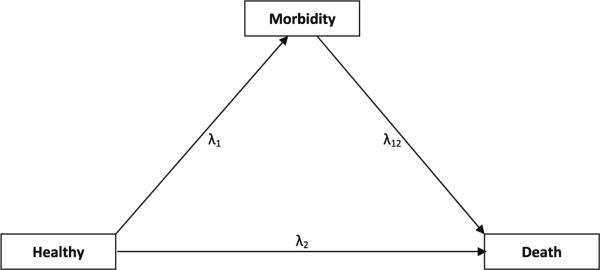
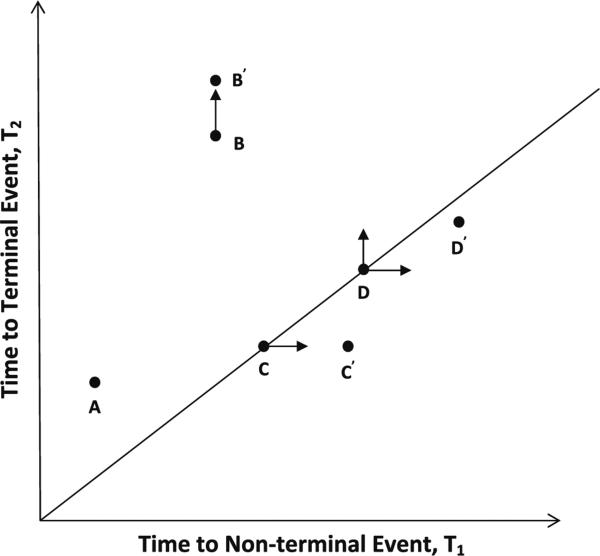
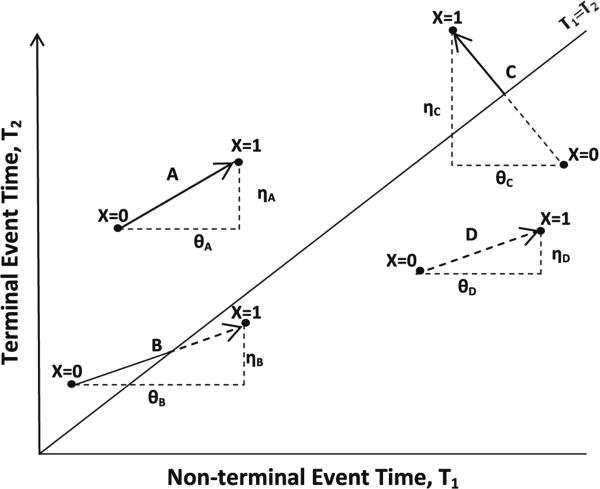
A semicompeting risks problem involves two-types of events: a nonterminal and a terminal event (death). Typically, the nonterminal event is the focus of the study, but the terminal event can preclude the occurrence of the nonterminal event. Semicompeting risks are ubiquitous in studies of aging. Examples of semicompeting risk dyads include: dementia and death, frailty syndrome and death, disability and death, and nursing home placement and death. Semicompeting risk models can be divided into two broad classes: models based only on observables quantities (class [Formula: see text]) and those based on potential (latent) failure times (class [Formula: see text]). The classical illness-death model belongs to class [Formula: see text]. This model is a special case of the multistate models, which has been an active area of methodology development. During the past decade and a half, there has also been a flurry of methodological activity on semicompeting risks based on latent failure times ([Formula: see text] models). These advances notwithstanding, the semicompeting risks methodology has not penetrated biomedical research, in general, and gerontological research, in particular. Some possible reasons for this lack of uptake are: the methods are relatively new and sophisticated, conceptual problems associated with potential failure time models are difficult to overcome, paucity of expository articles aimed at educating practitioners, and non-availability of readily usable software. The main goals of this review article are: (i) to describe the major types of semicompeting risks problems arising in aging research, (ii) to provide a brief survey of the semicompeting risks methods, (iii) to suggest appropriate methods for addressing the problems in aging research, (iv) to highlight areas where more work is needed, and (v) to suggest ways to facilitate the uptake of the semicompeting risks methodology by the broader biomedical research community.
Figures
References
-
- Aalen OO. Effects of frailty in survival analysis. Stat Methods Med Res. 1994;3:227–243. - PubMed
-
- Boyd CM, Fortin M. Future of multimorbidity research: how should understanding of multimorbidity inform health system design? Public Health Rev. 2010;32:451–474.
-
- Chen Y-H. Maximum likelihood analysis of semicompeting risks data with semiparametric regression models. Lifetime Data Anal. 2012;18:36–57. - PubMed
Publication types
MeSH terms
Grants and funding
LinkOut - more resources
Full Text Sources
Other Literature Sources
Medical
Miscellaneous
