


Motivational interviewing targeting diet and physical activity improves adherence to paediatric obesity treatment: results from the MI Values randomized controlled trial
- PMID: 24729537
- PMCID: PMC4197118
- DOI: 10.1111/j.2047-6310.2014.226.x
Motivational interviewing targeting diet and physical activity improves adherence to paediatric obesity treatment: results from the MI Values randomized controlled trial
Abstract
Background: Adherence is a challenge in obesity treatment. Motivational interviewing (MI) may promote patient adherence. MI Values is a randomized controlled trial of MI implemented as an adjunct to an adolescent obesity treatment [Teaching Encouragement Exercise Nutrition Support (T.E.E.N.S.)].
Objective: Assess effects of MI Values on T.E.E.N.S. attrition and adherence.
Methods: Participants were randomized to MI (n = 58) or control (n = 41). At weeks 1 and 10, MI participants had brief MI sessions; controls viewed health education videos. All participants continued with T.E.E.N.S. (biweekly dietitian and behavioural support visits; 3 times per week supervised physical activity). Assessments were repeated at baseline, 3 and 6 months. T-tests and chi-square analyses examined T.E.E.N.S. attrition and adherence by group.
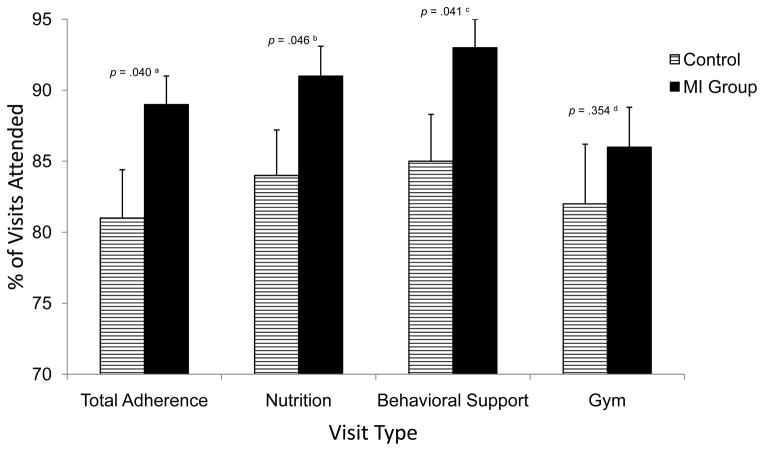
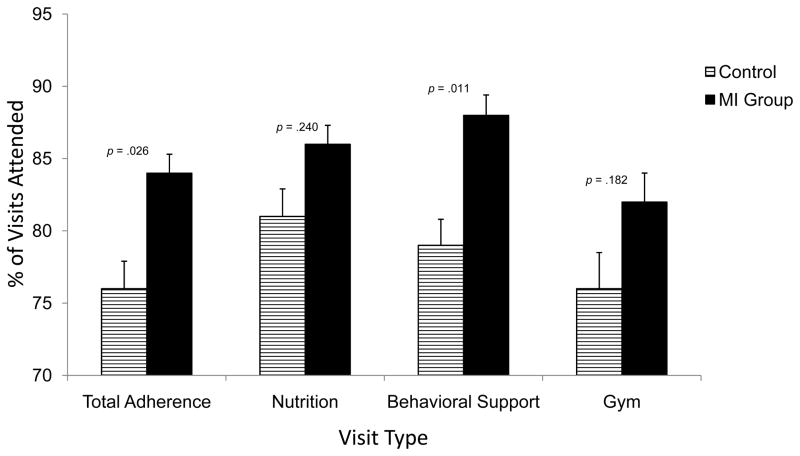
Results: Adolescents (N = 99) were primarily African-American (73%) females (74%); age = 13.8 ± 1.8 years, body mass index percentile = 98.0 ± 1.2. Compared with controls, MI participants had greater 3-month adherence overall (89.2% vs. 81.0%, P = 0.040), and to dietitian (91.3% vs. 84.0%; P = 0.046) and behavioural support (92.9% vs. 85.2%; P = 0.041) visits, and greater 6-month adherence overall (84.4% vs. 76.2%, P = 0.026) and to behavioural support visits (87.5% vs. 78.8%, P = 0.011).
Conclusions: MI enhanced adherence to this obesity intervention. MI Values is the first study to examine the impact of MI on treatment adherence among obese, primarily African-American adolescents.
Keywords: Motivational interviewing; paediatric obesity; treatment adherence.
© 2014 The Authors. Pediatric Obesity © 2014 International Association for the Study of Obesity.
Conflict of interest statement
The authors have no conflicts of interest to report.
Figures
References
-
- Oude Luttikhuis H, Baur L, Jansen H, et al. Interventions for treating obesity in children. Cochrane Database Syst Rev. 2009;(1):CD001872. - PubMed
-
- McGovern L, Johnson JN, Paulo R, et al. Clinical review: treatment of pediatric obesity: a systematic review and meta-analysis of randomized trials. J Clin Endocrinol Metab. 2008;93(12):4600–5. - PubMed
-
- Jeffery RW, Drewnowski A, Epstein LH, et al. Long-term maintenance of weight loss: current status. Health Psychol. 2000;19(1 Suppl):5–16. - PubMed
-
- Karlson CW, Rapoff MA. Attrition in Randomized Controlled Trials for Pediatric Chronic Conditions. Journal of Pediatric Psychology. 2009;34(7):782–793. - PubMed
Publication types
MeSH terms
Grants and funding
LinkOut - more resources
Full Text Sources
Other Literature Sources
Medical
Miscellaneous
