Review
. 2014 Apr 1:9:535-51.
doi: 10.2147/CIA.S51571. eCollection 2014.

The genetics of Alzheimer's disease

Affiliations
Review

The genetics of Alzheimer's disease

Eva Bagyinszky et al. Clin Interv Aging. .

Abstract

Alzheimer's disease (AD) is a complex and heterogeneous neurodegenerative disorder, classified as either early onset (under 65 years of age), or late onset (over 65 years of age). Three main genes are involved in early onset AD: amyloid precursor protein (APP), presenilin 1 (PSEN1), and presenilin 2 (PSEN2). The apolipoprotein E (APOE) E4 allele has been found to be a main risk factor for late-onset Alzheimer's disease. Additionally, genome-wide association studies (GWASs) have identified several genes that might be potential risk factors for AD, including clusterin (CLU), complement receptor 1 (CR1), phosphatidylinositol binding clathrin assembly protein (PICALM), and sortilin-related receptor (SORL1). Recent studies have discovered additional novel genes that might be involved in late-onset AD, such as triggering receptor expressed on myeloid cells 2 (TREM2) and cluster of differentiation 33 (CD33). Identification of new AD-related genes is important for better understanding of the pathomechanisms leading to neurodegeneration. Since the differential diagnoses of neurodegenerative disorders are difficult, especially in the early stages, genetic testing is essential for diagnostic processes. Next-generation sequencing studies have been successfully used for detecting mutations, monitoring the epigenetic changes, and analyzing transcriptomes. These studies may be a promising approach toward understanding the complete genetic mechanisms of diverse genetic disorders such as AD.

Keywords: APOE; amyloid precursor protein; dementia; diagnosis; genetic testing; mutation; presenilin 1; presenilin 2.


Figures
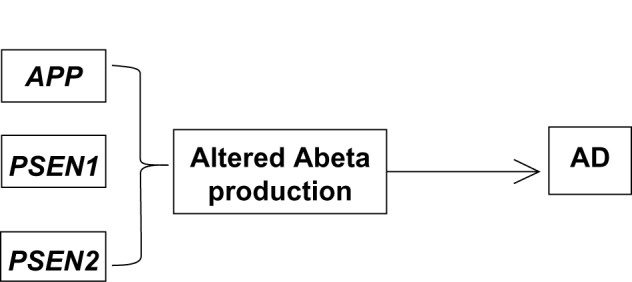
Figure 1
Figure 1
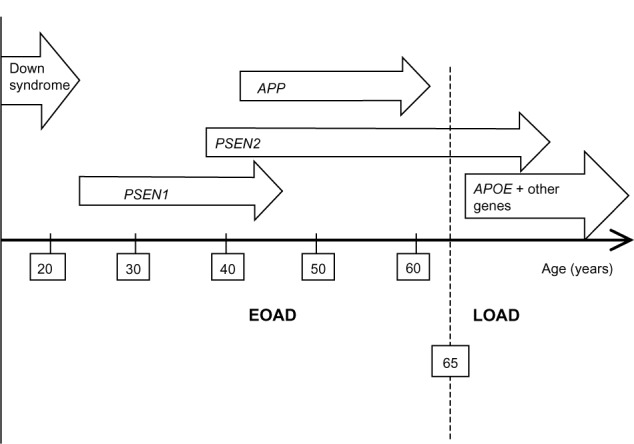
The amyloid precursor protein (APP), presenilin (PSEN) 1, and PSEN2 genes involved in early onset Alzheimer’s disease (AD). Abbreviation: Abeta, amyloid beta.
Figure 2
Figure 2
The age onset of Alzheimer’s disease (AD), depending on the different involvement of genes. The symptoms of dementia can occur at an earlier age in Down syndrome patients than in AD patients without trisomy. Abbreviations: APOE, apolipoprotein E gene; APP, amyloid precursor protein gene; EOAD, early onset Alzheimer’s disease; LOAD, late-onset Alzheimer’s disease; PSEN1/2, presenilin 1/2 gene.
Figure 3
Figure 3
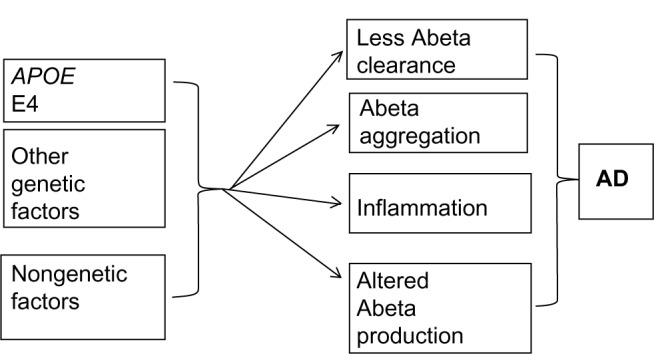
Factors involved in late-onset Alzheimer’s disease (AD). Abbreviations: Abeta, amyloid beta; APOE, apolipoprotein E.
Figure 4
Figure 4
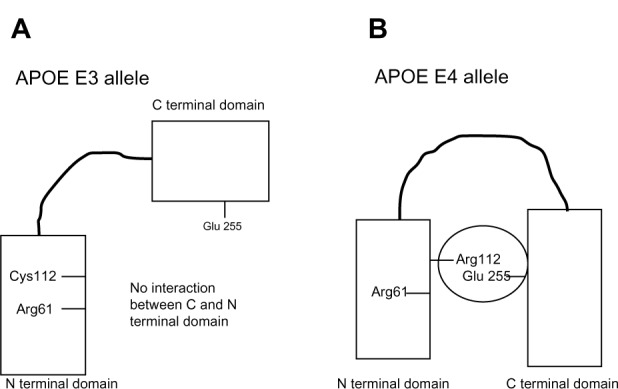
The difference between apolipoprotein E (APOE) protein E3 allele (A) and APOE E4 allele (B). The pathomechanism of the APOE E4 allele could be based on the interaction between Arg112 and Glu255. Notes: Reproduced with permission from Mahley RW, Huang Y. Alzheimer disease: multiple causes, multiple effects of apolipoprotein E4, and multiple therapeutic approaches. Ann Neurol. 2009;65(6):623–625. Copyright © 2009 American Neurological Association. Reproduced with permission from Mahley RW, Weisgraber KH, Huang Y. Apolipoprotein E4: a causative factor and therapeutic target in neuropathology, including Alzheimer’s disease. Proc Natl Acad Sci U S A. 2006;103(15):5644–5651. Copyright (2006) National Academy of Sciences, USA.
Figure 5
Figure 5
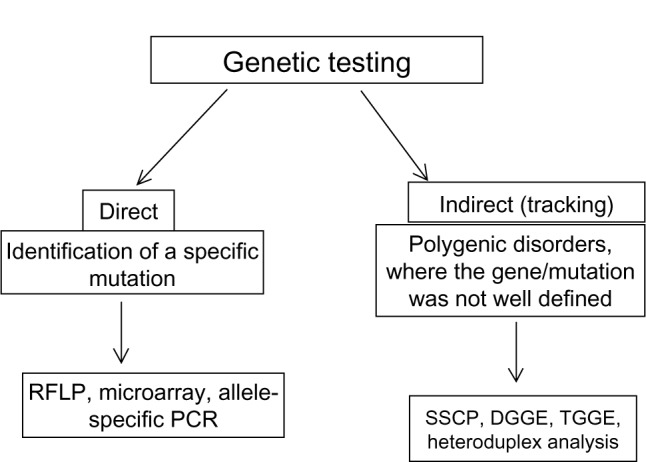
Polymerase chain reaction (PCR)-based genetic methods. Abbreviations: DGGE, denaturing gradient gel electrophoresis; RFLP, restriction fragment length polymorphism; TGGE, temperature gradient gel electrophoresis; SSCP, single-strand conformation polymorphism.
Figure 6
Figure 6
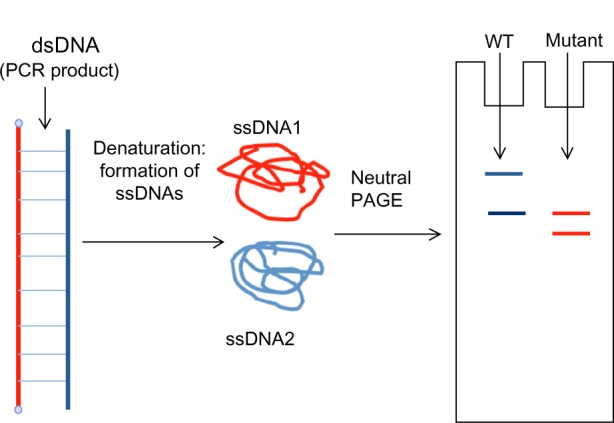
The single-strand conformation polymorphism process. After denaturation of the polymerase chain reaction (PCR) product, the conformation of single-stranded DNA (ssDNA) could be different, resulting in altered mobility in polyacrylamide gel. Abbreviations: dsDNA, double-strand DNA; PAGE, polyacrylamide gel electrophoresis; WT, wild type.
Figure 7
Figure 7
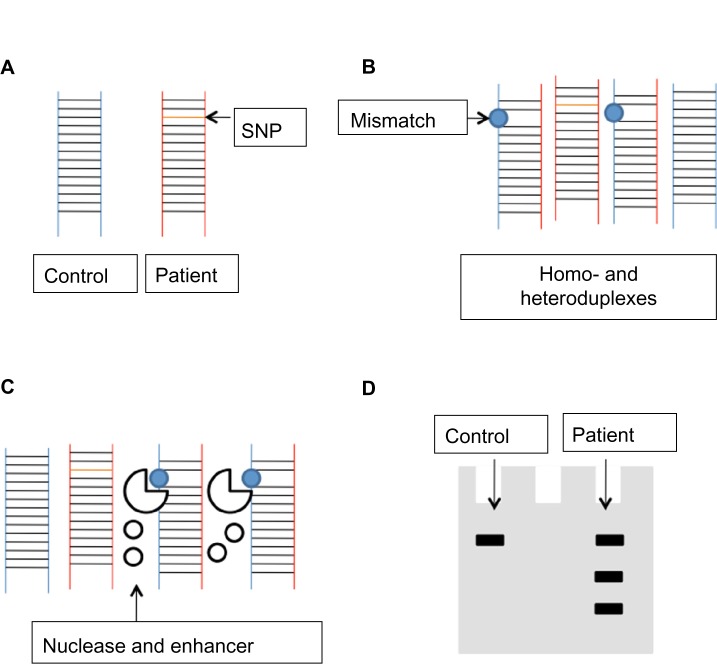
The basic steps of genotyping with Surveyor® Nuclease (Transgenomic, Inc, Omaha, NE, USA). After mixing the polymerase chain reaction amplicons of healthy control and patient (A), hybridization should be performed, resulting in homo- and heteroduplex formation (B). Treatment with Surveyor Nuclease cleaves the DNA at the mismatch site (C). Cleavage products can be separated by electrophoresis (D). Abbreviation: SNP, single-nucleotide polymorphism.

References

    1. Ertekin-Taner N. Genetics of Alzheimer’s disease: a centennial review. Neurol Clin. 2007;25(12):611–617. - PMC - PubMed
    1. Reitz C, Mayeux R. Use of genetic variation as biomarkers for Alzheimer’s disease. Ann N Y Acad Sci. 2009;1180:75–96. - PMC - PubMed
    1. Brickell KL, Leverenz JB, Steinbart EJ, et al. Clinicopathological concordance and discordance in three monozygotic twin pairs with familial Alzheimer’s disease. J Neurol Neurosurg Psychiatry. 2007;78(10):1050–1055. - PMC - PubMed
    1. Meyer JM, Breitner JC. Multiple threshold model for the onset of Alzheimer’s disease in the NAS-NRC twin panel. Am J Med Genet. 1998;81(1):92–97. - PubMed
    1. Bird DT. Genetic aspects of Alzheimer disease. Genet Med. 2008;10(4):231–239. - PMC - PubMed

Publication types