


Epidemiology of yaws: an update
- PMID: 24729728
- PMCID: PMC3979691
- DOI: 10.2147/CLEP.S44553
Epidemiology of yaws: an update
Abstract
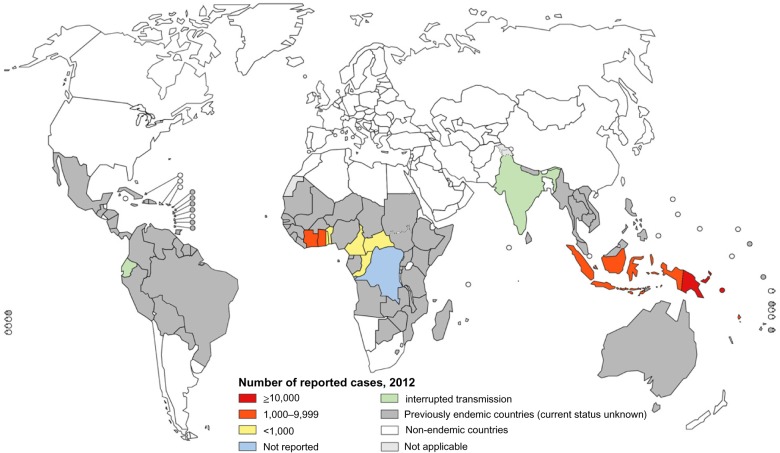
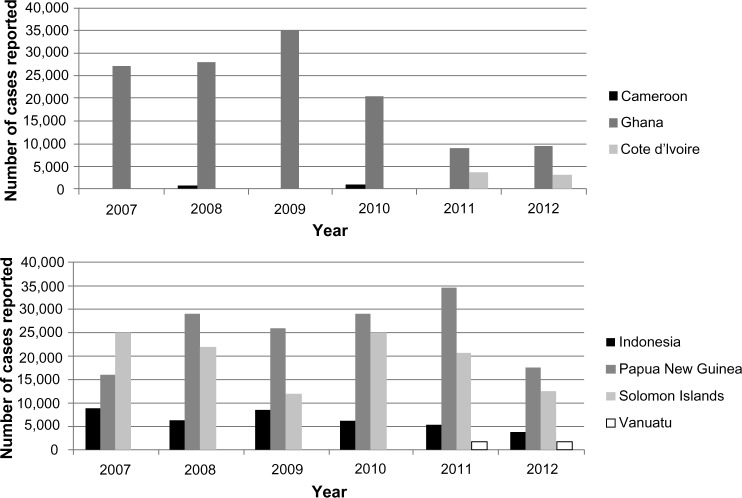
Yaws, a neglected tropical disease, is targeted for eradication by 2020 through large-scale mass-treatment programs of endemic communities. A key determinant for the success of the eradication campaign is good understanding of the disease epidemiology. We did a review of historical trends and new information from endemic countries, with the aim of assessing the state of knowledge on yaws disease burden. Transmission of yaws is now present in Africa, Asia, and the South Pacific. At least 12 countries are known to harbor yaws cases and 21 to 42 million people live in endemic areas. Between 2008 and 2012 more than 300,000 new cases were reported to the World Health Organization. Yaws presented high geographical variation within a country or region, high seasonality for incidence of active disease, and evidence that low standards of hygiene predispose to suffering of the disease. Key data issues include low levels of reporting, potential misdiagnosis, and scarce documentation on prevalence of asymptomatic infections. Currently available data most likely underestimates the magnitude of the disease burden. More effort is needed in order to refine accuracy of data currently being reported. A better characterization of the epidemiology of yaws globally is likely to positively impact on planning and implementation of yaws eradication.
Keywords: Treponema pertenue; endemic countries; eradication; incidence; prevalence.
Figures
References
-
- Mitjà O, Asiedu K, Mabey D. Yaws. Lancet. 2013;381:763–773. - PubMed
-
- World Health Organization . Summary Report of the Consultative Meeting on Eradication of Yaws, March 5–7, 2012, Morges, Switzerland. Geneva: World Health Organization; 2012. [Accessed February 5, 2013]. Available from: http://apps.who.int/iris/bitstream/10665/75528/1/WHO_HTM_NTD_IDM_2012.2_....
-
- Mitjà O, Hays R, Ipai A, et al. Single-dose azithromycin versus benzathine benzylpenicillin for treatment of yaws in children in Papua New Guinea: an open-label, non-inferiority, randomised trial. Lancet. 2011;379:342–347. - PubMed
-
- Saunders G, Chambers H, Rerrie J. Annual report of the Jamaica Yaws Commission for 1936. Kingston, Jamaica: 1936.
Publication types
Grants and funding
LinkOut - more resources
Full Text Sources
Other Literature Sources
