. 2014 Apr;121(2):225-47.
doi: 10.1037/a0035942.

Clarifying the roles of homeostasis and allostasis in physiological regulation

Affiliations

Clarifying the roles of homeostasis and allostasis in physiological regulation

Douglas S Ramsay et al. Psychol Rev. 2014 Apr.

Abstract

Homeostasis, the dominant explanatory framework for physiological regulation, has undergone significant revision in recent years, with contemporary models differing significantly from the original formulation. Allostasis, an alternative view of physiological regulation, goes beyond its homeostatic roots, offering novel insights relevant to our understanding and treatment of several chronic health conditions. Despite growing enthusiasm for allostasis, the concept remains diffuse, due in part to ambiguity as to how the term is understood and used, impeding meaningful translational and clinical research on allostasis. Here, we provide a more focused understanding of homeostasis and allostasis by explaining how both play a role in physiological regulation, and a critical analysis of regulation suggests how homeostasis and allostasis can be distinguished. Rather than focusing on changes in the value of a regulated variable (e.g., body temperature, body adiposity, or reward), research investigating the activity and relationship among the multiple regulatory loops that influence the value of these regulated variables may be the key to distinguishing homeostasis and allostasis. The mechanisms underlying physiological regulation and dysregulation are likely to have important implications for health and disease.


Figures
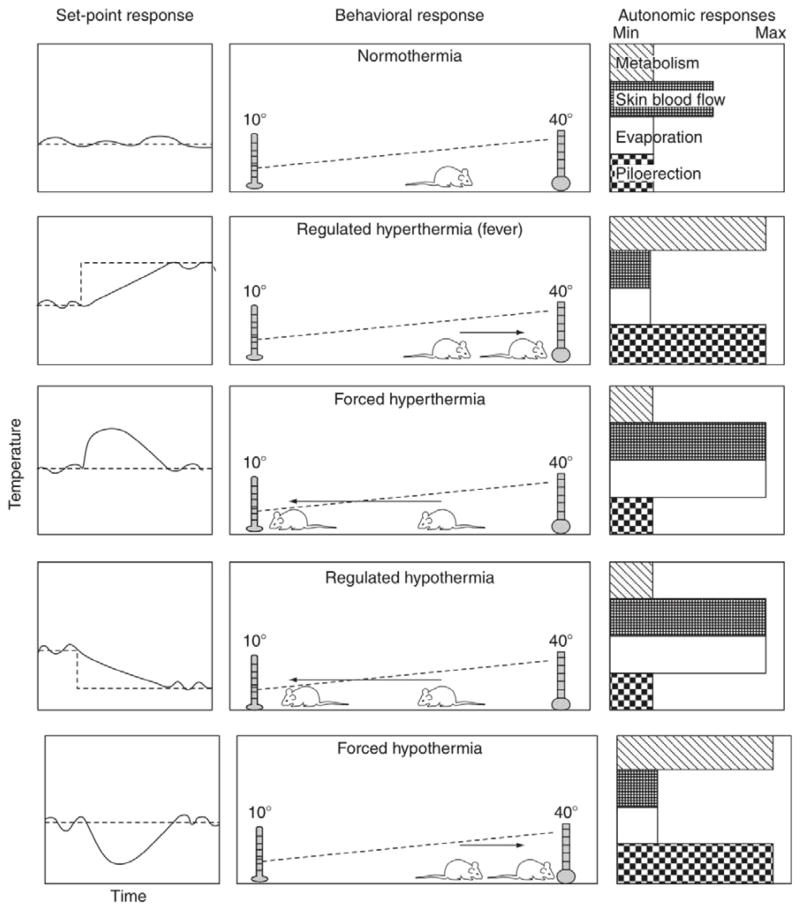
Figure 1
Figure 1
“Summary of behavioral and autonomic responses of a homeotherm when subjected to manipulation of body and set-point temperature. Graphs on the left represent the relationship between the set point (dashed line) and core temperature (solid line).” [This figure and figure legend are reprinted with permission (Gordon, 2009, p. 894).]
Figure 2
Figure 2
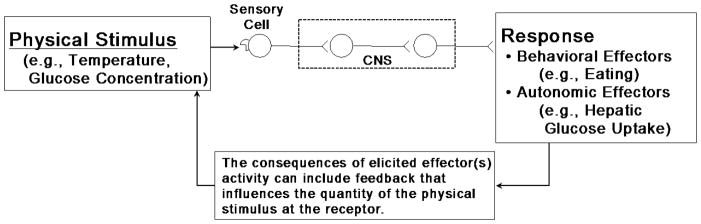
Schematic representation of a single regulatory sensor - effector loop. Although the sensory cell is depicted in the periphery, they also exist within the CNS. The activation threshold of the receptor on the primary sensory neuron is triggered when the quantity of the physical stimulus is sufficient. Note: all such loops involve the CNS and are multi-synaptic.
Figure 3
Figure 3
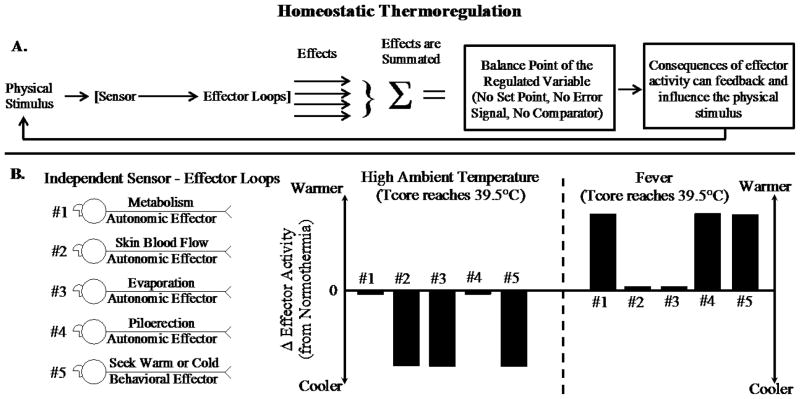
Schematic describing how a homeostatic model explains thermoregulatory effector activity when body temperature (Tcore) is comparably elevated due to being in a high ambient temperature or an infection-induced fever. Panel A. Schematic depicting how the activity of multiple independent sensor-effector loops contributes to the balance point of a regulated variable. Panel B. Two different patterns of effector activity (adjusted for basal activity levels during normothermia) that result from five different thermo-effector loops. When ambient temperature is high, cooling responses are activated; during a fever, warming responses are activated. As in Gordon’s homeostatic model (see Fig. 1), the same pattern of coordinated effector activity occurs to move Tcore in the same direction, but this approach does not measure the value of the regulated variable and compare it to a set-point value.
Figure 4
Figure 4
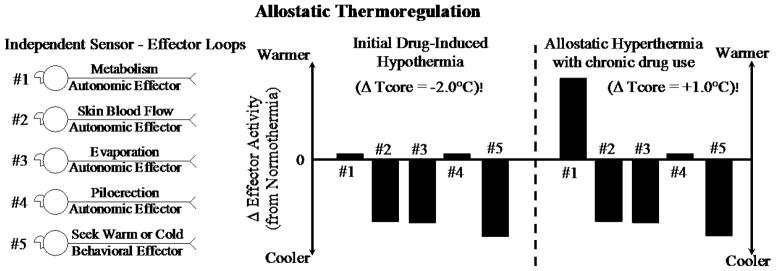
Schematic describing how an allostatic model explains thermoregulatory effector activity when body temperature (Tcore) drops during an initial drug administration but then reverses and eventually becomes an allostatic hyperthermia (sign reversal) over repeated drug administrations. The schematic in Figure 3 (Panel A) depicts how the activity of multiple independent sensor-effector loops contributes to the balance point of a regulated variable. The effector activity (adjusted for basal activity levels during normothermia) that results from five different thermo-effector loops changes with chronic drug use. When the drug is initially administered, cooling responses are activated which cause hypothermia. However, with repeated drug use, Tcore becomes hyperthermic which is due to the increase in metabolic heat production that overcompensates for the concurrent effectors that favor cooling.
Figure 5
Figure 5
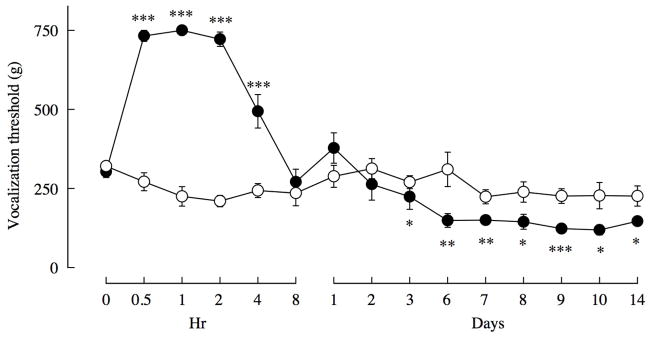
“Nociceptive threshold in rats at different times (hr, days) following the implantation of an osmotic pump releasing fentanyl. On day 0 of the experiment, rats were implanted subcutaneously with an osmotic pump that released 0.31 mg rat−1day−1 of fentanyl (n = 14); control animals (n = 13) were implanted with a pump delivering 0.12 ml day−1 of saline. Nociceptive thresholds were measured by the paw-pressure vocalization test before and at different time intervals after pump implantation. A 750 g cut-off value was used to prevent tissue damage. Results are expressed as the mean (± s.e.m.) paw pressure (in g) inducing vocalization. Differences between fentanyl-treated (closed circle) and saline-treated (open circle) (control) groups were determined with the Student’s t-test subsequent to two-way ANOVA; *p<0.05; **p<0.01; ***p<0.001.” [This figure and figure legend are reprinted with permission (Bruins Slot et al., 2002, p. 177)].

Comment in

References

    1. Ahmed SH, Koob GF. Transition to drug addiction: a negative reinforcement model based on an allostatic decrease in reward function. Psychopharmacology (Berl) 2005;180(3):473–490. doi: 10.1007/s00213-005-2180-z. - DOI - PubMed
    1. Angst MS, Clark JD. Opioid-induced hyperalgesia: a qualitative systematic review. Anesthesiology. 2006;104(3):570–587. - PubMed
    1. Baker TB, Piper ME, McCarthy DE, Majeskie MR, Fiore MC. Addiction motivation reformulated: An affective processing model of negative reinforcement. Psychological Review. 2004;111(1):33–51. doi: 10.1037/0033-295x.111.1.33. - DOI - PubMed
    1. Bauman DE. Regulation of nutrient partitioning during lactation: Homeostasis and homeorhesis revisited. In: Cronjé P, Boomker EA, editors. Ruminant physiology: digestion, metabolism, growth, and reproduction. Wallingford, Oxon, UK; New York, NY, USA: CABI Pub; 2000. pp. 311–328.
    1. Bauman DE, Currie WB. Partitioning of nutrients during pregnancy and lactation: a review of mechanisms involving homeostasis and homeorhesis. Journal of Dairy Science. 1980;63(9):1514–1529. - PubMed

Publication types

MeSH terms