. 2014 Apr 15:9:29.
doi: 10.1186/1749-7922-9-29. eCollection 2014.

Extended negative pressure wound therapy-assisted dermatotraction for the closure of large open fasciotomy wounds in necrotizing fasciitis patients

Affiliations

Extended negative pressure wound therapy-assisted dermatotraction for the closure of large open fasciotomy wounds in necrotizing fasciitis patients

Jun Yong Lee et al. World J Emerg Surg. .

Abstract

Background: Necrotizing fasciitis (NF) is a rapid progressive infection of the subcutaneous tissue or fascia and may result in large open wounds. The surgical options to cover these wounds are often limited by the patient condition and result in suboptimal functional and cosmetic wound coverage. Dermatotraction can restore the function and appearance of the fasciotomy wound and is less invasive in patients with comorbidities. However, dermatotraction for scarred, stiff NF fasciotomy wounds is often ineffective, resulting in skin necrosis. The authors use extended negative pressure wound therapy (NPWT) as an assist in dermatotraction to close open NF fasciotomy wounds. The authors present the clinical results, followed by a discussion of the clinical basis of extended NPWT-assisted dermatotraction.

Methods: A retrospective case series of eight patients with NF who underwent open fasciotomy was approved for the study. After serial wound preparation, dermatotraction was applied in a shoelace manner using elastic vessel loops. Next, the extended NPWT was applied over the wound. The sponge was three times wider than the wound width, and the transparent covering drape almost encircled the anatomical wound area. The negative pressure of the NPWT was set at a continuous 100 mmHg by suction barometer. The clinical outcome was assessed based on wound area reduction after treatment and by the achievement of direct wound closure.

Results: After the first set of extended NPWT-assisted dermatotraction procedures, the mean wound area was significantly decreased (658.12 cm(2) to 29.37 cm(2); p = 0.002), as five out of eight patients achieved direct wound closure. One patient with a chest wall defect underwent latissimus dorsi musculocutaneous flap coverage, with primary closure of the donor site. Two Fournier's gangrene patients underwent multiple sets of treatment and finally achieved secondary wound closure with skin grafts. The patients were followed up for 18.3 months on average and showed satisfactory results without wound recurrence.

Conclusions: Extended NPWT-assisted dermatotraction advances scarred, stiff fasciotomy wound margins synergistically in NF and allows direct closure of the wound without complications. This method can be another good treatment option for the NF patient with large open wounds whose general condition is unsuitable for extensive reconstructive surgery.

Keywords: Dermatotraction; Fasciotomy; Fournier’s gangrene; Necrotizing fasciitis; Negative pressure wound therapy.


Figures
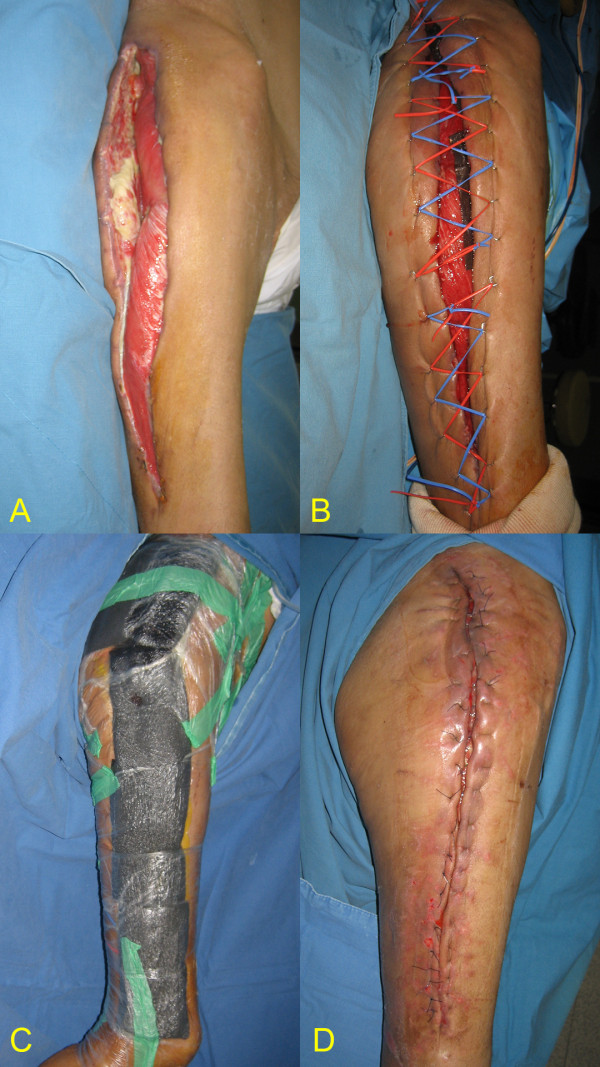
Figure 1
Figure 1
Open fasciotomy wound closure with extended NPWT-assisted dermatotraction in necrotizing fasciitis; A 59-year-old male patient with necrotizing fasciitis on his right thigh showed contracted skin margins with necrotic tissues on the 14th day after initial fasciotomy. (A). After 46 days of wound preparation, the elastic vessel loop is applied for the dermatotraction in a shoelace manner (B). The extended NPWT assisted the underlying dermatotraction in closing the open fasciotomy wound (C). After the 14 days of treatment, the fasciotomy wound could be closed directly (D).
Figure 2
Figure 2
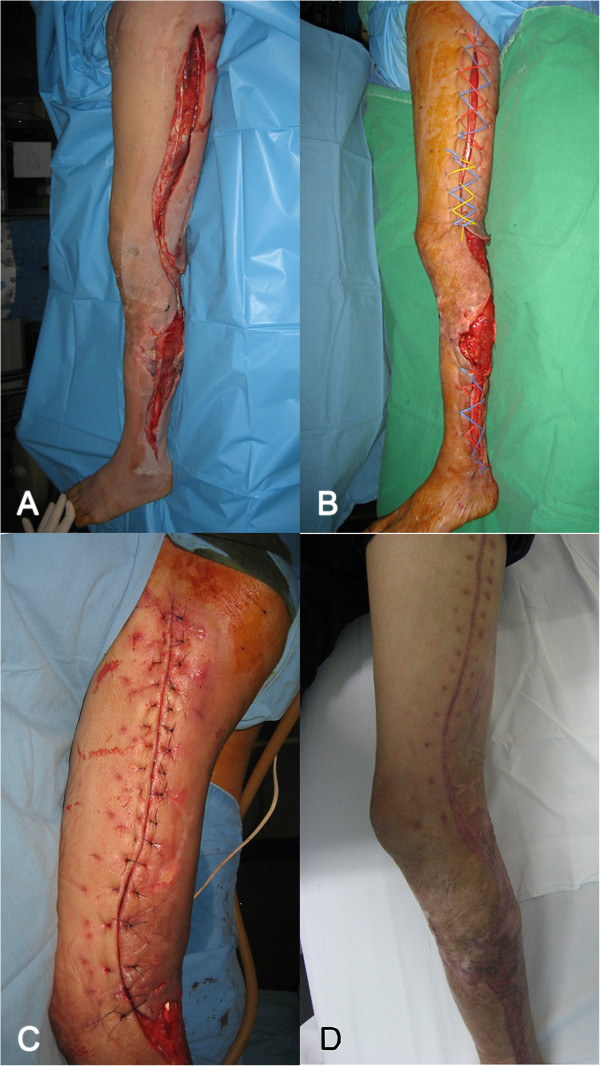
Open fasciotomy wound closure with extended NPWT-assisted dermatotraction in necrotizing fasciitis; A 62-year-old male patient with necrotizing fasciitis on the left lower extremity underwent open fasciotomy on his thigh and lower leg. (A). After 7 days of thorough wound debridement and preparation, extended NPWT-assisted dermatotraction was applied (B). After two cycles of treatment, the fasciotomy wounds were closed directly, and the posterior calf’s raw surface was covered with split-thickness skin graft (C). Three months after wound closure, the wounds were completely healed without complications (D).
Figure 3
Figure 3
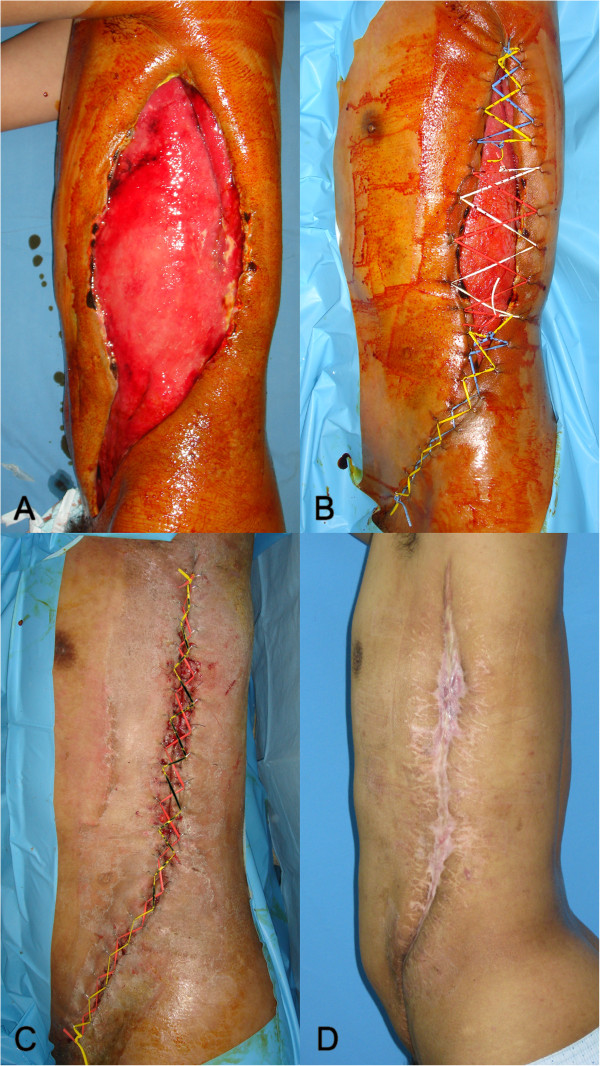
Open fasciotomy wound closure with extended NPWT-assisted dermatotraction in necrotizing fasciitis; A 43-year-old male patient with necrotizing fasciitis that had developed an abscess in the left axilla underwent open fasciotomy one month before presentation. (A). After 40 days of wound preparation since initial fasciotomy, the patient underwent NPWT-assisted dermatotraction, which decreased the size of wound prominently after 6 days of treatment (B). The wound was closed directly after 40 days of NPWT assisted dermatotraction (C). The patient was followed up for 27 months and the wound was completely healed without complications (D).
Figure 4
Figure 4
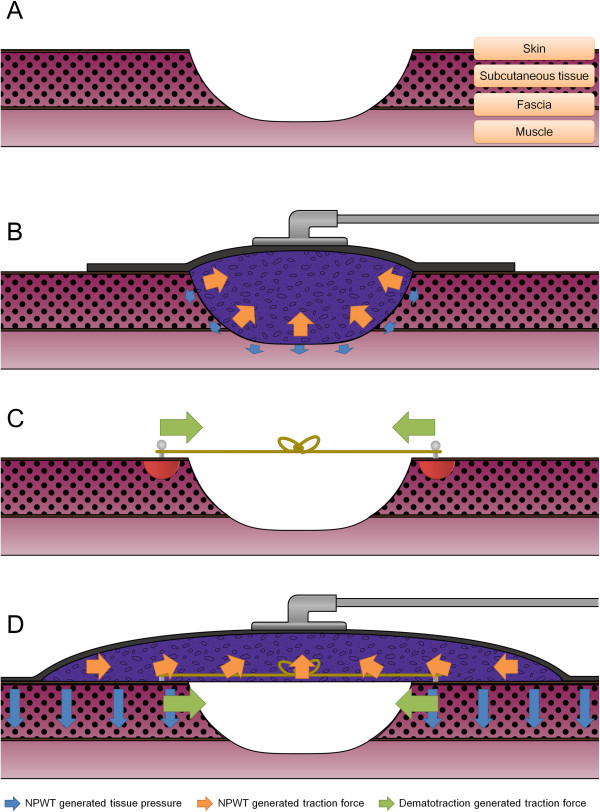
Theoretical basis of extended NPWT-assisted dermatotraction; The fasciotomy releases all the retention forces by fascia and skin, thus decrease the tissue pressures of the cylindrical compartment. (A). The cavitary NPWT increases the tissue pressure with shallow penetration to the deep tissue, and limits wound contraction because of the intervening sponge (B). The dermatotraction forces are concentrated on the anchoring point, which can disturb tissue perfusion and necrose the skin, especially in the stiff open fasciotomy wound of necrotizing fasciitis (red semicircle, C). Extended NPWT increases normal skin perfusion and sheers the wound margins to the central axis of the fasciotomy. This assists the dermatotraction by distributing the concentrated traction forces at the anchoring point and further approximating the wound margins. The near-circumferential adhesive surgical drape of the NPWT also limits tissue edema and delivers NPWT-generated increments of tissue pressure to the deep tissues like an elastic stocking (D).

References

    1. Legbo JN, Shehu BB. Necrotizing fasciitis: a comparative analysis of 56 cases. J Natl Med Assoc. 2005;97:1692–1697. - PMC - PubMed
    1. Goh T, Goh LG, Ang CH, Wong CH. Early diagnosis of necrotizing fasciitis. Br J Surg. 2014;101:e119–e125. doi: 10.1002/bjs.9371. - DOI - PubMed
    1. Schnurer S, Beier JP, Croner R, Rieker RJ, Horch RE. [Pathogenesis, classification and diagnosis of necrotizing soft tissue infections] Chirurg. 2012;83:943–952. doi: 10.1007/s00104-012-2281-2. - DOI - PubMed
    1. Netzer G, Fuchs BD. Necrotizing fasciitis in a plaster-casted limb: case report. Am J Crit Care. 2009;18:288–287. doi: 10.4037/ajcc2009363. - DOI - PubMed
    1. Roje Z, Roje Z, Matic D, Librenjak D, Dokuzovic S, Varvodic J. Necrotizing fasciitis: literature review of contemporary strategies for diagnosing and management with three case reports: torso, abdominal wall, upper and lower limbs. WJES. 2011;6:46. - PMC - PubMed

LinkOut - more resources