


Distinctive RNA expression profiles in blood associated with Alzheimer disease after accounting for white matter hyperintensities
- PMID: 24731980
- PMCID: PMC4139468
- DOI: 10.1097/WAD.0000000000000022
Distinctive RNA expression profiles in blood associated with Alzheimer disease after accounting for white matter hyperintensities
Abstract
Background: Defining the RNA transcriptome in Alzheimer Disease (AD) will help understand the disease mechanisms and provide biomarkers. Though the AD blood transcriptome has been studied, effects of white matter hyperintensities (WMH) were not considered. This study investigated the AD blood transcriptome and accounted for WMH.
Methods: RNA from whole blood was processed on whole-genome microarrays.
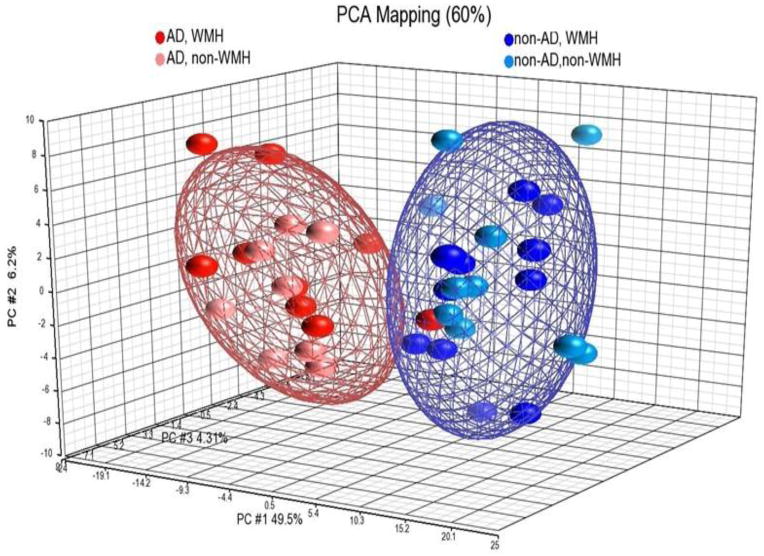
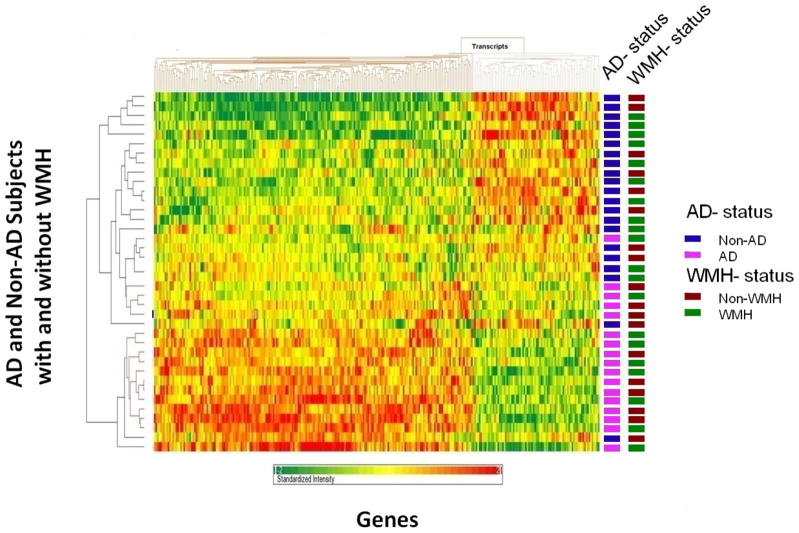
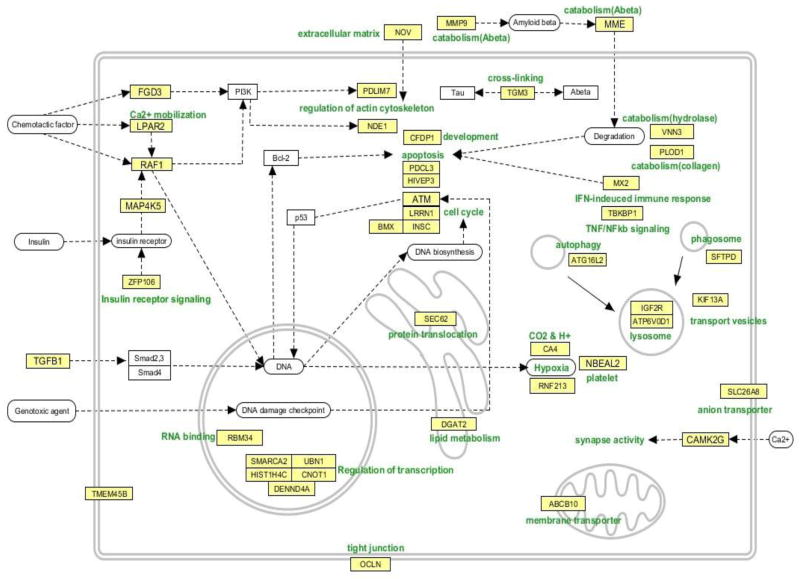
Results: A total of 293 probe sets were differentially expressed in AD versus controls, 5 of which were significant for WMH status. The 288 AD-specific probe sets classified subjects with 87.5% sensitivity and 90.5% specificity. They represented 188 genes of which 29 have been reported in prior AD blood and 89 in AD brain studies. Regulated blood genes included MMP9, MME (Neprilysin), TGFβ1, CA4, OCLN, ATM, TGM3, IGFR2, NOV, RNF213, BMX, LRRN1, CAMK2G, INSR, CTSD, SORCS1, SORL1, and TANC2.
Conclusions: RNA expression is altered in AD blood irrespective of WMH status. Some genes are shared with AD brain.
Conflict of interest statement
The authors report no conflicts of interest.
Figures
References
-
- Fehlbaum-Beurdeley P, Jarrige-Le Prado AC, Pallares D, Carriere J, Guihal C, Soucaille C, et al. Toward an alzheimer’s disease diagnosis via high-resolution blood gene expression. Alzheimer’s & dementia : the journal of the Alzheimer’s Association. 2010;6:25–38. - PubMed
-
- Rye PD, Booij BB, Grave G, Lindahl T, Kristiansen L, Andersen HM, et al. A novel blood test for the early detection of alzheimer’s disease. Journal of Alzheimer’s disease : JAD. 2011;23:121–129. - PubMed
-
- Lunnon K, Ibrahim Z, Proitsi P, Lourdusamy A, Newhouse S, Sattlecker M, et al. Mitochondrial dysfunction and immune activation are detectable in early alzheimer’s disease blood. Journal of Alzheimer’s disease : JAD. 2012;30:685–710. - PubMed
-
- Maes OC, Schipper HM, Chertkow HM, Wang E. Methodology for discovery of alzheimer’s disease blood-based biomarkers. J Gerontol A Biol Sci Med Sci. 2009;64:636–645. - PubMed
-
- Han G, Wang J, Zeng F, Feng X, Yu J, Cao HY, et al. Characteristic transformation of blood transcriptome in alzheimer’s disease. Journal of Alzheimer’s disease : JAD. 2013;35:373–386. - PubMed
Publication types
MeSH terms
Substances
Grants and funding
LinkOut - more resources
Full Text Sources
Other Literature Sources
Medical
Research Materials
Miscellaneous
