Emergency department use: is frequent use associated with a lack of primary care provider?
- PMID: 24733342
- PMCID: PMC4046533
Emergency department use: is frequent use associated with a lack of primary care provider?
Abstract
Objective: To determine if having a primary care provider is an important factor in frequency of emergency department (ED) use.
Design: Analysis of a central computerized health network database.
Setting: Three EDs in southern New Brunswick.
Participants: All ED visits during 1 calendar year to an urban regional hospital (URH), an urban urgent care centre (UCC), and a rural community hospital (RCH) were captured.
Main outcome measures: Patients with and without listed primary care providers were compared in terms of number of visits to the ED. A logistic regression analysis was used to determine factors predictive of frequent attendance.
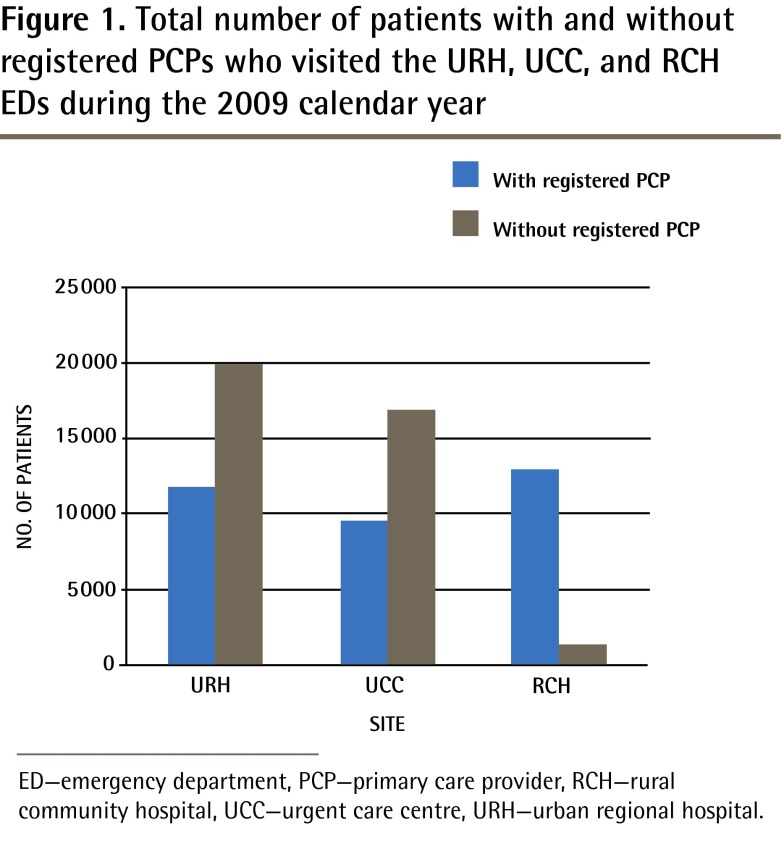
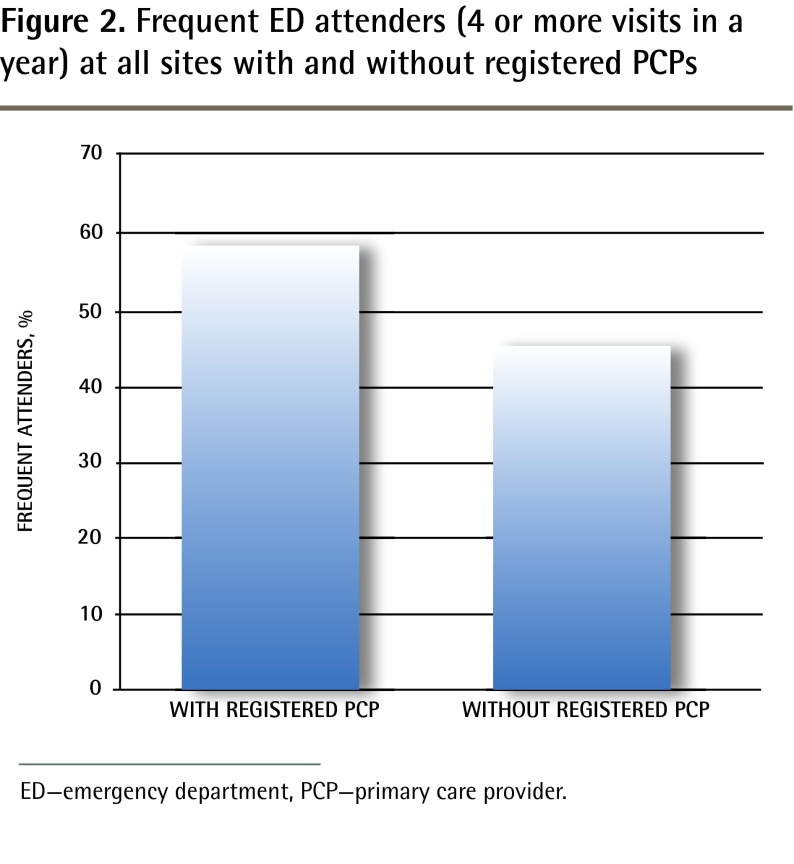
Results: In total, 48 505, 41 004, and 27 900 visits were made to the URH, UCC, and RCH, respectively, in 2009. The proportion of patients with listed primary care providers was 36.6% for the URH, 37.1% for the UCC, and 89.4% for the RCH. Among ED patients at all sites, frequent attenders (4 or more visits to an ED in 1 year) were significantly more likely (59.6% vs 45.1%, P < .001) to have listed primary care providers. Other factors that predicted frequent use included attendance at a rural ED, female sex, and older age.
Conclusion: This study characterizes attendance rates for 3 EDs in southern New Brunswick. Our findings highlight interesting differences between urban and rural ED populations, and suggest that frequent use of the ED might not be related to lack of a listed primary care provider.
Objectif: Vérifier si le fait d’avoir un fournisseur de soins de première ligne joue un rôle important pour déterminer la fréquence des visites à l’urgence.
Type d’étude: Analyse d’une base de données d’un réseau de santé électronique central.
Contexte: Trois départements d’urgence (DU) du sud du Nouveau-Brunswick.
Participants: On a tenu compte de toutes les visites effectuées au cours d’une année du calendrier au DU d’un hôpital régional urbain (HRU), d’un centre urbain de soins urgents (CSU) et d’un hôpital communautaire rural (HCR).
Principaux paramètres à l’étude: On a comparé les patients qui avaient accès à un fournisseur de soins de première ligne à ceux qui n’y avaient pas accès pour ce qui est du nombre de visites à des DU. Une analyse de régression multiple a servi à déterminer les facteurs prédictifs de visites nombreuses.
Résultats: En 2009, il y a eu 48 505, 41 004 et 27 900 visites, respectivement au HRU, au CSU et au HCR. La proportion des patients ayant accès à un fournisseur de soins de première ligne était de 36,6 % au HRU, de 37,1 % au CSU et de 89,4 % au HCR. Parmi les patients de tous ces établissements, les plus assidus (au moins 4 visites au DU dans l’année) étaient plus susceptibles d’avoir accès à un fournisseur de soins de première ligne (59,6 % vs 45,1 %, P < ,001). Parmi les autres facteurs prédictifs de visites fréquentes, mentionnons le fait de visiter un DU rural, d’être une femme et d’être plus âgé.
Conclusion: Cette étude étudiait les taux de visites à 3 urgences du sud du Nouveau-Brunswick. Les résultats révèlent d’intéressantes différences entre les populations des DU urbains et ruraux, et permettent de croire qu’il n’y a pas de relation entre l’utilisation fréquente des DU et le fait de ne pas avoir accès à un fournisseur de soins de première ligne.
Figures
References
-
- LaCalle E, Rabin E. Frequent users of the emergency departments: the myths, the data and the policy implications. Ann Emerg Med. 2010;56(1):42–8. - PubMed
-
- Ruger JP, Richter CJ, Spitznagel EL, Lewis LM. Analysis of costs, length of stay and utilization of emergency department services by frequent users: implications for health policy. Acad Emerg Med. 2004;11(12):1311–7. - PubMed
-
- Canadian Association of Emergency Physicians . The Canadian Association of Emergency Physicians’ submission to the Commission on the Future of Health Care in Canada: emergency department overcrowding. Ottawa, ON: Canadian Association of Emergency Physicians; 2010.
-
- Statistics Canada . Canadian Community Health Survey. Population with a regular medical doctor by sex, provinces and territories. Ottawa, ON: Statistics Canada; 2009. Available from: www40.statcan.gc.ca/l01/cst01/health76b-eng.htm. Accessed 2014 Mar 17.
-
- Sandoval E, Smith S, Walter J, Schuman SA, Olson MP, Striefler R, et al. A comparison of frequent and infrequent visitors to an urban emergency department. J Emerg Med. 2010;38(2):115–21. - PubMed
MeSH terms
LinkOut - more resources
Full Text Sources