. 2014 May 6;111(18):6642-7.
doi: 10.1073/pnas.1405181111. Epub 2014 Apr 14.

Transcription factors TFIIF and TFIIS promote transcript elongation by RNA polymerase II by synergistic and independent mechanisms

Affiliations

Transcription factors TFIIF and TFIIS promote transcript elongation by RNA polymerase II by synergistic and independent mechanisms

Volker Schweikhard et al. Proc Natl Acad Sci U S A. .

Abstract

Recent evidence suggests that transcript elongation by RNA polymerase II (RNAPII) is regulated by mechanical cues affecting the entry into, and exit from, transcriptionally inactive states, including pausing and arrest. We present a single-molecule optical-trapping study of the interactions of RNAPII with transcription elongation factors TFIIS and TFIIF, which affect these processes. By monitoring the response of elongation complexes containing RNAPII and combinations of TFIIF and TFIIS to controlled mechanical loads, we find that both transcription factors are independently capable of restoring arrested RNAPII to productive elongation. TFIIS, in addition to its established role in promoting transcript cleavage, is found to relieve arrest by a second, cleavage-independent mechanism. TFIIF synergistically enhances some, but not all, of the activities of TFIIS. These studies also uncovered unexpected insights into the mechanisms underlying transient pauses. The direct visualization of pauses at near-base-pair resolution, together with the load dependence of the pause-entry phase, suggests that two distinct mechanisms may be at play: backtracking under forces that hinder transcription and a backtrack-independent activity under assisting loads. The measured pause lifetime distributions are inconsistent with prevailing views of backtracking as a purely diffusive process, suggesting instead that the extent of backtracking may be modulated by mechanisms intrinsic to RNAPII. Pauses triggered by inosine triphosphate misincorporation led to backtracking, even under assisting loads, and their lifetimes were reduced by TFIIS, particularly when aided by TFIIF. Overall, these experiments provide additional insights into how obstacles to transcription may be overcome by the concerted actions of multiple accessory factors.

Keywords: Pol II; optical trap; optical tweezers.


Conflict of interest statement

The authors declare no conflict of interest.

Figures

Fig. 1.
Fig. 1.
TFIIS and TFIIF reactivate arrested RNAPII by distinct mechanisms. (A) Experimental geometry for the optical-trapping assay. (B) A representative single-molecule record of RNAPII elongation (displacement converted to bp; left vertical axis) against opposing load (trace is color-coded according to the force). Force was increased stepwise every ∼200 bp (gray trace; right vertical axis). A large backtrack (blue arrow) led to force-induced arrest; after ∼300 s, force was lowered to −2 pN to test for transcription restart. (C) Representative elongation records, color-coded as in B, with transcription factors as follows. (i) RNAPII + 1 µM WT TFIIS. (ii) RNAPII⋅TFIIF. (iii) RNAPII⋅TFIIF + 1 µM WT TFIIS. In backtrack-and-rescue events (red and green double arrows), RNAPII recovered from a large backtrack and resumed elongation under high load. In low-force restart events (black arrows), elongation only resumed once the force was lowered. (D) Probability of low-force restart. (E) Average number of backtrack-and-rescue events per molecule for the factor combinations indicated. Error bars are SE.
Fig. 2.
Fig. 2.
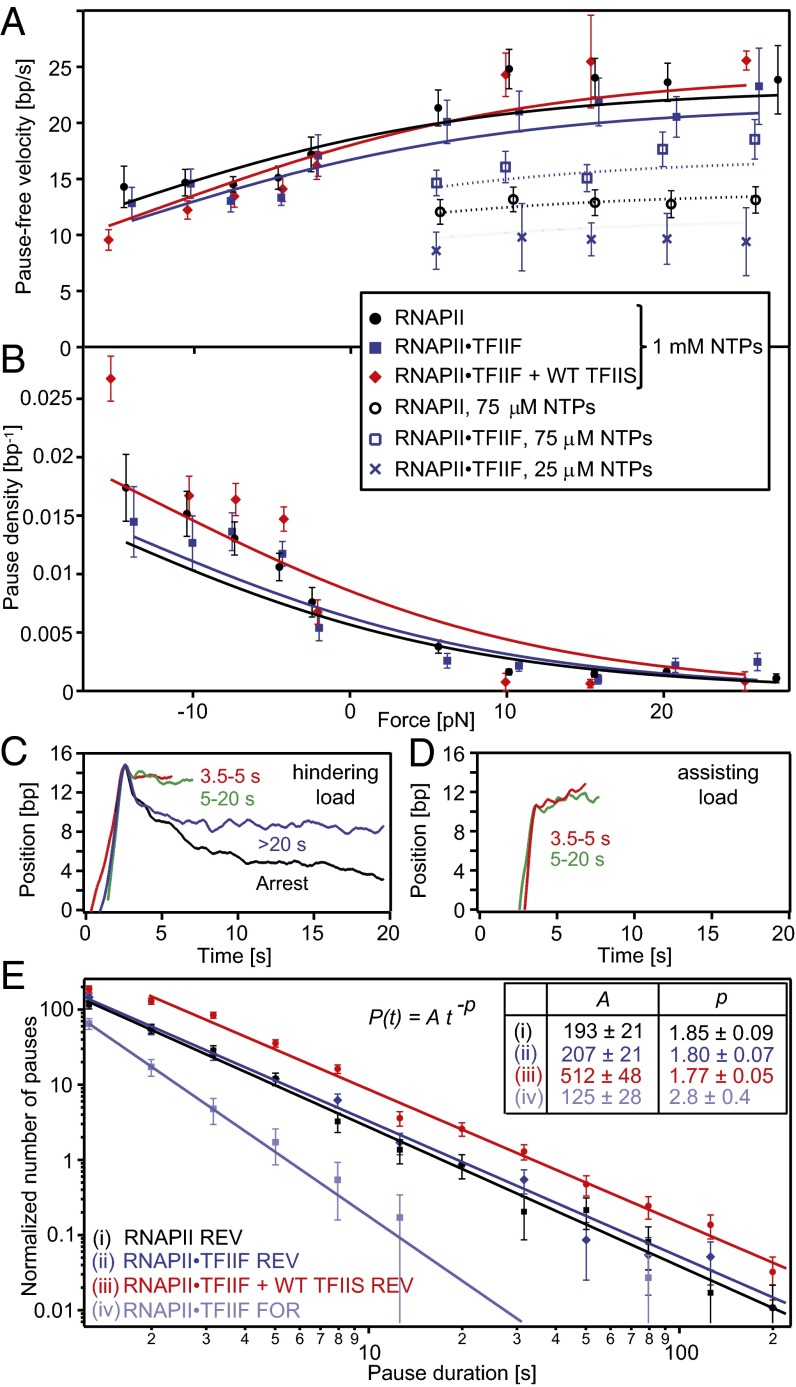
Influence of TFIIS and TFIIF on transcription speeds and pausing. (A) The pause-free elongation velocity at saturating (filled symbols) and subsaturating (open symbols and crosses) NTP concentrations. (B) Pause density (pauses per bp transcribed) under assisting (+) and hindering (−) loads. (C and D) Averaged position records during pause entry for RNAPII and RNAPII⋅TFIIF. (C) Under hindering loads, short (<20 s) pauses exhibited small backtracks (∼1–2 bp); long pauses (≥20 s) and arrests were backtracked by ∼6 and ∼10 bp on average, respectively. (D) Pauses under assisting loads were not backtracked and exhibited slow forward creep. (E) Distributions of pause lifetimes under assisting (FOR) and hindering (REV) loads were approximated by distinct power laws (fit parameters for amplitude, A, and exponent, p, with SE). The distribution was normalized as described in Materials and Methods. Numbers of pauses scored were as follows: RNAPII⋅TFIIF FOR, 248; RNAPII⋅TFIIF REV, 278; RNAPII REV, 266; RNAPII⋅TFIIF + TFIIS REV, 638. Fits were restricted to ranges of duration with six or more pauses per bin as follows: RNAPII⋅TFIIF FOR, 1–3.5 s; RNAPII⋅TFIIF REV, 1–35 s; RNAPII REV, 1–25 s; RNAPII⋅TFIIF + TFIIS REV, 1–55 s. Error bars are SE.
Fig. 3.
Fig. 3.
Effects of TFIIS and TFIIF under assisting load and conditions favoring misincorporation, induced by ITP. (A) ITP (0.4 mM; other NTPs at 1 mM) increased both the average density and duration of pauses but left pause-free velocities nearly unchanged. In the presence of ITP, TFIIS restored both mean pause density and duration for RNAPII⋅TFIIF to normal levels, while reducing the pause duration for RNAPII (alone) only slightly. (B) ITP did not significantly affect the power-law exponent in fits to pause lifetime distributions (shown for RNAPII⋅TFIIF); TFIIS restored the original pause distribution. The number of pauses was normalized as in Fig. 2E. Numbers of pauses scored were as follows: RNAPII⋅TFIIF FOR, 248 (same data as Fig. 2E; shown for comparison); RNAPII⋅TFIIF FOR + ITP, 243; RNAPII⋅TFIIF FOR + ITP + WT TFIIS, 54. Fit domains were as follows: RNAPII⋅TFIIF FOR, 1–3.5 s; RNAPII⋅TFIIF FOR + ITP, 1–8.5 s; RNAPII⋅TFIIF FOR + ITP + WT TFIIS, 1–3.5 s; Error bars are SE.

References

    1. Sikorski TW, Buratowski S. The basal initiation machinery: Beyond the general transcription factors. Curr Opin Cell Biol. 2009;21(3):344–351. - PMC - PubMed
    1. Venters BJ, Pugh BF. How eukaryotic genes are transcribed. Crit Rev Biochem Mol Biol. 2009;44(2-3):117–141. - PMC - PubMed
    1. Selth LA, Sigurdsson S, Svejstrup JQ. Transcript elongation by RNA polymerase II. Annu Rev Biochem. 2010;79:271–293. - PubMed
    1. Zhou J, Schweikhard V, Block SM. Single-molecule studies of RNAPII elongation. Biochim Biophys Acta. 2013;1829(1):29–38. - PMC - PubMed
    1. Abbondanzieri EA, Greenleaf WJ, Shaevitz JW, Landick R, Block SM. Direct observation of base-pair stepping by RNA polymerase. Nature. 2005;438(7067):460–465. - PMC - PubMed

Publication types

MeSH terms

LinkOut - more resources