Review
. 2014 Mar 28:5:125.
doi: 10.3389/fimmu.2014.00125. eCollection 2014.

Innate and adaptive immune interactions at the fetal-maternal interface in healthy human pregnancy and pre-eclampsia

Affiliations
Review

Innate and adaptive immune interactions at the fetal-maternal interface in healthy human pregnancy and pre-eclampsia

Peter Hsu et al. Front Immunol. .

Abstract

Maternal immune tolerance of the fetus is indispensable for a healthy pregnancy outcome. Nowhere is this immune tolerance more important than at the fetal-maternal interface - the decidua, the site of implantation, and placentation. Indeed, many lines of evidence suggest an immunological origin to the common pregnancy-related disorder, pre-eclampsia. Within the innate immune system, decidual NK cells and antigen presenting cells (including dendritic cells and macrophages) make up a large proportion of the decidual leukocyte population, and are thought to modulate vascular remodeling and trophoblast invasion. On the other hand, within the adaptive immune system, Foxp3(+) regulatory T cells are crucial for ensuring immune tolerance toward the semi-allogeneic fetus. Additionally, another population of CD4(+)HLA-G(+) suppressor T cells has also been identified as a potential player in the maintenance of immune tolerance. More recently, studies are beginning to unravel the potential interactions between the innate and the adaptive immune system within the decidua, that are required to maintain a healthy pregnancy. In this review, we discuss the recent advances exploring the complex crosstalk between the innate and the adaptive immune system during human pregnancy.

Keywords: CD4+HLA-G+; NK cells; T regulatory cells; decidual; dendritic cells; pre-eclampsia; pregnancy.


Figures
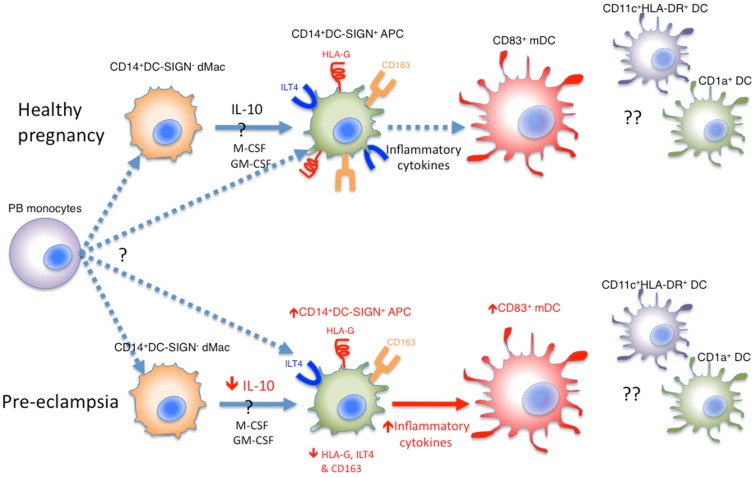
Figure 1
Figure 1
Various APCs in the human decidua. Whether decidual CD14+DC-SIGN dMacs and CD14+DC-SIGN+ APCs are derived independently from peripheral blood (PB) monocytes is unknown. Alternatively, CD14+DC-SIGN dMacs may be on a continuum of DC differentiation, where local IL-10, M-CSF, and GM-CSF drive their development into CD14+DC-SIGN+ APCs expressing HLA-G and ILT4. These APCs may be matured into CD83+ mature DCs (mDCs) under the influence of inflammatory cytokines, which in healthy pregnancy is minimal. In pre-eclampsia, both CD14+DC-SIGN+ APCs and mDCs increase, probably driven by increased inflammatory cytokines in this disease. This is coupled with reduced HLA-G and ILT4 expression by CD14+DC-SIGN+ APCs, likely due to reduced local IL-10 levels. Whilst CD11c+HLA-DR+ and CD1a+ DCs have been identified in human decidua, their roles and relationship with CD83+ DCs are unclear.
Figure 2
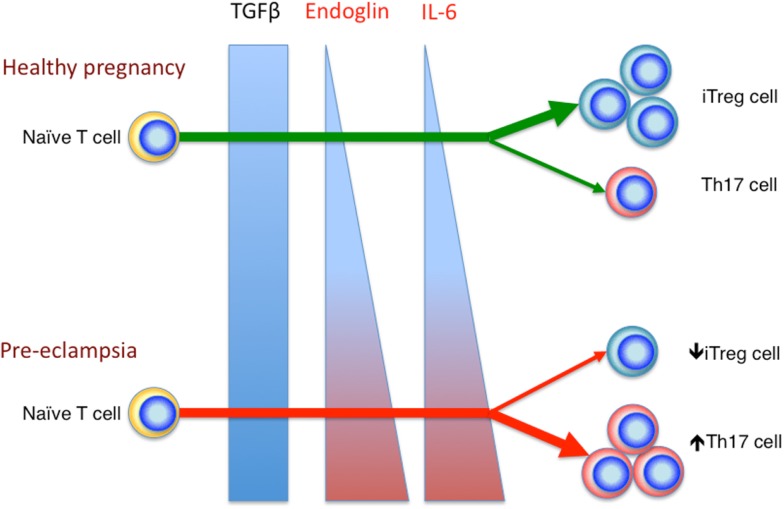
Figure 2
Reciprocal development of iTreg and Th17 cells in healthy pregnancy and pre-eclampsia. In the relative absence of IL-6 and endoglin, TGFβ signaling enhances iTreg, but not Th17 cell differentiation in healthy pregnancy. In pre-eclampsia, the elevated level of endoglin could reduce TGFβ signaling, which in combination with the increased IL-6 level, would deter iTreg cell induction, but drive Th17 differentiation.
Figure 3
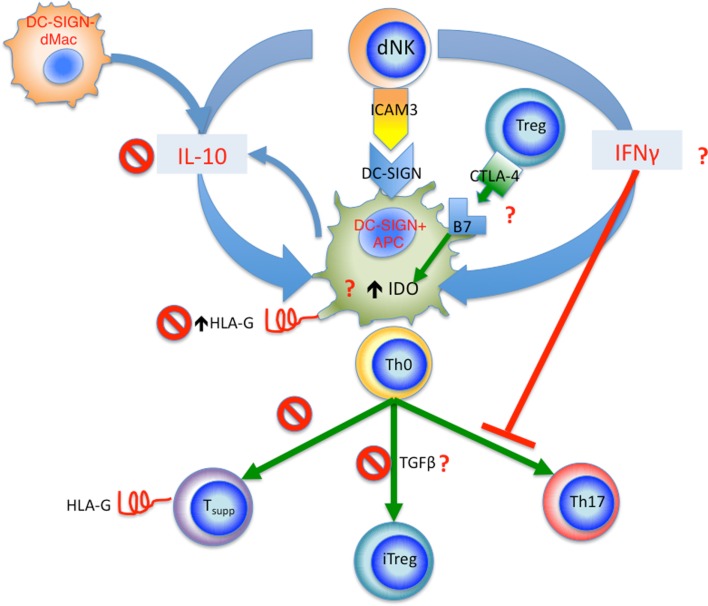
Figure 3
Summary of proposed innate and adaptive interactions in human pregnancy. Decidual DC-SIGN+ APCs appear to be a central player in these interactions. dNK cells interact with DC-SIGN+ APCs via ICAM3, this leads to release of IFNγ, which in turn upregulates IDO in DC-SIGN+ APCs, as well as inhibiting Th17 cell differentiation. The tolerogenic DC-SIGN+ APCs function to induce iTreg cells from naïve CD4+ T cells (Th0), Treg cells in turn regulated DC-SIGN+ APCs via CTLA-4 and B7 (CD80 and CD86) interaction, further increasing IDO expression. IL-10 from dNK cells and DC-SIGN dMacs acts to upregulate HLA-G expression by DC-SIGN+ APCs; the HLA-G is then passed onto activated T cells via trogocytosis, resulting in accumulation of CD4+HLA-G+ T suppressor cells. In pre-eclampsia, several check points are affected as marked by the “No symbol.” These include reduced IL-10 level, reduced HLA-G expression by DC-SIGN+ APCs, reduced generation of CD4+HLA-G+ T suppressor cells, and reduced iTreg cell induction. Other yet unknown mechanisms may also be affected in pre-eclampsia marked by the red question mark, including IFNγ production by dNKs, CTLA-4 expression by Treg cells and interaction with B7 molecules, as well as IDO expression and TGFβ production by DC-SIGN+ APCs.

References

    1. Medawar PB. Some immunological and endocrinological problems raised by evolution of viviparity in vertebrates. Symp Soc Exp Biol (1953) 7:320–8
    1. Apps R, Murphy SP, Fernando R, Gardner L, Ahad T, Moffett A. Human leucocyte antigen (HLA) expression of primary trophoblast cells and placental cell lines, determined using single antigen beads to characterize allotype specificities of anti-HLA antibodies. Immunology (2009) 127(1):26–39 10.1111/j.1365-2567.2008.03019.x - DOI - PMC - PubMed
    1. Nelson JL. Microchimerism: incidental byproduct of pregnancy or active participant in human health? Trends Mol Med (2002) 8(3):109–13 10.1016/S1471-4914(01)02269-9 - DOI - PubMed
    1. Nelson JL. Microchimerism in human health and disease. Autoimmunity (2003) 36(1):5–9 10.1080/0891693031000067304 - DOI - PubMed
    1. Morin-Papunen L, Tiilikainen A, Hartikainen-Sorri AL. Maternal HLA immunization during pregnancy: presence of anti HLA antibodies in half of multigravidous women. Med Biol (1984) 62(6):323–5 - PubMed