


Prevalence of psychological disorders in patients with alopecia areata in comparison with normal subjects
- PMID: 24734190
- PMCID: PMC3966411
- DOI: 10.1155/2014/304370
Prevalence of psychological disorders in patients with alopecia areata in comparison with normal subjects
Abstract
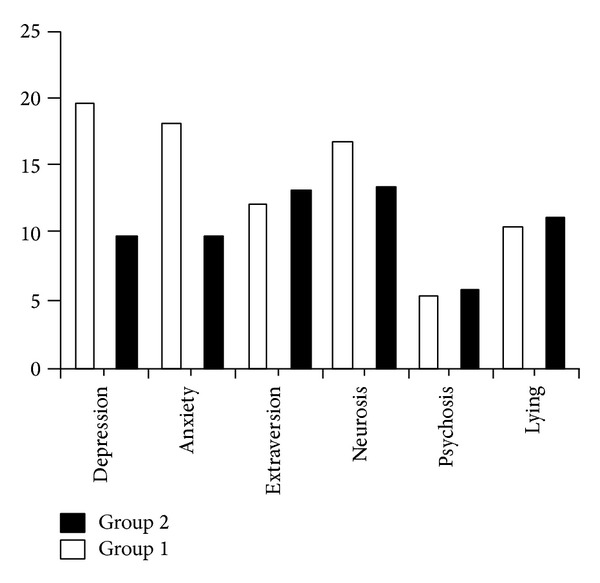
Alopecia areata is a chronic disease with a great impact on the patient's quality of life. In this study we reviewed the frequency of psychological disorders in patients with alopecia areata in comparison to a control group. We enrolled 40 patients with alopecia areata and a 40-volunteer random age-sex matched control group. The study is based on anxiety and Beck Depression Inventory (BDI) and the Eysenck Personality Questionnaire (EPQ). Analytical evaluation was done by Mann-Whitney, Kruskal Wallis, and t-tests. There was a significant difference between the case and control group regarding the prevalence of depression (P value = 0.008), anxiety (P value = 0.003), and neuroticism (P value = 0.05). There was no significant differences regarding extraversion (P value = 0.249), psychosis (P value = 0.147), and lying (P value = 0.899) between the two groups. In alopecia areata involving the head, there was a significant relation only between neuroticism (P value = 0.045) and lying (P value = 0.005). The facial involvement had a significant relation with depression (P value = 0.020), anxiety (P value = 0.019), and neuroticism (P value = 0.029). The frequency of psychological disorders in the case group is significantly greater than the control group.
Figures
References
-
- Kaplan HI. History of psychometric medicine. In: Sadock BJ, Sadock VA, editors. Kaplan & Sadock Comprehensive Textbook of Psychiatry. 8th edition. Vol. 24. Baltimore Williams & Williams; 2005. p. p. 2105.
-
- Lesley M. Psychocutaneous disorders. In: Sadock BJ, Sadock VA, editors. Kaplan & Sadock Comprehensive Text Book of Psychiatry. 8th edition. Vol. 24. Baltimore Williams & Williams; 2005. p. p. 2166.
-
- Domonkos AN. Andrews Disease of the Skin. 6th edition. Vol. 28. Lippincott Williams & Wilkins; 2007. Pruritus, cutaneous neuroses and neuro-cutaneous dermatoses; pp. 813–828.
-
- Koblenser CS. Psychosomatic concepts in dermatology. Archives of Dermatology. 1983;119(6):501–512. - PubMed
-
- Habif TP. Clinical Dermatology. Mosby; 2001.
LinkOut - more resources
Full Text Sources
Other Literature Sources
