. 2015 Feb 20;4(2):141-9.
doi: 10.1021/sb400162z. Epub 2014 Apr 28.

Trade-offs in engineering sugar utilization pathways for titratable control

Affiliations

Trade-offs in engineering sugar utilization pathways for titratable control

Taliman Afroz et al. ACS Synth Biol. .

Abstract

Titratable systems are common tools in metabolic engineering to tune the levels of enzymes and cellular components as part of pathway optimization. For nonmodel microorganisms with limited genetic tools, inducible sugar utilization pathways offer built-in titratable systems. However, these pathways can exhibit undesirable single-cell behaviors that hamper the uniform and tunable control of gene expression. Here, we applied mathematical modeling and single-cell measurements of L-arabinose utilization in Escherichia coli to systematically explore how sugar utilization pathways can be altered to achieve desirable inducible properties. We found that different pathway alterations, such as the removal of catabolism, constitutive expression of high-affinity or low-affinity transporters, or further deletion of the other transporters, came with trade-offs specific to each alteration. For instance, sugar catabolism improved the uniformity and linearity of the response at the cost of requiring higher sugar concentrations to induce the pathway. Within these alterations, we also found that a uniform and linear response could be achieved with a single alteration: constitutively expressing the high-affinity transporter. Equivalent modifications to the D-xylose utilization pathway yielded similar responses, demonstrating the applicability of our observations. Overall, our findings indicate that there is no ideal set of typical alterations when co-opting natural utilization pathways for titratable control and suggest design rules for manipulating these pathways to advance basic genetic studies and the metabolic engineering of microorganisms for optimized chemical production.

Keywords: Escherichia coli; carbon catabolism; feedback; inducible systems; linearization; systems biology.


Figures
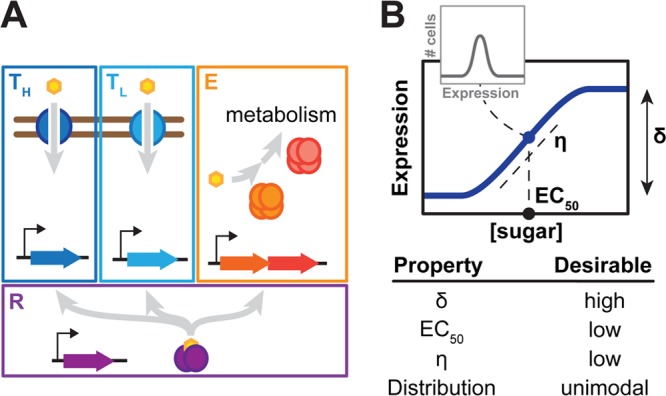
Figure 1
Figure 1
Co-opting sugar utilization pathways for titratable control of gene expression. (A) Components of inducible sugar utilization pathways. High affinity (TH) and low-affinity (TL) transporters import the sugar into the cell, while catabolic enzymes (E) shunt the sugar into central metabolism. Transcription regulators (R) up-regulate the expression of the transporters and the enzymes, but only in the presence of the sugar. (B) Desirable properties for a titratable response. These properties include a uniform response at all inducer concentrations, a large dynamic range (high δ), low inducer concentrations to induce the pathway (low EC50), and strong linearity (low η).
Figure 2
Figure 2
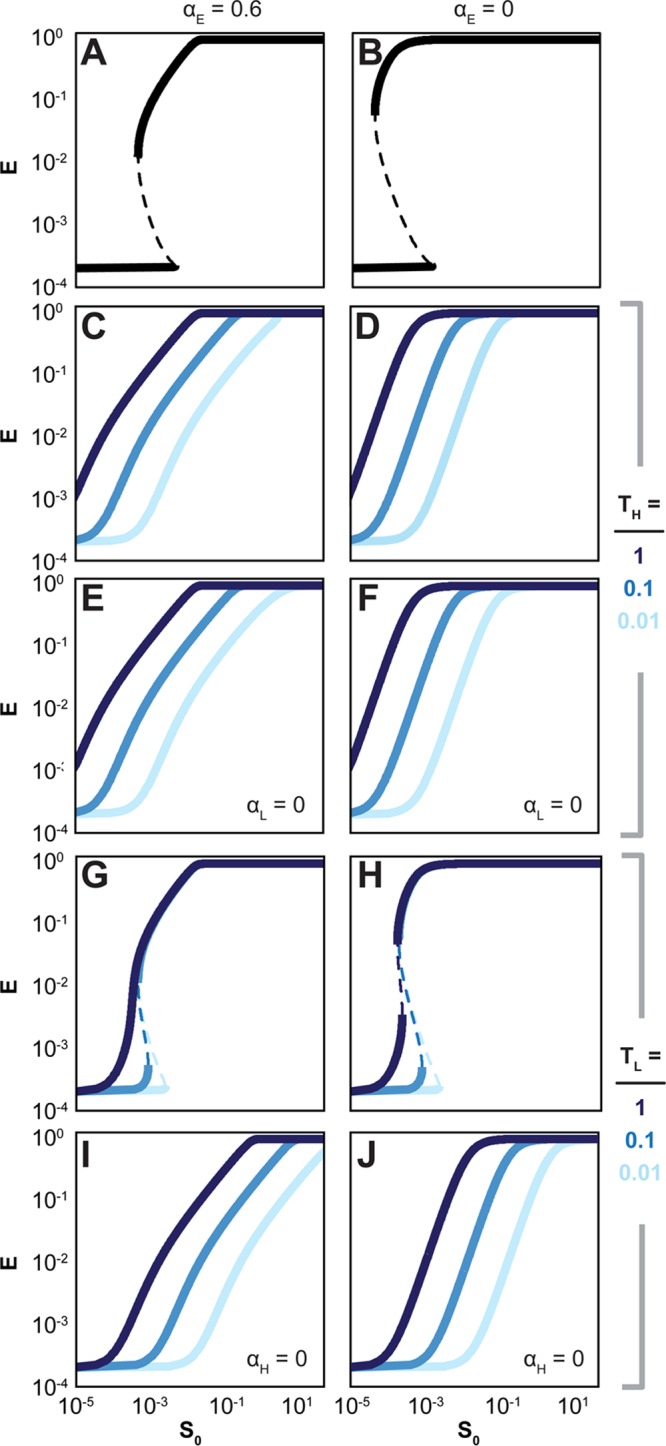
Simple mathematical model predicts trade-offs when altering the pathway structure. (A) The model assumes a base pathway comprising a high-affinity/low-capacity transporter (TH) and a low-affinity/high-capacity transporter (TL) that import extracellular sugar (S0) into the cell, a catabolic enzyme (E) that degrades the sugar, and a constitutively expressed regulator that upregulates the expression of the transporters and the enzymes when bound to the sugar. The steady-state expression levels of the enzyme are reported as a function of extracellular sugar concentration. Note that all variables were nondimensionalized as part of the model derivation. Dashed lines indicate bifurcation regions. To alter the pathway, TH was constitutively expressed (C,D) and the activity of TL was further eliminated (E,F), TL was constitutively expressed (G,H) and the activity of TH was further eliminated (I,J), and the activity of the catabolic enzymes was eliminated (B,D,F,H,J). Three strengths of constitutive expression were selected for TH and TL (low, light blue; medium, blue; high, dark blue). See Supporting Information (SI) for more details.
Figure 3
Figure 3
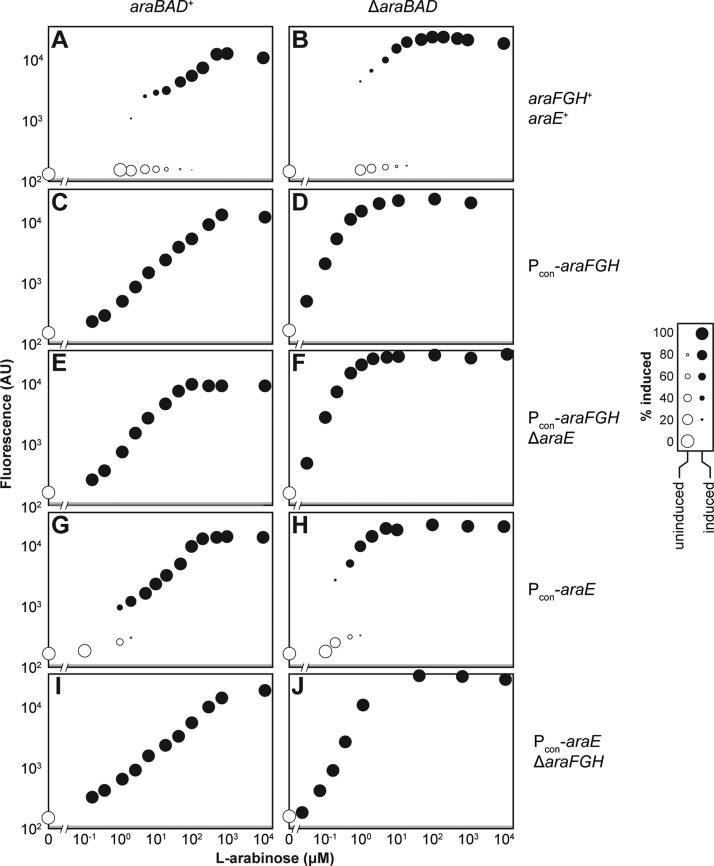
Probing alterations to the l-arabinose utilization pathway in E. coli. The wild type pathway (A) was subjected to different alterations: araFGH was constitutively expressed (Pcon-araFGH) (C,D) and araE was further deleted (ΔaraE) (E,F), araE was constitutively expressed (Pcon-araE) (G,H) and araFGH was further deleted (ΔaraFGH) (I,J), and araBAD was deleted (ΔaraBAD) (B,D,F,H,J). Each designated strain was back-diluted into M9 minimal medium supplemented with the indicated concentration of l-arabinose and grown for 6 h to ABS600 ∼ 0.4 prior to flow cytometry analysis. For unimodal distributions, the resulting mean fluorescence is plotted. For bimodal distributions, two dots are plotted to represent the mean fluorescence and the relative number of cells in the induced (black) and uninduced (white) subpopulations (see SI Figure S2 for more details on the flow cytometry analysis). The diameter of each dot is directly proportional to the fraction of cells in that subpopulation. Gray boxes indicate the limit of detection due to autofluorescence. Each dot plot is representative of at least three independent experiments conducted on separate days. See Table 1 for the response metrics that account for the replicate experiments.
Figure 4
Figure 4
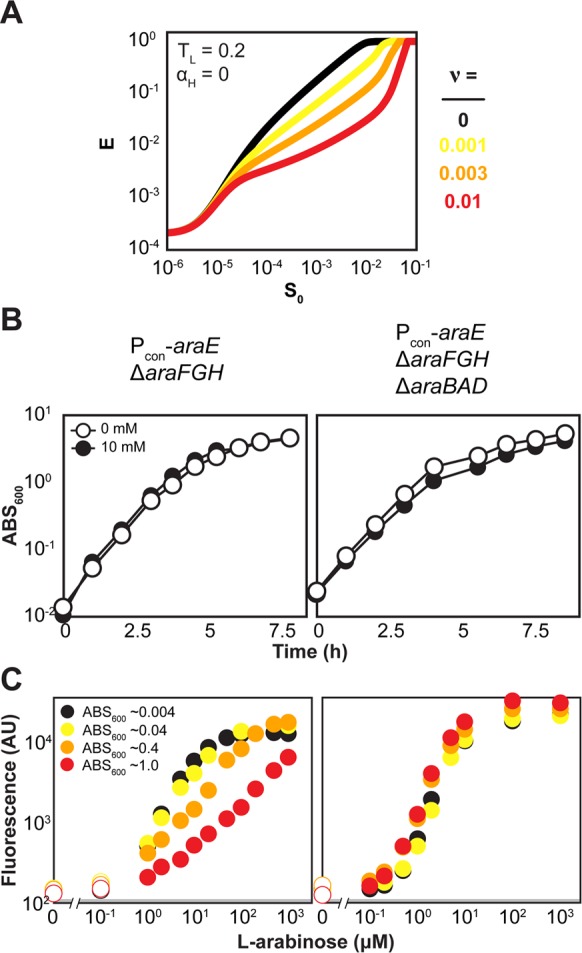
Effect of cell density in the presence or absence of sugar catabolism. (A) Model predictions for the pathway with a constitutively expressed low-affinity transporter (TL = 0.2) and the deleted high-affinity transporter (αH = 0) when accounting for depletion of extracellular sugar through catabolism. Each simulation was conducted to τ = 10. The different curves reflect the relative volume of the cells to the medium (ν). Note that all variables were nondimensionalized as part of the model derivation. See Supporting Information for more details. (B) Growth curves for the Pcon-araE ΔaraFGH strain with or without (ΔaraBAD) sugar catabolism in defined medium with or without 10 mM l-arabinose. Each value represents the mean of three independent experiments. The SEM for each measurement was smaller than the symbol. (C) Representative dot plots for both strains in log phase grown to the indicated final cell densities. See Figure 3 for more information on the dot plots. Each dot plot is representative of at least three experiments conducted from independent colonies. See Table 1 for the response metrics that account for the replicate experiments.
Figure 5
Figure 5
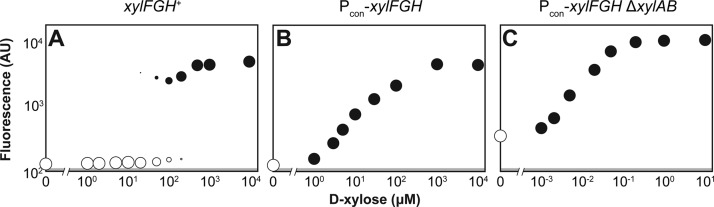
Linearizing the response to d-xylose. The wild type E. coli strain (A), the strain constitutively expressing the high-affinity transporter xylFGH (B), and the strain constitutively expressing the high-affinity transporter xylFGH and lacking the catabolic operon xylAB (C) each harbored the reporter plasmid pUA66-pxylA. The designated strain was back-diluted into M9 minimal medium supplemented with the indicated concentration of d-xylose and grown for 6 h to ABS600 ∼ 0.4 prior to flow cytometry analysis. See Figure 3 for more information on the dot plots. Each dot plot is representative of at least three experiments conducted from independent colonies.

References

    1. Temme K.; Zhao D.; Voigt C. A. (2012) Refactoring the nitrogen fixation gene cluster from Klebsiella oxytoca. Proc. Natl. Acad. Sci. U.S.A. 109, 7085–7090. - PMC - PubMed
    1. Guzman L. M.; Belin D.; Carson M. J.; Beckwith J. (1995) Tight regulation, modulation, and high-level expression by vectors containing the arabinose PBAD promoter. J. Bacteriol. 177, 4121–4130. - PMC - PubMed
    1. De Boer H. A.; Comstock L. J.; Vasser M. (1983) The tac promoter: A functional hybrid derived from the trp and lac promoters. Proc. Natl. Acad. Sci. U.S.A. 80, 21–25. - PMC - PubMed
    1. Weber W.; Stelling J.; Rimann M.; Keller B.; Daoud-El Baba M.; Weber C. C.; Aubel D.; Fussenegger M. (2007) A synthetic time-delay circuit in mammalian cells and mice. Proc. Natl. Acad. Sci. U.S.A. 104, 2643–2648. - PMC - PubMed
    1. Hawkins K. M.; Smolke C. D. (2006) The regulatory roles of the galactose permease and kinase in the induction response of the GAL network in Saccharomyces cerevisiae. J. Biol. Chem. 281, 13485–13492. - PubMed

Publication types

MeSH terms