. 2014 Jun 1;306(11):E1257-63.
doi: 10.1152/ajpendo.00599.2013. Epub 2014 Apr 15.

Neuronostatin inhibits glucose-stimulated insulin secretion via direct action on the pancreatic α-cell

Affiliations

Neuronostatin inhibits glucose-stimulated insulin secretion via direct action on the pancreatic α-cell

Alison S Salvatori et al. Am J Physiol Endocrinol Metab. .

Abstract

Neuronostatin is a recently described peptide hormone encoded by the somatostatin gene. We previously showed that intraperitoneal injection of neuronostatin into mice resulted in c-Jun accumulation in pancreatic islets in a pattern consistent with the activation of glucagon-producing α-cells. We therefore hypothesized that neuronostatin could influence glucose homeostasis via a direct effect on the α-cell. Neuronostatin enhanced low-glucose-induced glucagon release in isolated rat islets and in the immortalized α-cell line αTC1-9. Furthermore, incubation with neuronostatin led to an increase in transcription of glucagon mRNA, as determined by RT-PCR. Neuronostatin also inhibited glucose-stimulated insulin secretion from isolated islets. However, neuronostatin did not alter insulin release from the β-cell line INS 832/13, indicating that the effect of neuronostatin on insulin secretion may be secondary to a direct action on the α-cell. In agreement with our in vitro data, intra-arterial infusion of neuronostatin in male rats delayed glucose disposal and inhibited insulin release during a glucose challenge. These studies suggest that neuronostatin participates in maintaining glucose homeostasis through cell-cell interactions between α-cells and β-cells in the endocrine pancreas, leading to attenuation in insulin secretion.

Keywords: glucagon; glucose homeostasis; islet function; neuronostatin.


Figures

Fig. 1.
Fig. 1.
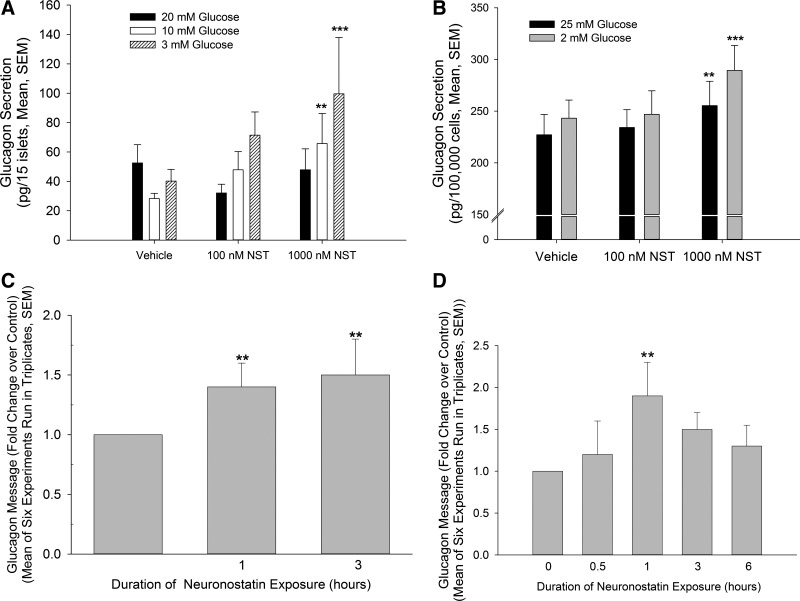
Neuronostatin (NST) enhances low-glucose-induced glucagon secretion and enhances glucagon expression. A: isolated rat islets (15 islets/200 μl KRB) were incubated for 30 min in KRB containing 20 mM glucose in the presence or absence of NST. Low-glucose-induced glucagon secretion was initiated by changing the incubation medium to KRB containing 20, 10, or 3 mM glucose ± NST. NST significantly enhanced low glucose-stimulated glucagon release. B: immortalized α-cell line, αTC1-9, was incubated in KRB containing 25 mM glucose ± NST. Following 1-h equilibration, glucagon secretion was initiated by switching the medium to KRB containing 25 or 2 mM glucose ± indicated peptides, and cells were incubated for 2 h. As with isolated whole islets, NST significantly enhanced glucagon secretion. To assess the effect of NST on glucagon mRNA expression, islets (C) or αTC1-9 cells (D) were treated with 100 nM NST for indicated times. Real-time PCR was performed and glucagon message normalized to the internal control GAPDH (C) or actin (D) and presented as fold increase over untreated controls. Statistical significance: **P < 0.01, ***P < 0.001 vs. no peptide control. No significant within-group differences were observed by 2-way ANOVA with Bonferroni post hoc analysis.
Fig. 2.
Fig. 2.
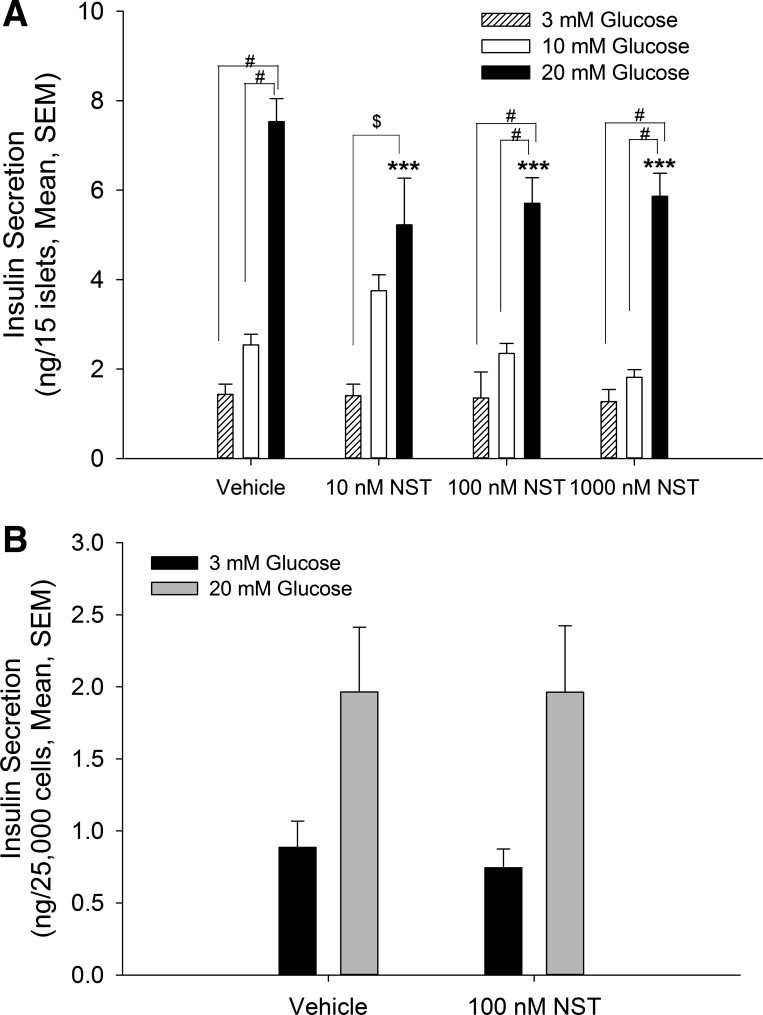
NST attenuates glucose-stimulated insulin secretion in rat islets but not in INS 832/13 cells. A: isolated rat islets (15 islets/200 μl KRB) were incubated for 30 min in KRB containing 3 mM glucose in the presence or absence of indicated peptides. Glucose-induced insulin secretion was initiated by changing the incubation medium to KRB containing 3, 10, or 20 mM glucose ± NST. Incubation with 10, 100, or 1,000 nM NST significantly inhibited glucose-stimulated insulin secretion. B: INS 832/13 cells were incubated with KRB containing 3 mM glucose ± NST. Following 1-h equilibration, glucose-induced insulin secretion was initiated by removing the incubation medium and replacing it with KRB containing 3 or 20 mM glucose ± NST. NST failed to alter glucose-stimulated insulin release in INS 832/13 cells. ***P < 0.001 vs. no peptide control; $P < 0.01; #P < 0.001 vs. indicated treatment groups as determined by 2 -way ANOVA with Bonferroni post hoc analysis.
Fig. 3.
Fig. 3.
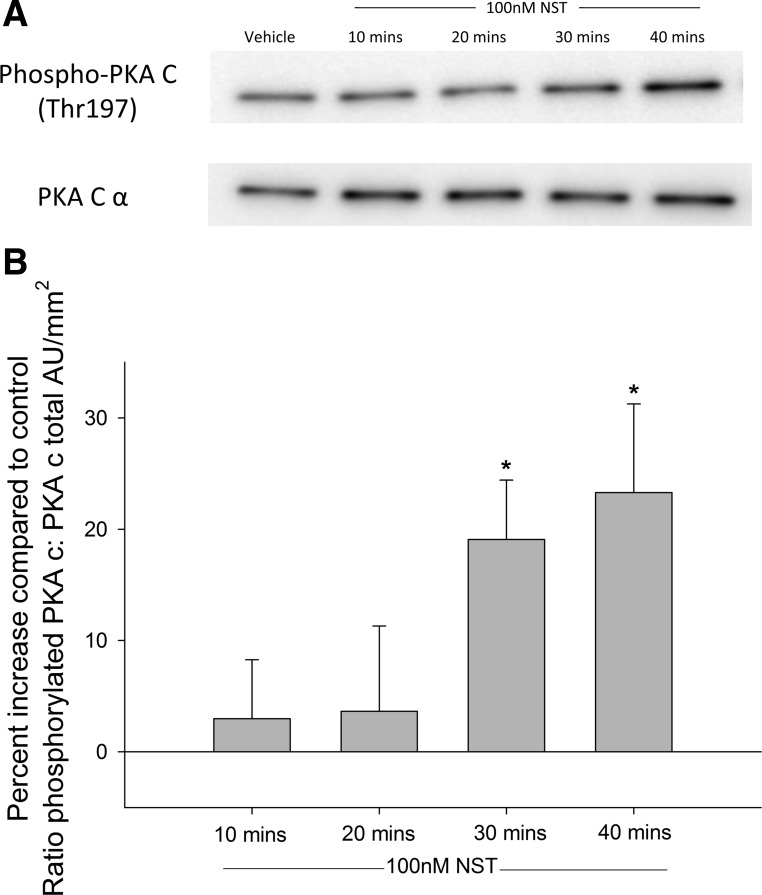
NST activates PKA in αTC1-9 cells. αTC1-9 cells were serum starved overnight in 1 mM glucose and treated with 100 nM NST for indicated times. Cells were lysed and analyzed by Western blot using phosphospecific or total antibodies. A: treatment with NST for 30 or 40 min increased phosphorylated PKA, whereas total PKA levels were unaffected. B: quantification of band density. *P < 0.05 vs. no peptide control. Results are representative of the average ± SE of 3 independent experiments.
Fig. 4.
Fig. 4.
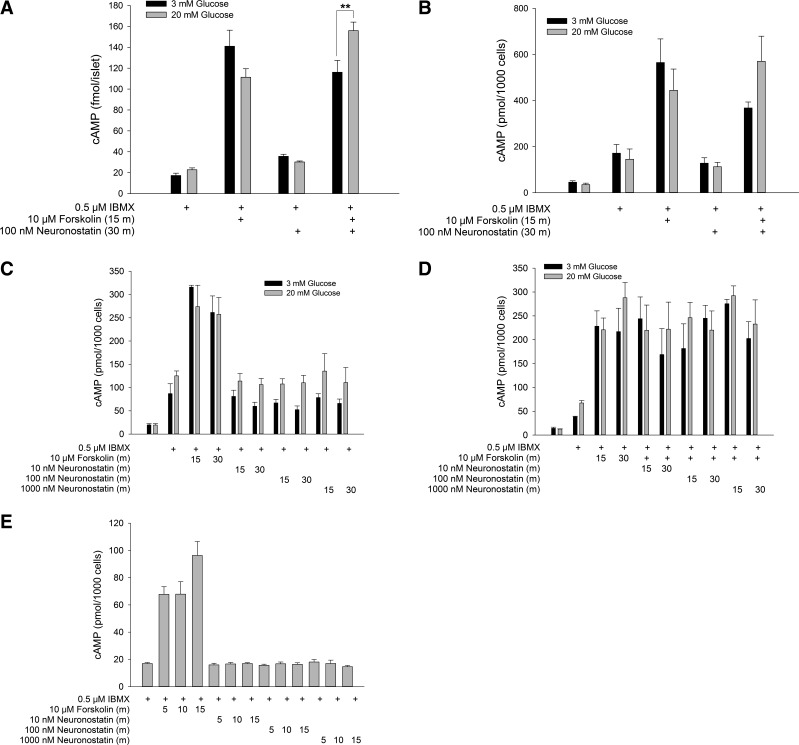
NST fails to modulate cAMP levels. Rat islets (A), INS 832/13 (B), or Min6 (C and D) cells were preincubated in KRB containing 3 mM glucose for 30 min in the presence or absence of IBMX, as indicated. Preincubation buffer was removed and replaced with KRB containing 3 mM glucose (open bars) or 20 mM glucose (filled bars) and treated as indicated. In conditions where cells were treated with both forskolin and NST, NST was included in the preincubation and stimulatory buffers. Alternatively, αTC1-9 cells were plated in complete medium and treated as indicated (E). Following treatment, all cells were lysed in 100% ethanol and samples dried by rotary evaporator. cAMP levels were determined by RIA. Data are represented as means ± SE of ≥3 experiments performed in duplicate (B–E) or of one experiment performed in quadruplicate (A). **P < 0.01 vs. indicated treatment groups as determined by 2-way ANOVA with Bonferroni post hoc analysis.
Fig. 5.
Fig. 5.
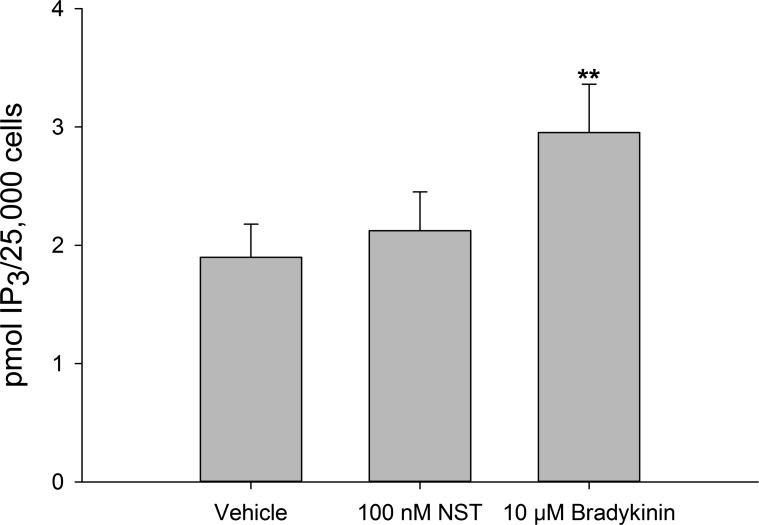
NST fails to modulate IP3 levels. αTC1-9 cells were preincubated for 30 min in KRB. Cells were treated with NST or bradykinin and lysed in ice cold 100% EtOH. IP3 was measured by RIA. NST failed to alter IP3 levels after 1 min of exposure. **P < 0.01 vs. untreated control.
Fig. 6.
Fig. 6.
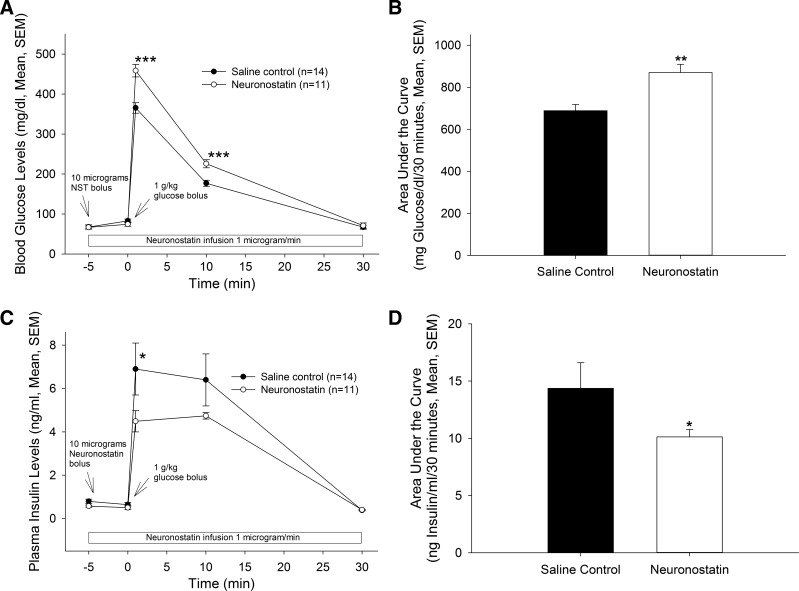
Intra-arterial infusion of NST delays glucose disposal and attenuates insulin release during a glucose challenge in conscious, unrestrained rats. Rats bearing carotid and jugular cannulae received a bolus of saline vehicle or 10 μg of NST via carotid catheter followed by infusion of saline or NST (1 μg/min). At 1, 10, and 30 min following a bolus of glucose (1 g/kg body wt ip), blood was drawn via jugular catheter for measurement of blood glucose and insulin levels. NST significantly delayed the clearance of glucose (A and B) and inhibited insulin release (C and D). *P < 0.05, **P < 0.01 vs. saline-treated control animals.

References

    1. Brazeau P, Vale W, Burgus R, Ling N, Butcher M, Rivier J, Guillemin R. Hypothalamic polypeptide that inhibits the secretion of immunoreactive pituitary growth hormone. Science 179: 77–79, 1973 - PubMed
    1. Chambers KT, Unverferth JA, Weber SM, Wek RC, Urano F, Corbett JA. The role of nitric oxide and the unfolded protein response in cytokine-induced beta-cell death. Diabetes 57: 124–132, 2008 - PubMed
    1. Gromada J, Franklin I, Wollheim CB. Alpha-cells of the endocrine pancreas: 35 years of research but the enigma remains. Endocr Rev 28: 84–116, 2007 - PubMed
    1. Harms PG, Ojeda SR. A rapid and simple procedure for chronic cannulation of the rat jugular vein. J Appl Physiol 36: 391–392, 1974 - PubMed
    1. Hauge-Evans AC, King AJ, Carmignac D, Richardson CC, Robinson IC, Low MJ, et al. Somatostatin secreted by islet delta-cells fulfills multiple roles as a paracrine regulator of islet function. Diabetes 58: 403–411, 2009 - PMC - PubMed

Publication types

MeSH terms

LinkOut - more resources