


How does family drug treatment court participation affect child welfare outcomes?
- PMID: 24736039
- PMCID: PMC4194264
- DOI: 10.1016/j.chiabu.2014.03.010
How does family drug treatment court participation affect child welfare outcomes?
Abstract
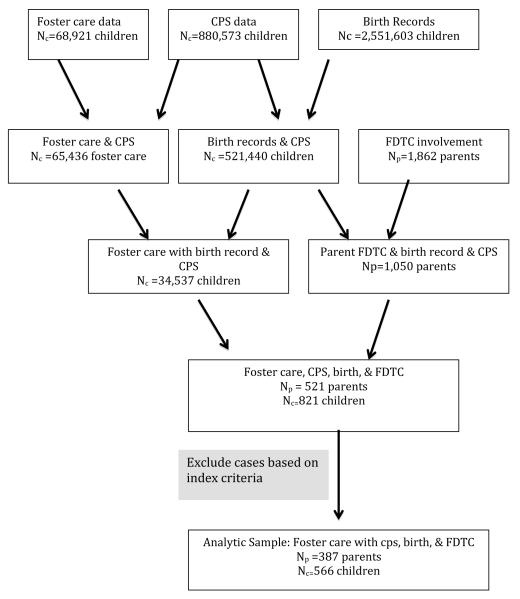
Parental substance use is a risk factor for child maltreatment. Family drug treatment courts (FDTCs) have emerged in the United States as a policy option to treat the underlying condition and promote family preservation. This study examines the effectiveness of FDTCs in North Carolina on child welfare outcomes. Data come from North Carolina records from child protection services, court system, and birth records. Three types of parental participation in a FDTC are considered: referral, enrolling, and completing an FDTC. The sample includes 566 children who were placed into foster care and whose parents participated in a FDTC program. Findings indicate that children of parents who were referred but did not enroll or who enrolled but did not complete had longer stays in foster care than children of completers. Reunification rates for children of completers were also higher. Outcomes for children in the referred and enrolled groups did not differ in the multivariate analyses. While effective substance use treatment services for parents may help preserve families, future research should examine factors for improving participation and completion rates as well as factors involved in scaling programs so that more families are served.
Keywords: Child welfare; Family drug treatment court; Foster care; Parental substance use.
Copyright © 2014 Elsevier Ltd. All rights reserved.
References
-
- American University School of Public Affairs BJA Drug court technical assistance/clearinghouse project summary of drug court activity by state and county juvenile/family drug courts. 2012 Nov 30; Retrieved from http://www.american.edu.
-
- Ashford J. Treating substance-Abusing parents: A study of the Pima County family drug court approach. Juvenile and Family Court Journal. 2004;55:27–37.
-
- Bambrough S, Shaw M, Kershaw S. The Family Drug and Alcohol Court service in London: a new way of doing Care Proceedings. Journal of Social Work Practice. 2013:1–14.
-
- Barnard M, McKeganey N. The impact of parental problem drug use on children: what is the problem and what can be done to help? Addiction. 2004;99:552–559. - PubMed
-
- Barth R, Lloyd E. Five-year developmental outcomes for young children remaining in foster care, returned home, or adopted. In: Fernandez E, Barth RP, editors. How does foster care work? International evidence on outcomes. Jessica Kingsley; London, England: 2010.
Publication types
MeSH terms
Grants and funding
LinkOut - more resources
Full Text Sources
Other Literature Sources
Medical
