


Using appropriate body mass index cut points for overweight and obesity among Asian Americans
- PMID: 24736092
- PMCID: PMC4217157
- DOI: 10.1016/j.ypmed.2014.04.010
Using appropriate body mass index cut points for overweight and obesity among Asian Americans
Abstract
Objective: Asian Americans have low prevalence of overweight/obesity based on standard BMI cut points yet have higher rates of diabetes. We examined the prevalence of overweight/obesity, using lower BMI cut points recommended by the World Health Organization (WHO) for Asians, and diabetes in Asian American subgroups in California.
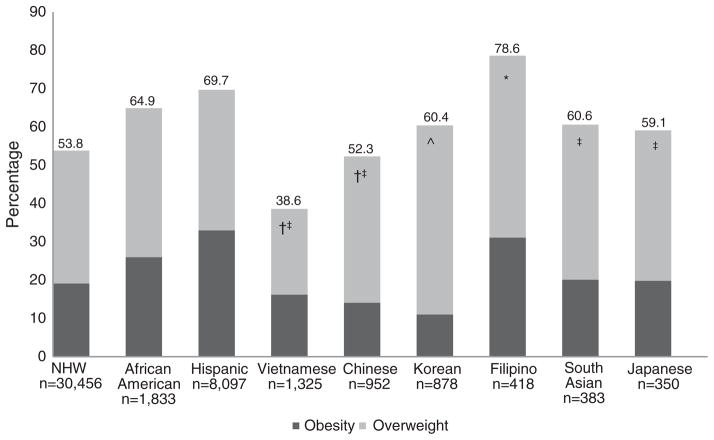
Method: Secondary analysis of the 2009 adult California Health Interview Survey (n=45,946) of non-Hispanic Whites (NHW), African Americans, Hispanics and Asians (Vietnamese, Chinese, Korean, Filipino, South Asian and Japanese). WHO Asian BMI cut points (overweight=23-27.5kg/m(2); obese≥27.5kg/m(2)) were used for Asian subgroups. Standard BMI cut points (overweight=25-29.9kg/m(2); obese≥30kg/m(2)) were applied for other groups.
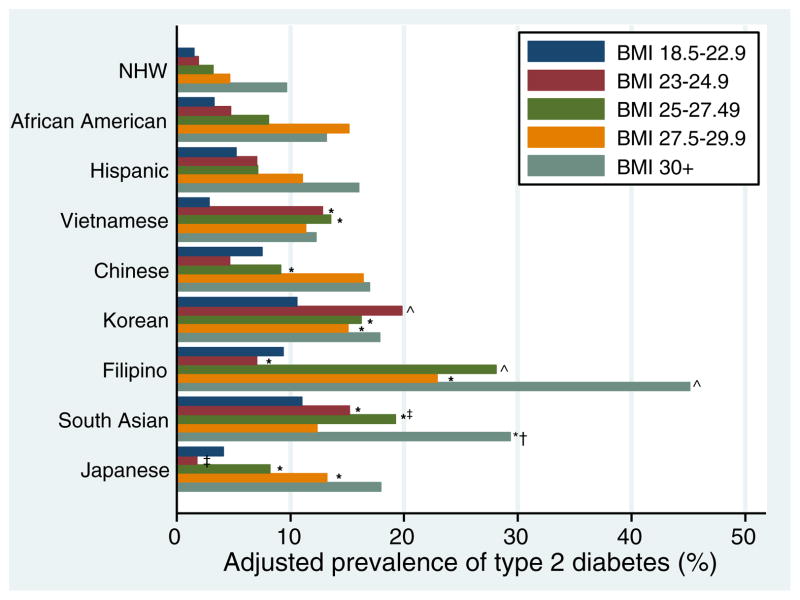
Results: Among Asian subgroups, overweight/obesity was highest among Filipinos (78.6%), which was higher than NHWs (p<0.001) but similar to African Americans and Hispanics. Compared to NHW, diabetes prevalence was higher for Vietnamese, Koreans, Filipinos and South Asians with BMI=23-24.9kg/m(2) and Koreans, Filipinos and Japanese with BMI=27.5-29.9kg/m(2), the ranges WHO recommends as overweight or obese for Asians but not for other groups.
Conclusions: Filipinos should be a priority population for overweight/obesity screening. Filipinos, Vietnamese, Korean, South Asians and Japanese have higher diabetes prevalence at lower BMI cut points. WHO Asian BMI cut points may have clinical utility to identify at-risk Asian Americans.
Keywords: Asian Americans; Minority health; Obesity; Overweight; Type 2 diabetes mellitus.
Copyright © 2014 Elsevier Inc. All rights reserved.
Conflict of interest statement
The authors declare that there are no conflicts of interest.
Figures
References
-
- American Medical Association. AMA Adopts New Policies on Second Day of Voting at Annual Meeting. American Medical Association; 2013. [Accessed October 2, 2013]. Available from: < http://www.ama-assn.org/ama/pub/news/news/2013/2013-06-18-new-ama-polici...>.
-
- California Health Interview Survey. CHIS 2009 Methodology Series: Report 4—Response Rates. UCLA Center for Health Policy Research; Los Angeles, CA: 2011.
Publication types
MeSH terms
Grants and funding
LinkOut - more resources
Full Text Sources
Other Literature Sources
Medical
