. 2014 Apr 16:5:3651.
doi: 10.1038/ncomms4651.

Variation in Arabidopsis flowering time associated with cis-regulatory variation in CONSTANS

Affiliations
Free PMC article

Variation in Arabidopsis flowering time associated with cis-regulatory variation in CONSTANS

Ulises Rosas et al. Nat Commun. .
Free PMC article

Abstract

The onset of flowering, the change from vegetative to reproductive development, is a major life history transition in flowering plants. Recent work suggests that mutations in cis-regulatory mutations should play critical roles in the evolution of this (as well as other) important adaptive traits, but thus far there has been little evidence that directly links regulatory mutations to evolutionary change at the species level. While several genes have previously been shown to affect natural variation in flowering time in Arabidopsis thaliana, most either show protein-coding changes and/or are found at low frequency (<5%). Here we identify and characterize natural variation in the cis-regulatory sequence in the transcription factor CONSTANS that underlies flowering time diversity in Arabidopsis. Mutation in this regulatory motif evolved recently and has spread to high frequency in Arabidopsis natural accessions, suggesting a role for these cis-regulatory changes in adaptive variation of flowering time.


Figures
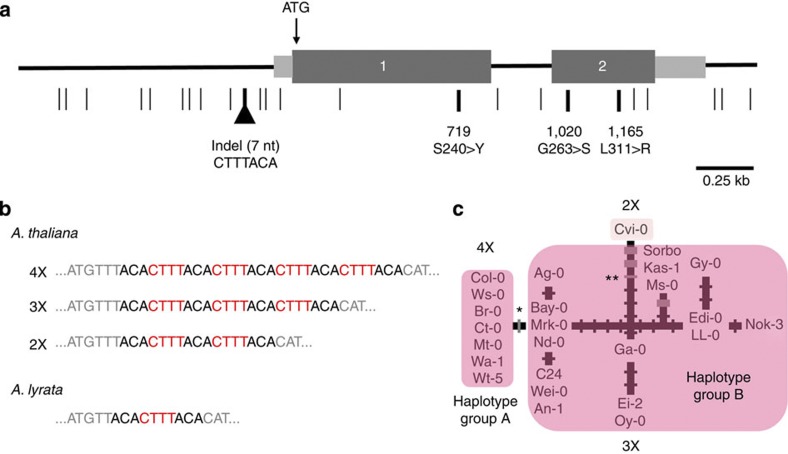
Figure 1
Figure 1. Molecular variation at the CO gene.
(a) Schematic diagram of the CO gene showing relative locations of single nucleotide polymorphisms (SNPs) and indels. Numbered dark grey boxes indicate the exons, while light grey boxes indicate UTRs. The horizontal line indicates extent of sequenced region for CO. The translation start site is indicated by ATG. The light vertical lines are silent site SNPs and the thick vertical lines are nonsynonymous SNPs, which are shown with the amino-acid polymorphisms. The inverted triangle is the relative position of the 7-bp repeat motif at the CO promoter. (b) The sequence of the cis-regulatory CDF1-binding motif at the CO promoter (red cases), showing the variation between accessions that have various repeat numbers of the motif in A. thaliana. The sequence of the motif in an individual in A. lyrata is also shown. (c) Haplotype network of the CO gene. A. thaliana accessions that are found with 4X haplotype group A and 3X haplotype group B alleles are indicated. The thin tick marks are mutations, with the thick tick marks being nonsynonymous changes. The mutation that leads to an increase in the copy number of the 7-bp cis-regulatory repeat from 3X to 4X is indicated by an asterisk, while the decrease in copy number from 3X to 2X by two asterisks.
Figure 2
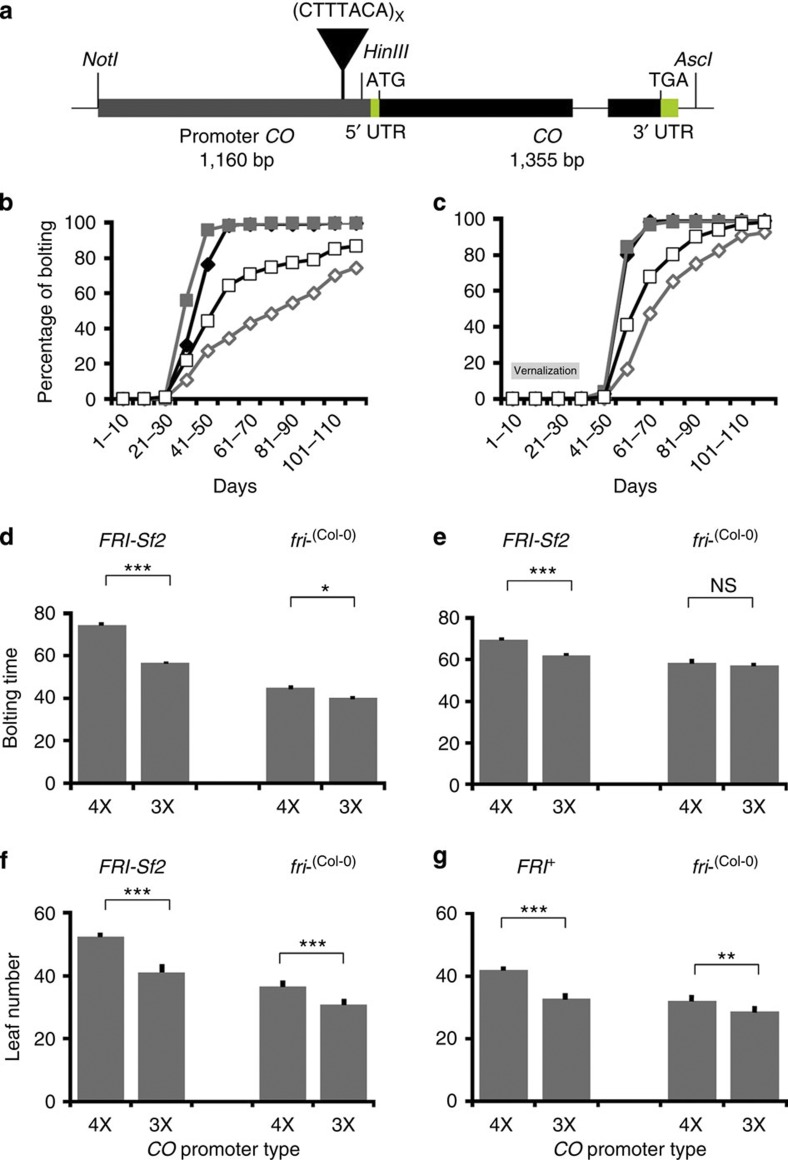
Figure 2. Phenotypes of CO transgenic complementation lines.
(a) Diagram of the inserts for transgenic complementation lines that have a 3X or 4X CO promoter fused to CO-coding region: the promoter (grey block), the tandem repeat (inverted triangle), UTRs (green blocks), exons (black block) and an intron (thin line). (bc) Cumulative flowering time of unvernalized (b) and vernalized (c) complementation lines of CO 3X (n=358 unvernalized plants, n=298 vernalized plants) and CO 4X (n=414 unvernalized plants, n=360 vernalized plants). Black diamonds indicate CO 4X fri-(Col-0), grey squares CO 3X fri-(Col-0), empty diamonds CO 4X FRI-Sf2 and empty squares CO 3X FRI-Sf2. (dg) Mean phenotypes in the FRI-Sf2 and fri− backgrounds are shown in unvernalized (d,f) and vernalized (21 days at 4 °C) plants (e,g). The dark tick marks indicate the s.e. Post hoc Tukey’s test in REML mixed model ***P<0.0005, **P<0.005, *P<0.05. NS, not significant. Error bars indicate s.e.m.
Figure 3
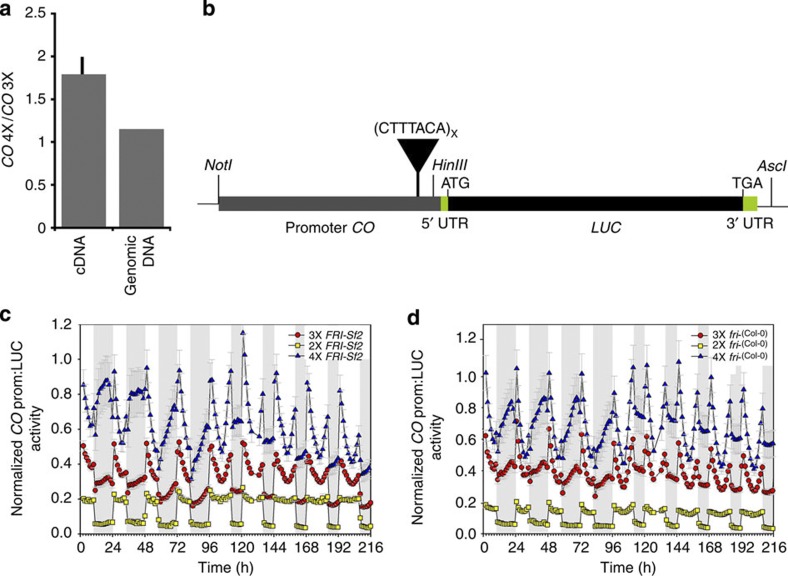
Figure 3. CO promoter type drives differences in gene activity.
(a) Expression ratio in a semi-hybrid (Col-0) heterozygote genetic background measured with pyrosequecing. Genomic DNA was used to quantify PCR biases (n=7 plants). (b) Luciferase gene expression in transgenic reporter lines (see Fig. 2a legend). Luciferase expression was continuously monitored in seedlings in the first 96 h under short days, followed by 120 h in long days. Experimental periods of dark are shown by the light grey boxes. Expression levels of LUC for 2X (n=36 plants), 3X (n=60 plants) and 4X (n=60 plants) CO promoter reporter constructs are shown for (c) FRI+ and (d) fri− backgrounds. Error bars indicate s.e.m.
Figure 4
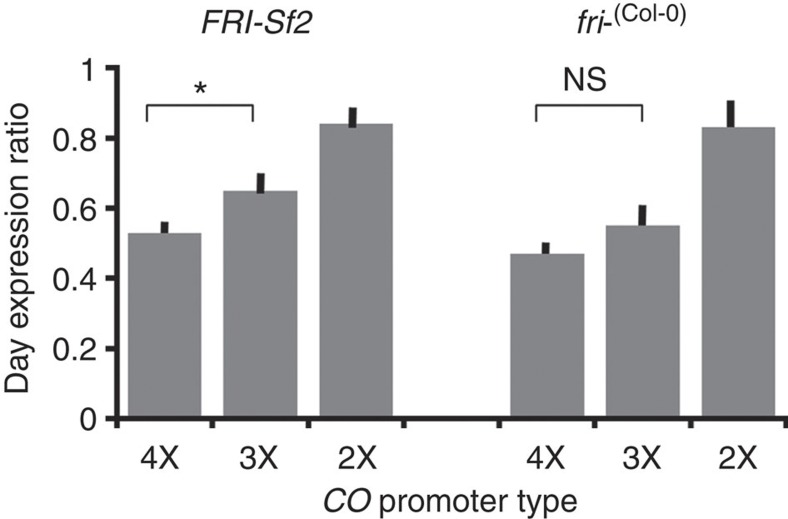
Figure 4. Variation in daytime repression of CO.
Ratio of daytime minimum over dawn maximum expression of LUC reporter gene driven by different CO promoter types. Two-tailed t-test: *P<0.05. NS, not significant. Error bars indicate s.e.m.

References

    1. Bernier G. The control of floral evocation and morphogenesis. Ann. Rev. Plant Physiol. Plant Mol. Biol. 39, 175–219 (1988).
    1. Elzinga J. A. et al. Time after time: flowering phenology and biotic interactions. Trends Ecol. Evol. 22, 432–439 (2007). - PubMed
    1. Putterill J., Robson F., Lee K., Simon R. & Coupland G. The CONSTANS gene of Arabidopsis promotes flowering and encodes a protein showing similarities to zinc finger transcription factors. Cell 80, 847–857 (1995). - PubMed
    1. Flowers J. M., Hanzawa Y., Hall M. C., Moore R. C. & Purugganan M. D. Population genomics of the Arabidopsis thaliana flowering time gene network. Mol. Biol. Evol. 26, 2475–2486 (2009). - PubMed
    1. Imaizumi T., Schultz T. F., Harmon F. G., Ho L. A. & Kay S. A. FKF1 F-Box protein mediates cyclic degradation of a repressor of CONSTANS in Arabidopsis. Science 309, 293–297 (2005). - PubMed

Publication types

Associated data

LinkOut - more resources