


Introduction and sustained high coverage of the HPV bivalent vaccine leads to a reduction in prevalence of HPV 16/18 and closely related HPV types
- PMID: 24736582
- PMCID: PMC4037824
- DOI: 10.1038/bjc.2014.198
Introduction and sustained high coverage of the HPV bivalent vaccine leads to a reduction in prevalence of HPV 16/18 and closely related HPV types
Abstract
Background: In 2008, a national human papillomavirus (HPV) immunisation programme began in Scotland for 12-13 year old females with a three-year catch-up campaign for those under the age of 18. Since 2008, three-dose uptake of bivalent vaccine in the routine cohort aged 12-13 has exceeded 90% annually, while in the catch-up cohort overall uptake is 66%.
Methods: To monitor the impact of HPV immunisation, a programme of national surveillance was established (pre and post introduction) which included yearly sampling and HPV genotyping of women attending for cervical screening at age 20. By linking individual vaccination, screening and HPV testing records, we aim to determine the impact of the immunisation programme on circulating type-specific HPV infection particularly for four outcomes: (i) the vaccine types HPV 16 or 18 (ii) types considered to be associated with cross-protection: HPV 31, 33 or 45; (iii) all other high-risk types and (iv) any HPV.
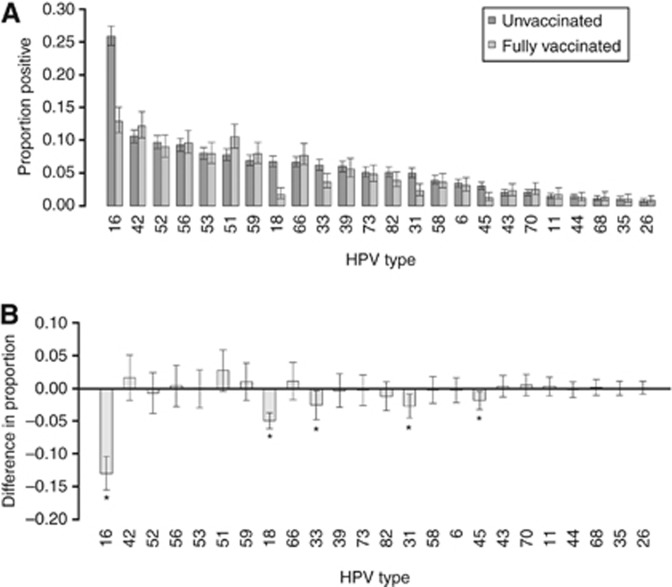
Results: From a total of 4679 samples tested, we demonstrate that three doses (n=1100) of bivalent vaccine are associated with a significant reduction in prevalence of HPV 16 and 18 from 29.8% (95% confidence interval 28.3, 31.3%) to 13.6% (95% confidence interval 11.7, 15.8%). The data also suggest cross-protection against HPV 31, 33 and 45. HPV 51 and 56 emerged as the most prevalent (10.5% and 9.6%, respectively) non-vaccine high-risk types in those vaccinated, but at lower rates than HPV 16 (25.9%) in those unvaccinated.
Conclusions: This data demonstrate the positive impact of bivalent vaccination on the prevalence of HPV 16, 18, 31, 33 and 45 in the target population and is encouraging for countries which have achieved high-vaccine uptake.
Figures
References
-
- Bouvard V, Baan R, Straif K, Grosse Y, Secretan B, El Ghissassi F, Benbrahim-Tallaa L, Guha N, Freeman C, Galichet L, Cogliano V WHO International Agency for Research on Cancer Monograph Working Group (2009) A review of human carcinogens—Part B: biological agents. Lancet Oncol 10: 321–322. - PubMed
-
- Brotherton JML, Fridman M, May CL, Chappell G, Saville AM, Gertig DM (2011) Early effect of the HPV vaccination programme on cervical abnormalities in Victoria, Australia: an ecological study. Lancet 377: 2085–2092. - PubMed
-
- CDC (2011) National and state vaccination coverage among adolescents aged 13 through 17–United States, 2010. MMWR 60: 1117–1123. - PubMed
-
- Cuschieri K, Brewster DH, Williams ARW, Brewster DH, Williams AR, Millan D, Murray G, Nicoll S, Imrie J, Hardie A, Graham C, Cubie HA (2010) Distribution of HPV types associated with cervical cancers in Scotland and implications for the impact of HPV vaccines. Br J Cancer 102: 930–932. - PMC - PubMed
Publication types
MeSH terms
Substances
Grants and funding
LinkOut - more resources
Full Text Sources
Other Literature Sources
Medical
