Review
. 2014;9(5):e28847.
doi: 10.4161/psb.28847.

Transcriptional regulators of legume-rhizobia symbiosis: nuclear factors Ys and GRAS are two for tango

Affiliations
Review

Transcriptional regulators of legume-rhizobia symbiosis: nuclear factors Ys and GRAS are two for tango

Carolina Rípodas et al. Plant Signal Behav. 2014.

Abstract

Transcription factors are DNA binding proteins that regulate gene expression. The nitrogen fixing symbiosis established between legume plants and soil bacteria is a complex interaction, in which plants need to integrate signals derived from the symbiont and the surrounding environment to initiate the developmental program of nodule organogenesis and the infection process. Several transcription factors that play critical roles in these processes have been reported in the past decade, including proteins of the GRAS and NF-Y families. Recently, we reported the characterization of a new GRAS domain containing-protein that interacts with a member of the C subunit of the NF-Y family, which plays an important role in nodule development and the progression of bacterial infection during the symbiotic interaction. The connection between transcription factors of these families highlights the significance of multimeric complexes in the fabulous capacity of plants to integrate and respond to multiple environmental stimuli.

Keywords: GRAS; lateral root; legume; nuclear factor Y; rhizobia; symbiosis.


Figures
None
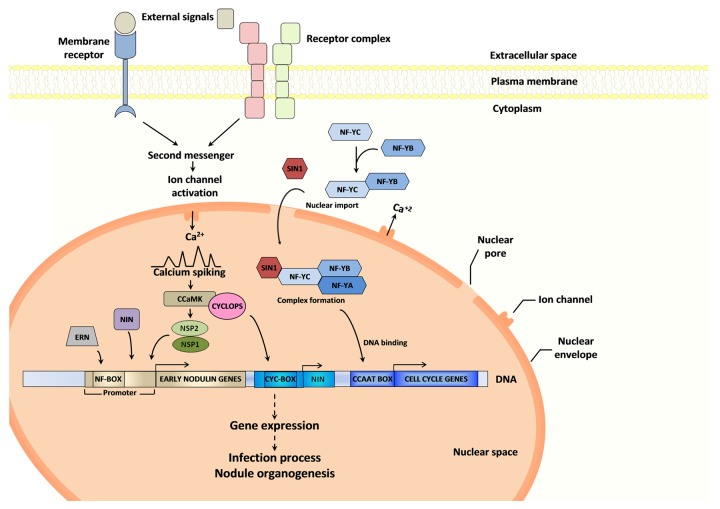
Figure 1. Transcription factors involved in nodulation. The nodulation signaling pathway is triggered when receptors located in the plasma membrane sense rhizobia derived signals. Upon receptor activation, oscillations of calcium concentration (calcium spiking) are produced in and around the nucleus. A nuclear located calcium and calmodulin dependent protein kinase (CCaMK) has been proposed as the protein that deciphers the calcium signal. Downstream from CCaMK, several transcriptional regulators are required for symbiosis establishment. CYCLOPS interacts and is phosphorylated by CCaMK, activating its capacity to recognize the NIN promoter. Nodulation signaling 1 (NSP1) and NSP2 both encode GRAS transcription factors that are essential for nodulation and activate the expression of early nodulation genes (nodulins). NIN and ERN are also involved in the transcriptional regulation of nodulins. Members of the NF-Y gene family are also required for nodulation. NF-YB would interact with NF-YC subunit in the cytoplasm prior to the nuclear import of the heterodimer. Once inside the nucleus, they interact with NF-YA to form the functional heterotrimer that binds with high affinity to CCAAT elements. SIN1 (a member of the GRAS family) physically interacts with the C subunit of the NF-Y transcription factor in the nucleus. This putative multimeric complex participates, directly or indirectly, in the transcriptional control of cell cycle genes.
None
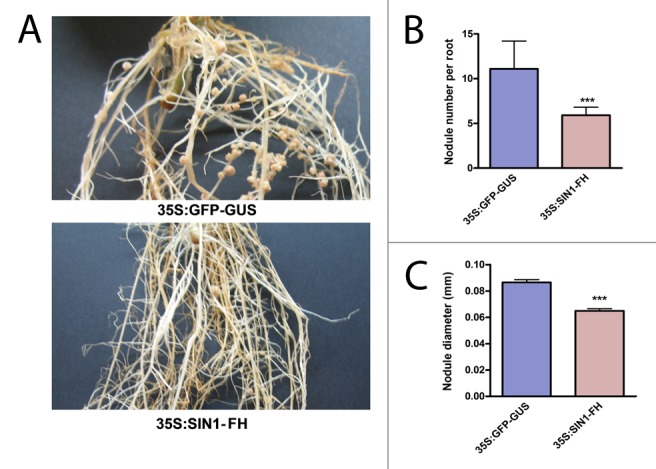
Figure 2. Overexpression of SIN1 resulted in the reduction of the number and size of root nodules. (A) Representative pictures illustrating the reduced nodule density and size found in 35S:SIN1-FH (FLAG-HIS) roots (upper panel) as compared with the control roots 35S:GFP-GUS (lower panel) at 17 dpi with R. etli. The complete open reading frame of SIN1 was cloned in the p35S:FH vector. Nodule number per root (B) and nodule size (C) developed in 35S:GFP-GUS or 35S:SIN1-FH roots at 17 dpi with R. etli. Error bars represent the SEM. Asterisks indicate significant differences with the control in an unpaired two-tailed t test with P < 0.001.

References

    1. Oldroyd GE, Downie JA. Coordinating nodule morphogenesis with rhizobial infection in legumes. Annu Rev Plant Biol. 2008;59:519–46. doi: 10.1146/annurev.arplant.59.032607.092839. - DOI - PubMed
    1. Battaglia M, et al. The NF-YC1 interacting protein SIN1, a member of the GRAS family, is required for nodule organogenesis, infection thread progression and lateral root growth. Plant Physiol. 2014;164:1430–42. doi: 10.1104/pp.113.230896. - DOI - PMC - PubMed
    1. Schauser L, Roussis A, Stiller J, Stougaard J. A plant regulator controlling development of symbiotic root nodules. Nature. 1999;402:191–5. doi: 10.1038/46058. - DOI - PubMed
    1. Nishimura R, Ohmori M, Kawaguchi M. The novel symbiotic phenotype of enhanced-nodulating mutant of Lotus japonicus: astray mutant is an early nodulating mutant with wider nodulation zone. Plant Cell Physiol. 2002;43:853–9. doi: 10.1093/pcp/pcf098. - DOI - PubMed
    1. Middleton PH, Jakab J, Penmetsa RV, Starker CG, Doll J, Kaló P, Prabhu R, Marsh JF, Mitra RM, Kereszt A, et al. An ERF transcription factor in Medicago truncatula that is essential for Nod factor signal transduction. Plant Cell. 2007;19:1221–34. doi: 10.1105/tpc.106.048264. - DOI - PMC - PubMed

Publication types

MeSH terms

LinkOut - more resources