


Association of XPC polymorphisms and lung cancer risk: a meta-analysis
- PMID: 24736739
- PMCID: PMC3988015
- DOI: 10.1371/journal.pone.0093937
Association of XPC polymorphisms and lung cancer risk: a meta-analysis
Abstract
Background: Xeroderma pigmentosum complementation group C gene (XPC) is a key member of nucleotide excision repair pathway and plays an important role in human DNA repair system. It is reported that several common polymorphisms of XPC are associated with susceptibility to lung cancer. However, the conclusion is still elusive.
Method: This meta-analysis was performed to determine the relationship between XPC polymorphisms (Lys939Gln, Ala499Val, and PAT) and lung cancer risk. Published literatures were identified by searching online databases and reference lists of relevant studies. Odds ratios (ORs) and 95% confidence intervals (CIs) were calculated to estimate the association strength. Publication bias were detected by Egger's and Begg's test.
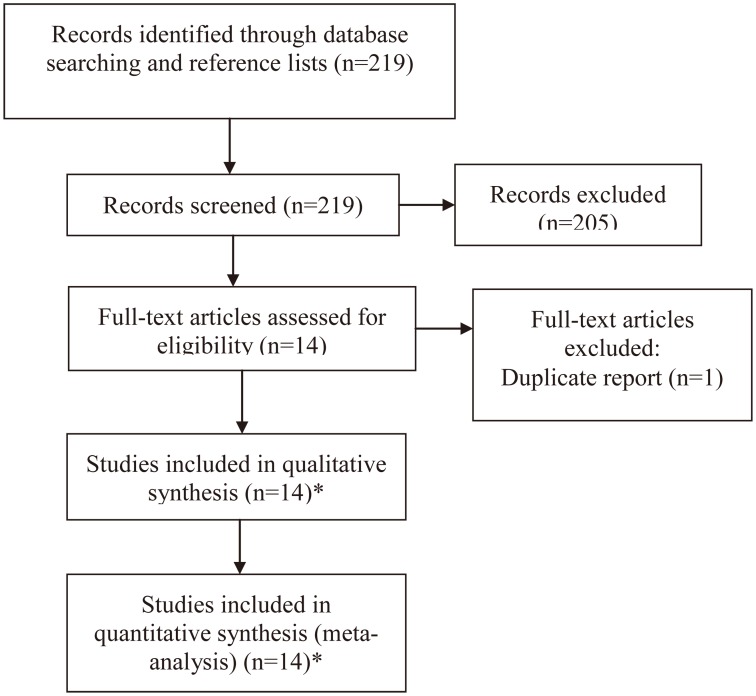
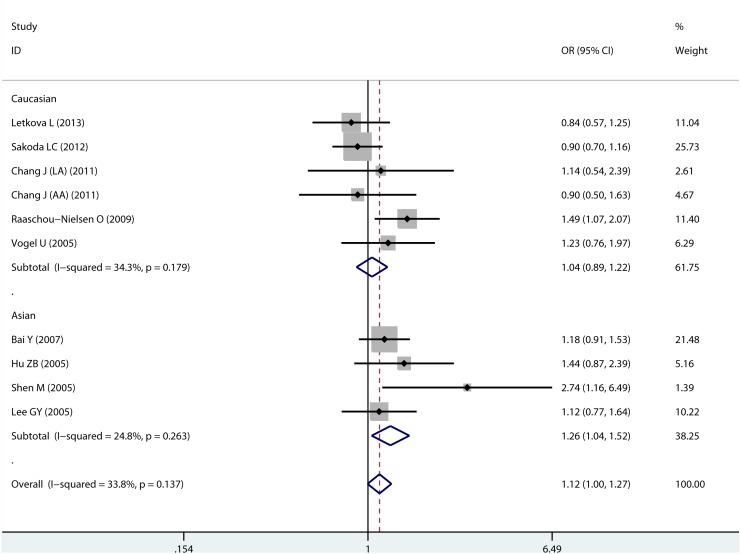
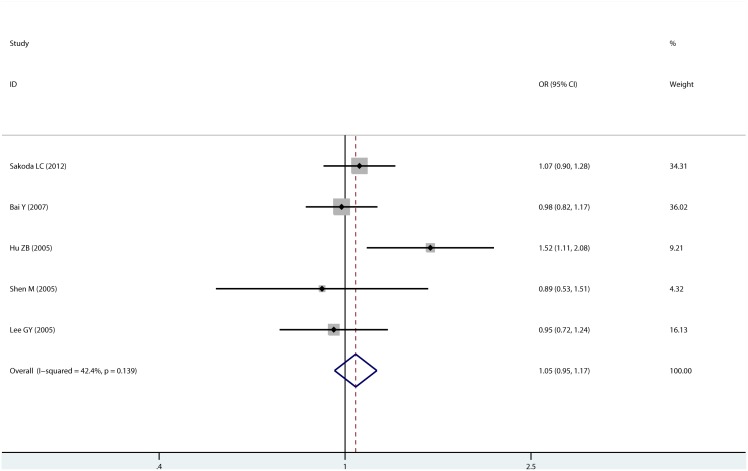
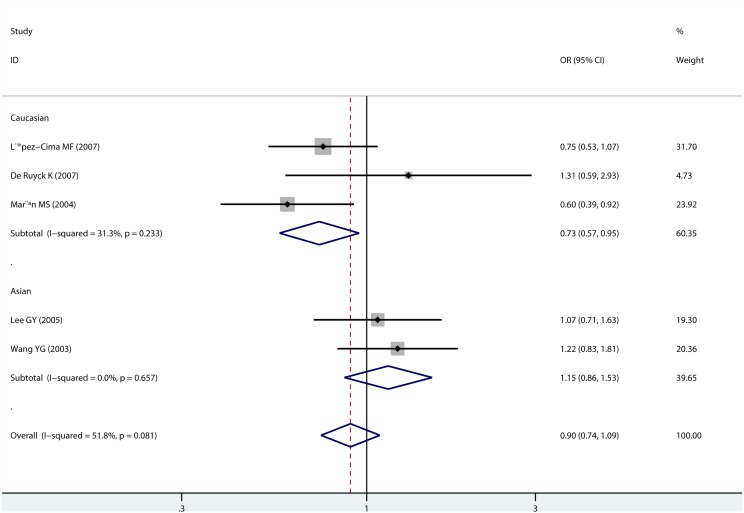
Result: After strict screening, we identified 14 eligible studies in this meta-analysis, including 5647 lung cancer cases and 6908 controls. By pooling all eligible studies, we found that the homozygote Gln939Gln genotype was associated with a significantly increased risk of lung cancer in Asian population (GlnGln vs LysLys, OR=1.229, 95% CI: 1.000-1.510; GlnGln vs LysLys/LysGln, OR=1.257, 95% CI: 1.038-1.522). As for the PAT polymorphism, in Caucasian population, we found carriers of the -/- genotype were associated significantly reduced risk of lung cancer in homozygote comparison model (-/- vs +/+, OR=0.735, 95% CI: 0.567-0.952).
Conclusion: In this meta-analysis we found that Gln939Gln genotype was associated with significantly increased risk of lung cancer in Asian population; the PAT -/- genotype significantly reduced susceptibility to lung cancer in Caucasian population; while the XPC Ala499Val polymorphism was not associated with lung cancer risk.
Conflict of interest statement
Figures
References
-
- Letkova L, Matakova T, Musak L, Sarlinova M, Krutakova M, et al. (2013) DNA repair genes polymorphism and lung cancer risk with the emphasis to sex differences. Mol Biol Rep 40: 5261–5273. - PubMed
-
- Hecht SS (1999) Tobacco smoke carcinogens and lung cancer. J Natl Cancer Inst 91: 1194–1210. - PubMed
-
- Spitz MR, Wei Q, Dong Q, Amos CI, Wu X (2003) Genetic susceptibility to lung cancer: the role of DNA damage and repair. Cancer Epidemiol Biomarkers Prev 12: 689–698. - PubMed
-
- Riboli E, Norat T (2003) Epidemiologic evidence of the protective effect of fruit and vegetables on cancer risk. Am J Clin Nutr 78: 559S–569S. - PubMed
-
- Wood RD, Mitchell M, Sgouros J, Lindahl T (2001) Human DNA repair genes. Science 291: 1284–1289. - PubMed
Publication types
MeSH terms
Substances
LinkOut - more resources
Full Text Sources
Other Literature Sources
Medical
Research Materials
