


Does increased water intake prevent disease progression in autosomal dominant polycystic kidney disease?
- PMID: 24739484
- PMCID: PMC4145867
- DOI: 10.1093/ndt/gfu093
Does increased water intake prevent disease progression in autosomal dominant polycystic kidney disease?
Abstract
Background: The clinical effects of increased water intake on autosomal dominant polycystic kidney disease (ADPKD) progression are unknown.
Methods: ADPKD patients with creatinine clearance ≧ 50 mL/min/1.73 m(2) were divided into high (H-, n = 18) and free (F-, n = 16) water-intake groups, mainly according to their preference. Prior to the study, 30 patients underwent annual evaluation of total kidney volume (TKV) and 24-h urine for an average of 33 months. During the 1-year study period, TKV and 24-h urine were analyzed at the beginning and end of the study and every 4 months, respectively.
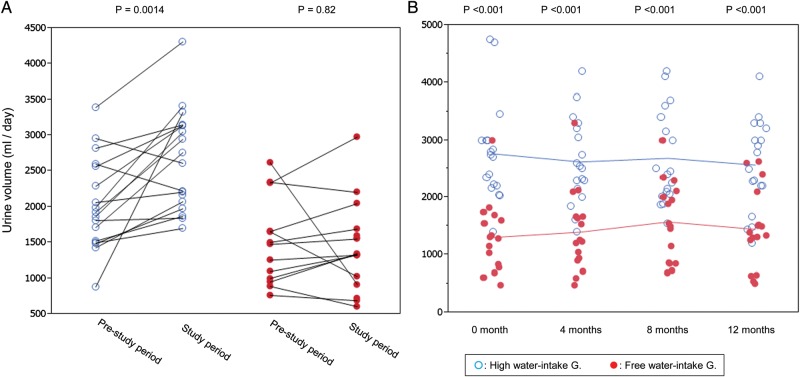
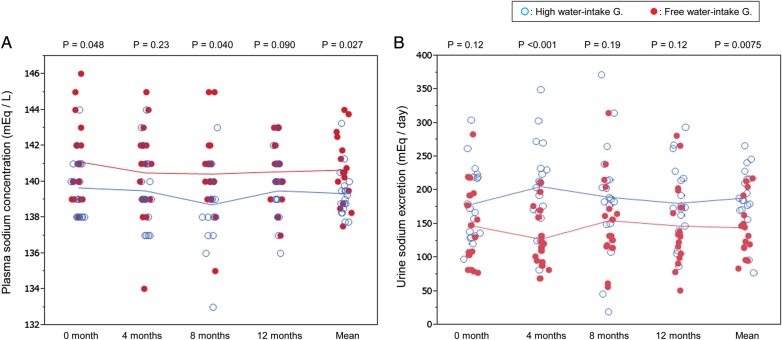
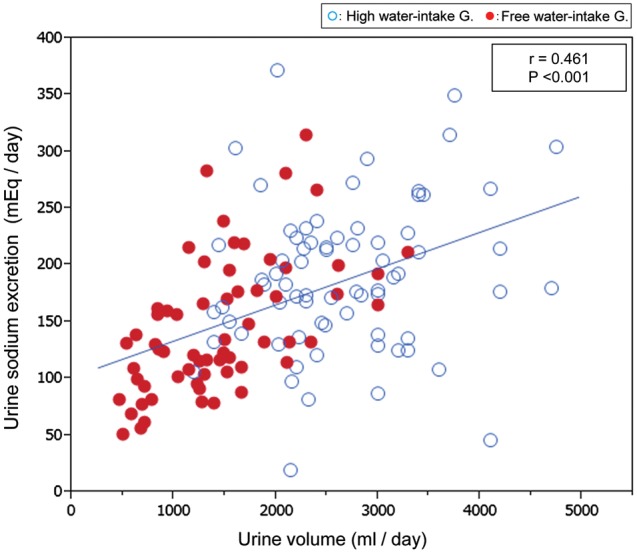
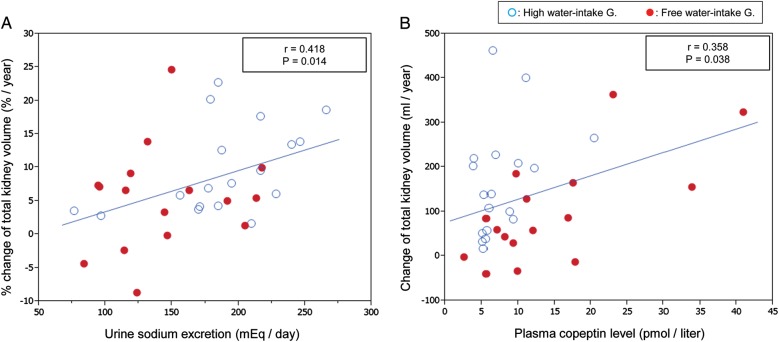
Results: During the pre-study period, urine volume (UV) in the H-group was higher (P = 0.034), but TKV and kidney function and their slopes were not significantly different between the two groups. After the study commenced, UV further increased (P < 0.001) in the H-group but not in the F-group. During the study period, TKV and kidney function slopes were not significantly different between the two groups (primary endpoint). Plasma copeptin was lower (P = 0.024) in the H-group than in the F-group. TKV and kidney function slopes became worse (P = 0.047 and 0.011, respectively) after high water intake (H-group) but not in the F-group. High UV was associated with increased urine sodium, and urine sodium positively correlated with the % TKV slope (P = 0.014).
Conclusions: Although the main endpoint was not significant, high water intake enhanced disease progression in the H-group when compared with the pre-study period. These findings necessitate a long-term randomized study before drawing a final conclusion.
Keywords: autosomal dominant polycystic kidney disease; glomerular filtration rate; kidney volume; urine volume; vasopressin.
© The Author 2014. Published by Oxford University Press on behalf of ERA-EDTA.
Figures


Comment in
-
Riding the waves: evidence for a beneficial effect of increased water intake in autosomal dominant polycystic kidney disease patients?Nephrol Dial Transplant. 2014 Sep;29(9):1615-7. doi: 10.1093/ndt/gfu054. Epub 2014 Mar 18. Nephrol Dial Transplant. 2014. PMID: 24642420 No abstract available.
References
-
- Hanaoka K, Guggino WB. cAMP regulates cell proliferation and cyst formation in autosomal polycystic kidney disease cells. J Am Soc Nephrol. 2000;11:1179–1187. - PubMed
-
- Yamaguchi T, Pelling JC, Ramaswamy NT. cAMP stimulates the in vitro proliferation of renal cyst epithelial cells by activating the extracellular signal-regulated kinase pathway. Kidney Int. 2000;57:1460–1471. - PubMed
-
- Nagao S, Nishii K, Katsuyama M. Increased water intake decreases progression of polycystic kidney disease in the PCK rat. J Am Soc Nephrol. 2006;17:2220–2227. - PubMed
-
- Gattone VH, Wang X, Harris PC, et al. Inhibition of renal cystic disease development and progression by a vasopressin V2 receptor antagonist. Nat Med. 2003;9:1323–1326. - PubMed
Publication types
MeSH terms
Substances
LinkOut - more resources
Full Text Sources
Other Literature Sources
