. 2014 Oct;8(10):2015-28.
doi: 10.1038/ismej.2014.50. Epub 2014 Apr 17.

Deterministic processes guide long-term synchronised population dynamics in replicate anaerobic digesters

Affiliations

Deterministic processes guide long-term synchronised population dynamics in replicate anaerobic digesters

Inka Vanwonterghem et al. ISME J. 2014 Oct.

Abstract

A replicate long-term experiment was conducted using anaerobic digestion (AD) as a model process to determine the relative role of niche and neutral theory on microbial community assembly, and to link community dynamics to system performance. AD is performed by a complex network of microorganisms and process stability relies entirely on the synergistic interactions between populations belonging to different functional guilds. In this study, three independent replicate anaerobic digesters were seeded with the same diverse inoculum, supplied with a model substrate, α-cellulose, and operated for 362 days at a 10-day hydraulic residence time under mesophilic conditions. Selective pressure imposed by the operational conditions and model substrate caused large reproducible changes in community composition including an overall decrease in richness in the first month of operation, followed by synchronised population dynamics that correlated with changes in reactor performance. This included the synchronised emergence and decline of distinct Ruminococcus phylotypes at day 148, and emergence of a Clostridium and Methanosaeta phylotype at day 178, when performance became stable in all reactors. These data suggest that many dynamic functional niches are predictably filled by phylogenetically coherent populations over long time scales. Neutral theory would predict that a complex community with a high degree of recognised functional redundancy would lead to stochastic changes in populations and community divergence over time. We conclude that deterministic processes may play a larger role in microbial community dynamics than currently appreciated, and under controlled conditions it may be possible to reliably predict community structural and functional changes over time.


Figures
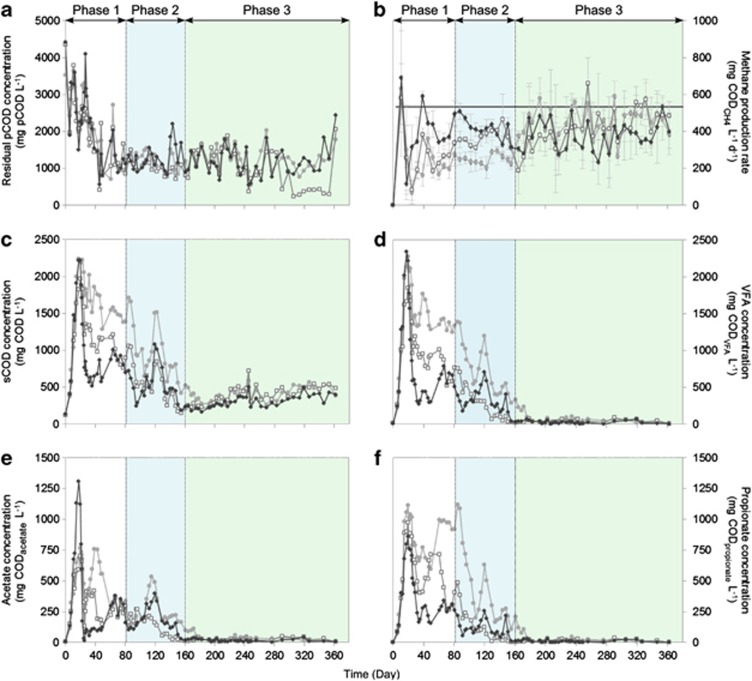
Figure 1
Figure 1
Reactor performance parameters over time for reactors AD1 (○ grey), AD2 (□ light grey) and AD3 (◊ black). Three distinct phases can be identified (phase 1—start-up, phase 2—stable hydrolysis and phase 3—steady state) showing differences in pCOD concentration (a), methane production rate (b), sCOD concentration (c), total VFA concentration (d), acetate concentration (e) and propionate concentration (f). Methane production was measured daily and average methane production rates were calculated on a weekly basis (error bars represent s.d.).
Figure 2
Figure 2
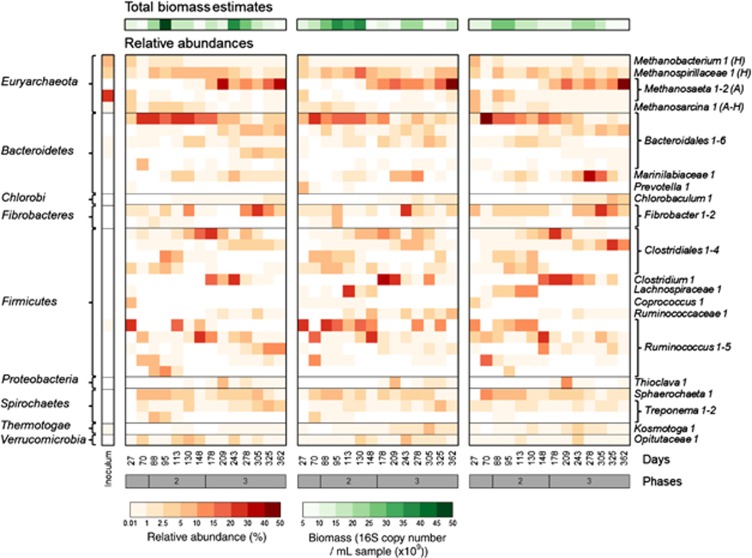
Microbial community composition and synchronised dynamics. This heatmap shows the total biomass estimates and relative abundance of the most dominant microbial populations (>5% relative abundance in at least one of the samples) in the three reactors (AD1, AD2 and AD3) at 14 time points. Different populations were associated with the three performance phases and changes in membership occurred in parallel in the three reactors over time. Taxonomy was determined at the phylum level (left column) and at the lowest possible assignment (right column). H: hydrogenotrophic methanogens; A: acetoclastic methanogens. Darker colour intensity indicates a higher total biomass estimate (green) or relative abundance (red).
Figure 3
Figure 3
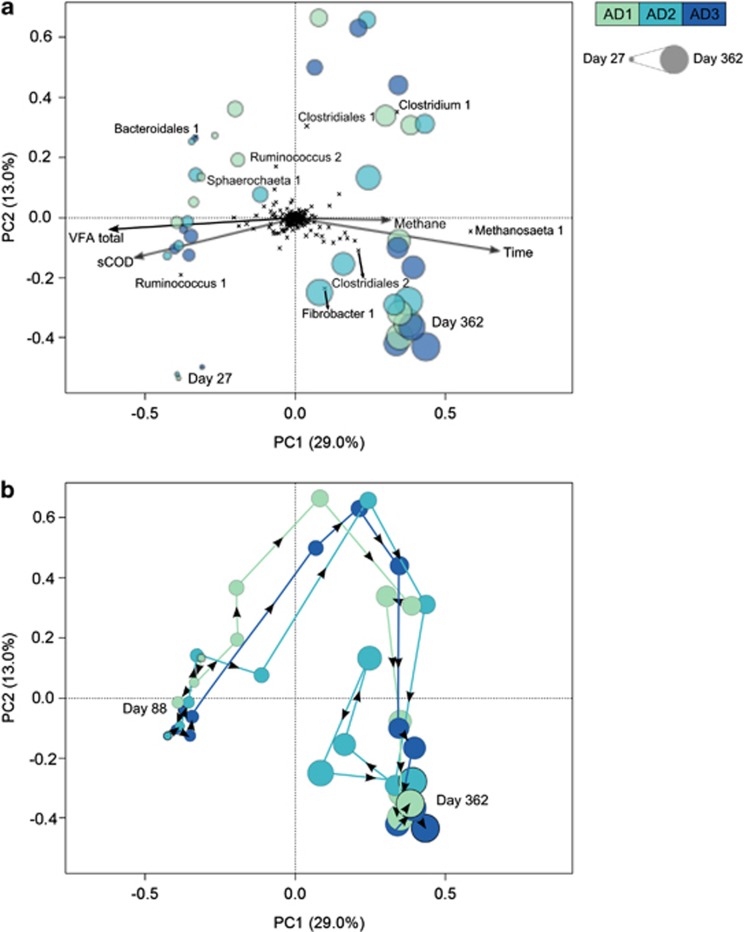
Microbial community dynamics linked to reactor performance. The PCA shows the microbial community composition at the OTU level (Hellinger transformed) for the three reactors (AD1, AD2 and AD3) at 14 time points. (a) Each sample is symbolised by a single circle coloured by reactor. The size of the circle increases with time. Individual OTUs are represented as black crosses and the taxonomy of those contributing most to the variability between community profiles is provided. Environmental parameter fitting was performed to correlate reactor performance parameters to the community composition and significant correlations are presented by the arrows. (b) Tracking of the microbial community composition in the three reactors over time, starting from day 88. Each line represents the trajectory in the PCA plot (based on community structure) of each reactor over time.
Figure 4
Figure 4
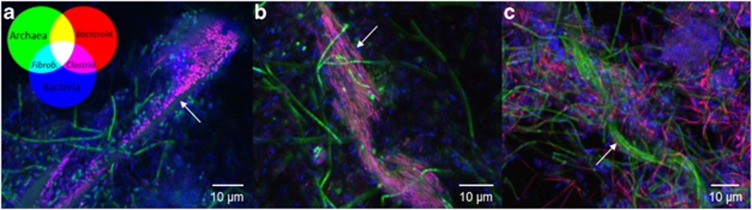
Morphology and spatial distribution of dominant populations. FISH micrographs are shown of the microbial community from AD3 on (a) day 88, (b) day 178 and (c) day 362. Universal probes targeting archaea (ARC951, green) and bacteria (EUB338 and EUB338+, blue) were used in combination with population-specific probes targeting Bacteroidales (Bac1080 and CF319a, red), Clostridiales (Clo549 and Ace731, magenta) and Fibrobacterales (Fibr225, cyan). The arrows point to possibly hydrolytic populations attached to cellulose particles (a, b), and clustering of archaeal rod-shaped cells into a sheathed filament (c).
Figure 5
Figure 5
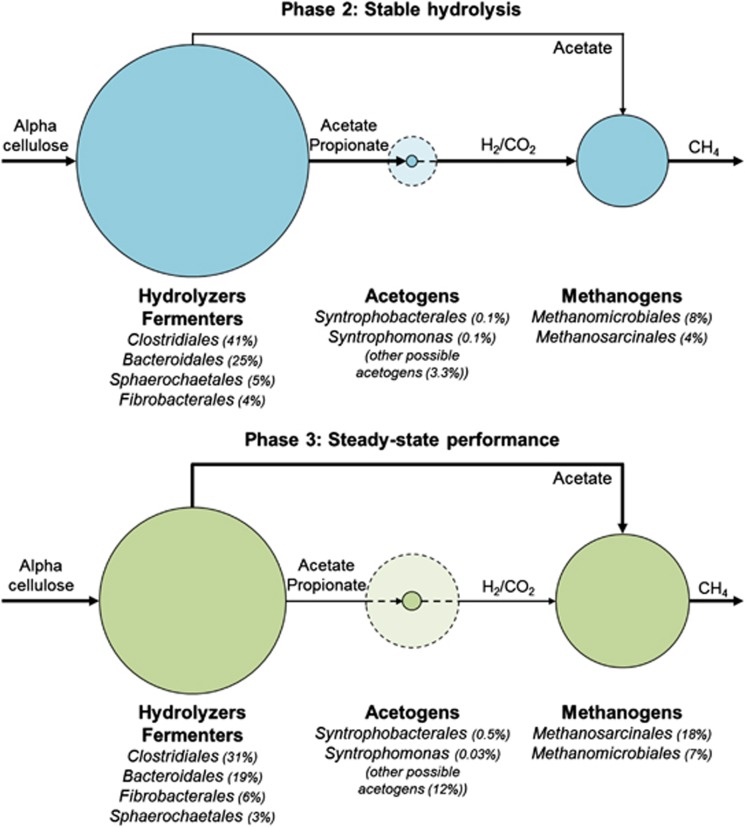
Schematic of the proposed populations involved in the different steps of anaerobic digestion. The circle size represents the average relative abundance of the populations during phase 2 (blue) and phase 3 (green). During steady-state performance, the functional guilds are more evenly distributed. The dotted circles represent populations belonging to the genus Clostridium and the orders Desulfovibrionales, Desulfuromonadales and Synergistales that may be capable of syntrophic metabolism (McDonald et al., 2008). The arrows indicate the flow of carbon through the system.

References

    1. Albertsen M, Hugenholtz P, Skarshewski A, Nielsen KA, Tyson GW, Nielsen PH. Genome sequences of rare, uncultured bacteria obtained by differential coverage binning of multiple metagenomes. Nat Biotechnol. 2013;31:533–538. - PubMed
    1. Allison SD, Martiny JBH. Resistance, resilience, and redundancy in microbial communities. Proc Natl Acad Sci USA. 2008;105:11512–11519. - PMC - PubMed
    1. Altschul SF, Gish W, Miller W, Myers EW, Lipma DJ. Basic local alignment search tool. J Mol Biol. 1990;215:403–410. - PubMed
    1. Amani T, Nosrati M, Sreekrishnan TR. Anaerobic digestion from the viewpoint of microbiological, chemical and operational aspects - a review. Environ Rev. 2010;18:255–278.

    1. Amann RI, Ludwig W, Schleifer KH. Phylogenetic identification and in situ detection of individual microbial cells without cultivation. Microbiol Rev. 1995;59:143–169. - PMC - PubMed

Publication types