Review
. 2014 Mar 28;111(13):225-35; quiz 236.
doi: 10.3238/arztebl.2014.0225.

The differential diagnosis and treatment of tremor

Affiliations
Review

The differential diagnosis and treatment of tremor

Kai Bötzel et al. Dtsch Arztebl Int. .

Abstract

Background: Essential tremor is the most common type of tremor, with a prevalence of 0.4% in the overall population and 4-7% in persons over age 65. In general, tremor is so common that patients with tremor are frequently treated not only by neurologists, but also by physicians from other specialties.

Method: This review is based on publications retrieved by a selective PubMed search and on guidelines from Germany and abroad.

Results: Particular tremor syndromes are usually diagnosed on the basis of their typical clinical presentation and whatever accompanying manifestations may be present. Ancillary tests are usually unnecessary. Unilateral rest tremor accompanied by rigidity and bradykinesia is typical of Parkinson's disease. Essential tremor is a bilateral postural tremor. The most common cause of intention tremor is multiple sclerosis. Mild tremor syndromes can often be treated satisfactorily with drugs. In case of severe tremor, which is rarer, a stereotactic operation can be considered. The usual outcome of such procedures is the complete suppression of tremor.

Conclusion: Most patients with tremor can be given a precise diagnosis and offered specific treatment. It is important for the physician to inform the patient about the expected course of tremor over time, its possible genetic causes, and the various available treatments.


Figures
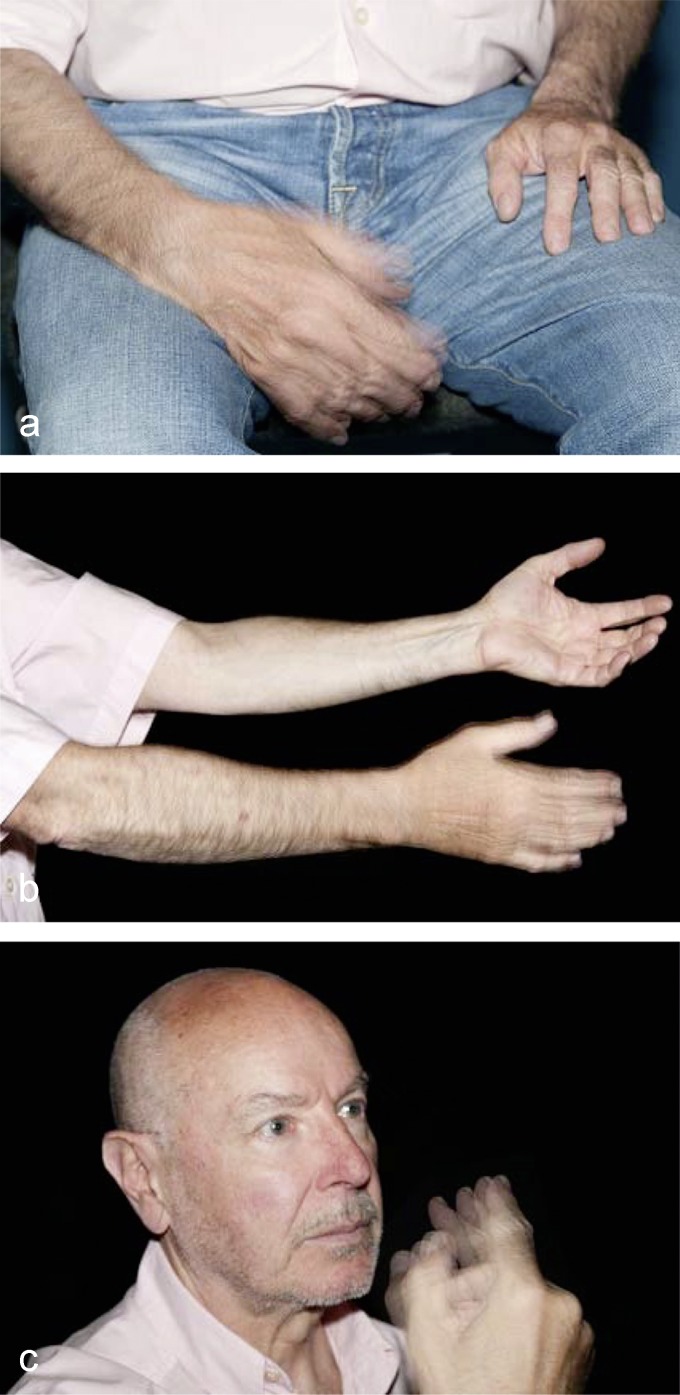
Figure 1
Figure 1
a) Rest tremor arises when the arm is laid down (at rest). This type of tremor is typical of Parkinson’s disease, in which tremor is usually unilateral at first. Rest tremor can be seen in one or more fingers, the hand, the foot, or the chin. b) Postural tremor regularly arises when the patient holds the arms outstretched. A postural tremor of very low amplitude may be a drug-induced tremor (e.g., due to lithium) or an intensified physiologic tremor in the setting or hyperthyroidism or alcohol withdrawal. Postural tremor with an amplitude greater than 1 cm is usually essential tremor. This entity is always bilateral. c) The finger-to-nose test reveals intention tremor, which arises as the finger approaches the target (nose). Intention tremor is due to cerebellar dysfunction and can be either uni- or bilateral.
Figure 2
Figure 2
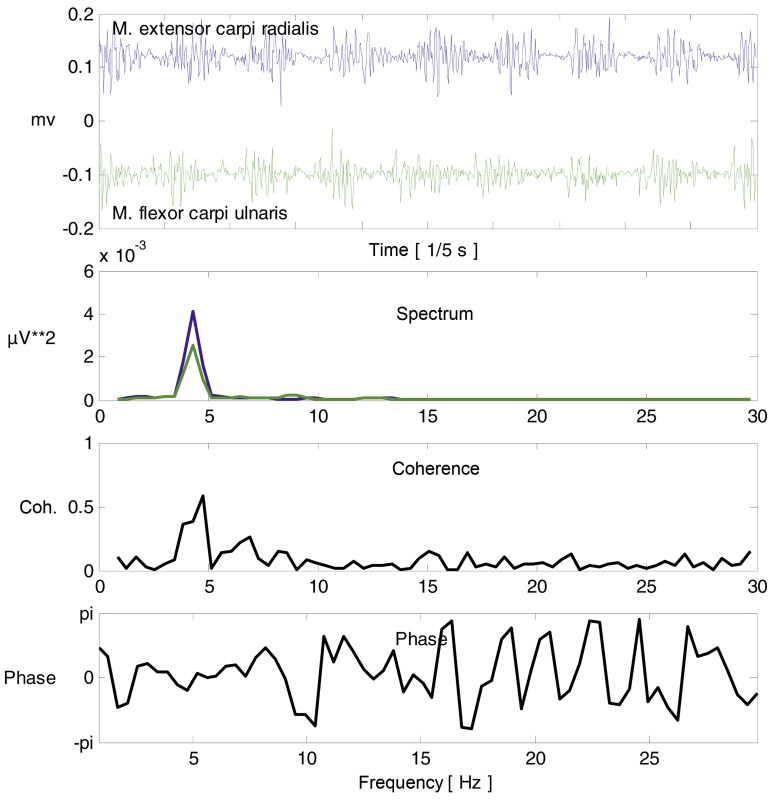
Tremor analysis with an outstretched left arm. Activity in the muscles participating in the tremor can be recorded and analyzed. The upper tracing reveals synchronous, regular activity of the hand extensors and flexors. The spectrum has a peak at 4.3 Hz; the movement is thus rhythmic, satisfying the definition of tremor. The coherence curve shows that the activity of each of the two muscles at 4.3 Hz is correlated with the other. The phase information at 4.3 Hz in this case indicates that the muscles are active without any temporal delay between them (i.e., the phase difference here is zero). The finding of activity at 4.3 Hz with simultaneous innervation of agonist and antagonist muscles is typical of essential tremor.
Figure 3
Figure 3
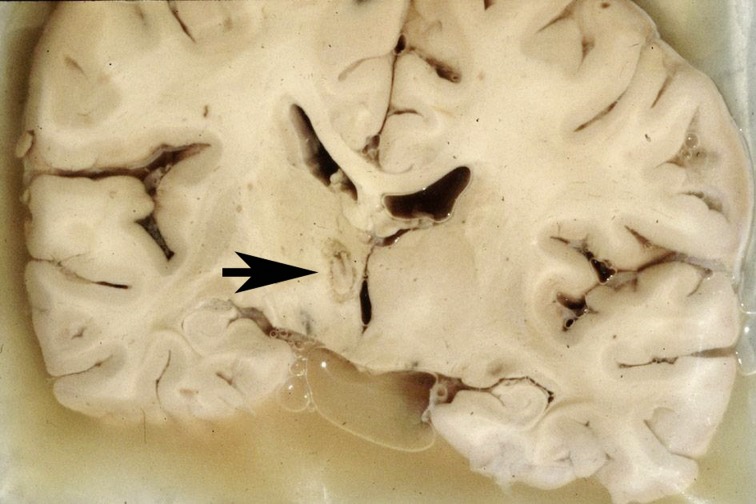
An anatomical specimen in which the left thalamus bears a lesion in the nucleus ventrointermedius (VIM), created by thermocoagulation (thalamotomy).
Figure 4
Figure 4
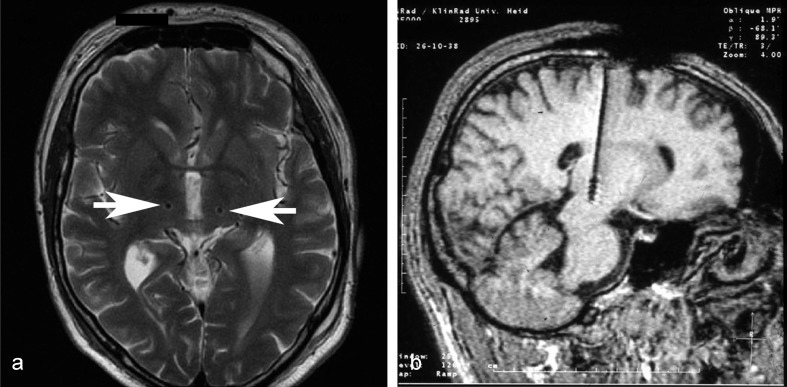
a) Axial MRI of the brain showing a DBS electrode. b) MRI with electrodes. Under certain conditions, MRI may be performed despite the presence of implanted DBS electrodes. This enables precise documentation of the position of the electrodes. The images show two stimulating electrodes in the VIM nucleus of the left thalamus and a sagittal view of an electrode in the right thalamus. The true diameter of each electrode is 1.3 mm; the electrodes seem much larger because of the metal-induced MRI artefact.

References

    1. Deuschl G, Bain P, Brin M. Consensus statement of the Movement Disorder Society on Tremor. Ad Hoc Scientific Committee. Mov Disord. 1998;13(Suppl 3 M):2–23. - PubMed
    1. Schulz JB, Gasser T. Parkinson-Syndrome. In: Brandt T, Diener HC, Gerloff C, editors. Therapie und Verlauf neurologischer Erkrankungen. Stuttgart: Kohlhammer; 2012. pp. p. 943–988.
    1. Ebersbach G, Stoeck M, Müller J, Wissel J, Poewe W. Dopa-responsiver Haltetremor bei idiopathischer Parkinson Erkrankung. Aktuelle Neurologie. 2000;27:327–331.
    1. Katzenschlager R, Sampaio C, Costa J, Lees A. Anticholinergics for symptomatic management of Parkinson’s disease. Cochrane Database Syst Rev. 2003 CD003735. - PMC - PubMed
    1. Reichmann H. Budipine in Parkinson’s tremor. J Neurol Sci. 2006;248:53–55. - PubMed