


Detection of freezing of gait in Parkinson disease: preliminary results
- PMID: 24740014
- PMCID: PMC4029660
- DOI: 10.3390/s140406819
Detection of freezing of gait in Parkinson disease: preliminary results
Abstract
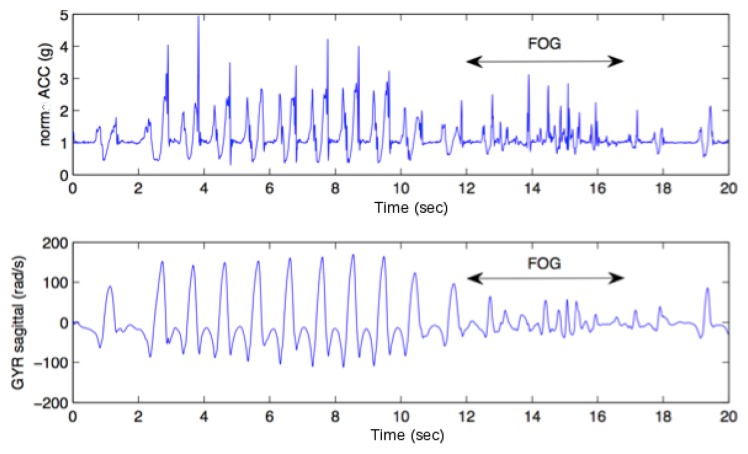
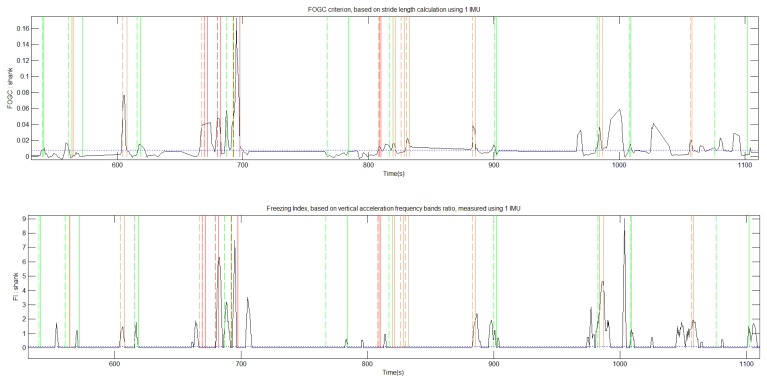
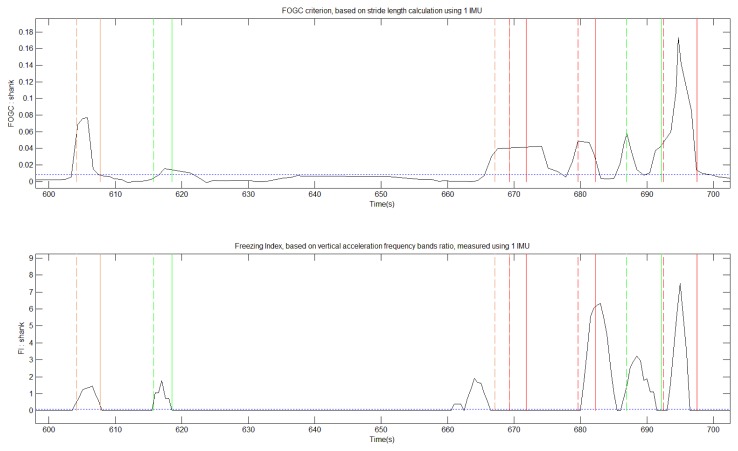
Freezing of gait (FOG) is a common symptom in Parkinsonism, which affects the gait pattern and is associated to a fall risk. Automatized FOG episode detection would allow systematic assessment of patient state and objective evaluation of the clinical effects of treatments. Techniques have been proposed in the literature to identify FOG episodes based on the frequency properties of inertial sensor signals. Our objective here is to adapt and extend these FOG detectors in order to include other associated gait pattern changes, like festination. The proposed approach is based on a single wireless inertial sensor placed on the patient's lower limbs. The preliminary experimental results show that existing frequency-based freezing detectors are not sufficient to detect all FOG and festination episodes and that the observation of some gait parameters such as stride length and cadence are valuable inputs to anticipate the occurrence of upcoming FOG events.
Figures


References
-
- Jankovic J. Parkinson's disease: Clinical features and diagnosis. J. Neurol. Neurosurg. Psychiatry. 2008;79:368–376. - PubMed
-
- Helly M.A., Reid W.G., Adena M.A., Halliday G.M., Morris J.G. The Sydney multicenter study of Parkinson's disease: The inevitability of dementia at 20 years. Mov. Disord. 2008;23:837–844. - PubMed
-
- Nieuwboer A., Giladi N. Understanding and treating freezing of gait in Parkinsonism, proposed working definition, and setting the stage. Mov. Disord. 2008;23:1639–1640. - PubMed
Publication types
MeSH terms
LinkOut - more resources
Full Text Sources
Other Literature Sources
Medical
