Characterizing the relationship between free drug samples and prescription patterns for acne vulgaris and rosacea
- PMID: 24740450
- PMCID: PMC4024076
- DOI: 10.1001/jamadermatol.2013.9715
Characterizing the relationship between free drug samples and prescription patterns for acne vulgaris and rosacea
Abstract
Importance: Describing the relationship between the availability of free prescription drug samples and dermatologists' prescribing patterns on a national scale can help inform policy guidelines on the use of free samples in a physician's office.
Objectives: To investigate the relationships between free drug samples and dermatologists' local and national prescribing patterns and between the availability of free drug samples and prescription costs.
Design, setting, and participants: Cross-sectional study investigating prescribing practices for acne, a common dermatologic condition for which free samples are often available. The settings were, first, the offices of nationally representative dermatologists from the National Disease and Therapeutic Index (an IMS Health Incorporated database) and, second, an academic medical center clinic without samples. Participants were ambulatory patients who received a prescription from a dermatologist for a primary initial diagnosis of acne vulgaris or rosacea in 2010.
Main outcomes and measures: National trends in dermatologist prescribing patterns, the degree of correlation between the availability of free samples and the prescribing of brand-name medications, and the mean cost of acne medications prescribed per office visit nationally and at an academic medical center without samples.
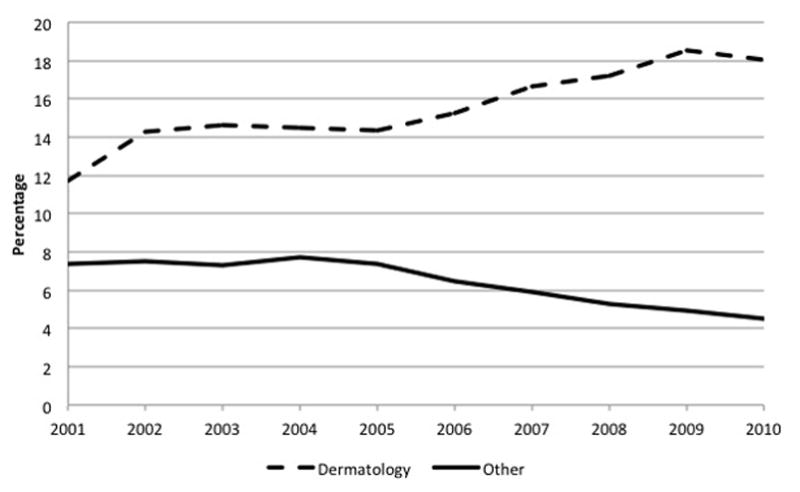
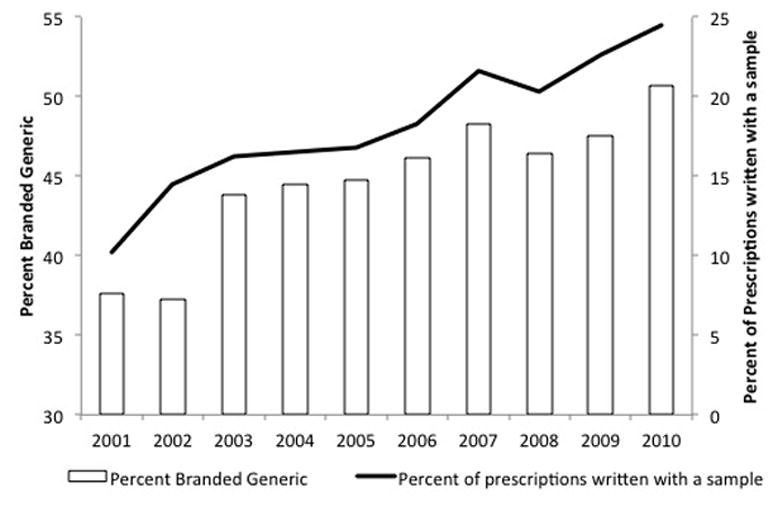
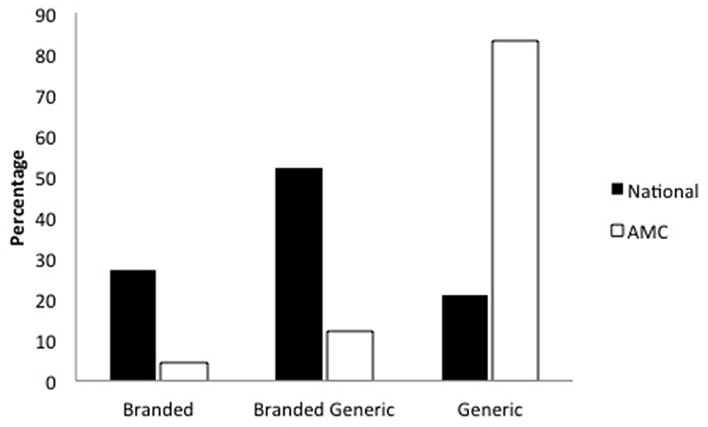
Results: On a national level, the provision of samples with a prescription by dermatologists has been increasing over time, and this increase is correlated (r = 0.92) with the use of the branded generic drugs promoted by these samples. Branded and branded generic drugs comprised most of the prescriptions written nationally (79%), while they represented only 17% at an academic medical center clinic without samples. Because of the increased use of branded and branded generic drugs, the national mean total retail cost of prescriptions at an office visit for acne was conservatively estimated to be 2 times higher (approximately $465 nationally vs $200 at an academic medical center without samples).
Conclusions and relevance: Free drug samples can alter the prescribing habits of physicians away from the use of less expensive generic medications. The benefits of free samples in dermatology must be weighed against potential negative effects on prescribing behavior and prescription costs.
Figures
Comment in
-
Drug samples in dermatology: out of the closet, into the dustbin.JAMA Dermatol. 2014 May;150(5):483-5. doi: 10.1001/jamadermatol.2013.9711. JAMA Dermatol. 2014. PMID: 24740350 Free PMC article. No abstract available.
-
The good, the bad, and the ugly of free drug samples.JAMA Dermatol. 2014 Nov;150(11):1237-8. doi: 10.1001/jamadermatol.2014.1820. JAMA Dermatol. 2014. PMID: 25188835 No abstract available.
References
-
- Campbell EG, Gruen RL, Mountford J, Miller LG, Cleary PD, Blumenthal D. A national survey of physician-industry relationships. N Engl J Med. 2007 Apr 26;356(17):1742–1750. - PubMed
-
- Adair RF, Holmgren LR. Do drug samples influence resident prescribing behavior? A randomized trial. Am J Med. 2005 Aug;118(8):881–884. - PubMed
-
- Martin J, Vittinghoff E, Guglielmo BJ, Udkow T, MacDougall C. National estimates and predictors of prescription medication sample use in the United States, 1999–2005. Journal of the American Pharmacists Association. 2010;50(6):677–685. - PubMed
-
- Hall KB, Tett SE, Nissen LM. Perceptions of the influence of prescription medicine samples on prescribing by family physicians. Med Care. 2006 Apr;44(4):383–387. - PubMed
Publication types
MeSH terms
Substances
Grants and funding
LinkOut - more resources
Full Text Sources
Other Literature Sources
Medical