Review
. 2014 Apr;74(6):659-74.
doi: 10.1007/s40265-014-0212-x.

Teriflunomide and its mechanism of action in multiple sclerosis

Affiliations
Review

Teriflunomide and its mechanism of action in multiple sclerosis

Amit Bar-Or et al. Drugs. 2014 Apr.

Abstract

Treatment of multiple sclerosis (MS) is challenging: disease-modifying treatments (DMTs) must both limit unwanted immune responses associated with disease initiation and propagation (as T and B lymphocytes are critical cellular mediators in the pathophysiology of relapsing MS), and also have minimal adverse impact on normal protective immune responses. In this review, we summarize key preclinical and clinical data relating to the proposed mechanism of action of the recently approved DMT teriflunomide in MS. Teriflunomide selectively and reversibly inhibits dihydro-orotate dehydrogenase, a key mitochondrial enzyme in the de novo pyrimidine synthesis pathway, leading to a reduction in proliferation of activated T and B lymphocytes without causing cell death. Results from animal experiments modelling the immune activation implicated in MS demonstrate reductions in disease symptoms with teriflunomide treatment, accompanied by reduced central nervous system lymphocyte infiltration, reduced axonal loss, and preserved neurological functioning. In agreement with the results obtained in these model systems, phase 3 clinical trials of teriflunomide in patients with MS have consistently shown that teriflunomide provides a therapeutic benefit, and importantly, does not cause clinical immune suppression. Taken together, these data demonstrate how teriflunomide acts as a selective immune therapy for patients with MS.


Figures
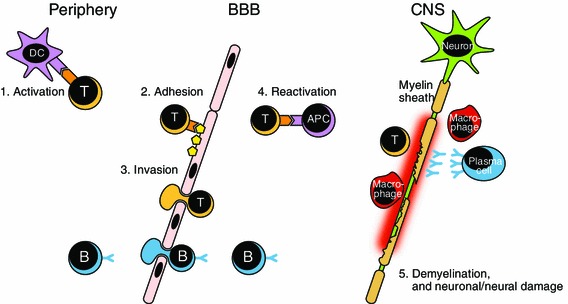
Fig. 1
Fig. 1
An overview of the roles of immune cells in multiple sclerosis pathogenesis. T cells are stimulated to proliferate when they encounter antigen-presenting cells in the lymph node. Circulating T cells and B cells can traffic from the circulation across the blood–brain barrier. In the CNS, T cells encounter CNS antigens presented by dendritic cells. Macrophages and activated T cells can attack components of the CNS directly or release cytokines to activate other cell types, including B cells, which mature into antibody-producing plasma cells. T T cell, B B cell, CNS central nervous system, BBB blood–brain barrier, APC antigen-presenting cell, DC dendritic cell [64, 81, 89, 94]
Fig. 2
Fig. 2
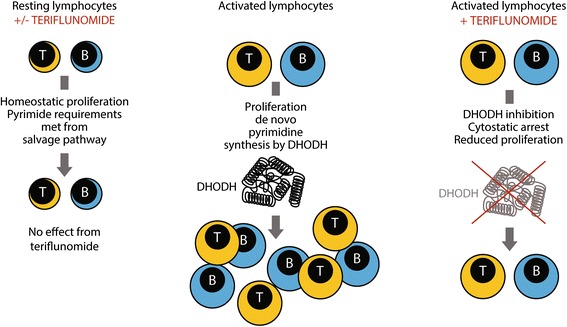
Proposed MoA of teriflunomide. Resting lymphocytes are unaffected by teriflunomide. They self-renew without any requirement for de novo pyrimidine synthesis, as they can meet their pyrimidine requirements from the salvage pathway. Proliferation of activated lymphocytes relies on de novo pyrimidine synthesis by DHODH, so their proliferation is inhibited by teriflunomide. MoA mechanism of action, DHODH dihydro-orotate dehydrogenase, T T cell, B B cell. Homeostatic proliferation refers to self-renewal, and proliferation refers to expansion in response to stimulus
Fig. 3
Fig. 3
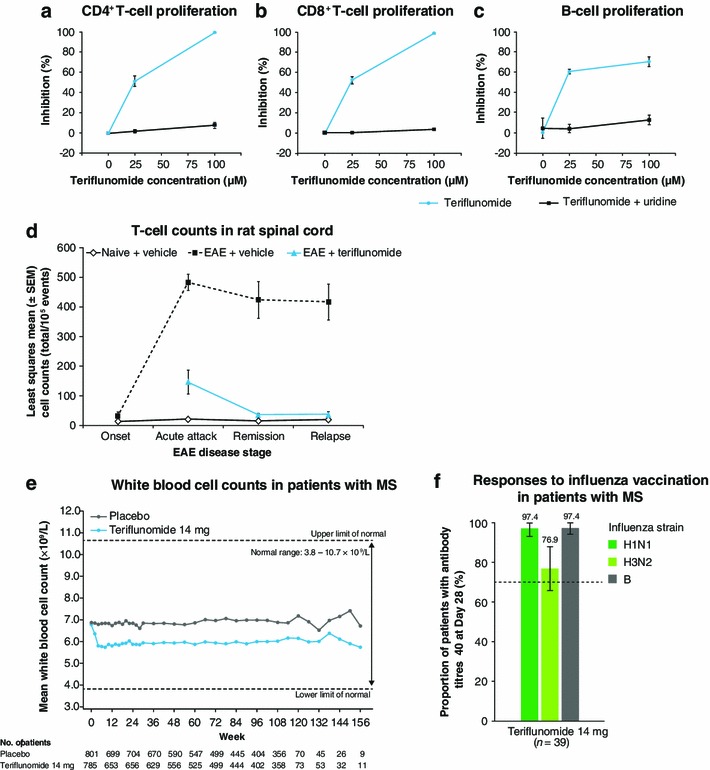
In vitro, preclinical, and clinical evidence for the selective immunomodulatory MoA of teriflunomide. Teriflunomide inhibits the proliferation of a CD4+ and b CD8+ T-cell subsets, and c B cells, in vitro, in a DHODH-dependent (uridine-reversible) manner. Graphs show the degree of inhibition of proliferation in response to anti-CD3 antibody (a, b) or CpG oligonucleotide (c), measured by CFSE dye dilution and flow cytometry; data presented as mean ± standard error. d In the Dark Agouti EAE rat model of MS, teriflunomide treatment attenuates the number of T cells (identified by anti-CD3 staining and flow cytometry) in cervical spinal cord at all phases of disease; data presented as lease square mean ± standard error of the mean. e White blood cell counts in patients treated with teriflunomide 14 mg remain within the normal range and stabilize after the first 3 months of treatment. f Responses to seasonal influenza vaccine, by influenza strain, in patients treated with teriflunomide 14 mg. Dotted line shows European criteria for vaccine efficacy (70 % of patients with post-vaccination titres ≥40), error bars show 90 % confidence interval. MoA mechanism of action, EAE experimental autoimmune encephalomyelitis, DHODH dihydro-orotate dehydrogenase, CFSE carboxyfluorescein succinimidyl ester, SEM standard error of the mean. Reproduced with permission from [64] (ac), [81] (d), [94] (f)

References

    1. Hauser SL, Oksenberg JR. The neurobiology of multiple sclerosis: genes, inflammation, and neurodegeneration. Neuron. 2006;52:61–76. - PubMed
    1. Trapp BD, Nave KA. Multiple sclerosis: an immune or neurodegenerative disorder? Annu Rev Neurosci. 2008;31:247–269. - PubMed
    1. Sospedra M, Martin R. Immunology of multiple sclerosis. Annu Rev Immunol. 2005;23:683–747. - PubMed
    1. McFarland HF, Martin R. Multiple sclerosis: a complicated picture of autoimmunity. Nat Immunol. 2007;8:913–919. - PubMed
    1. Hafler DA. Multiple sclerosis. J Clin Invest. 2004;113:788–794. - PMC - PubMed

MeSH terms