


Bayesian latent structure modeling of walking behavior in a physical activity intervention
- PMID: 24741000
- PMCID: PMC5388556
- DOI: 10.1177/0962280214529932
Bayesian latent structure modeling of walking behavior in a physical activity intervention
Abstract
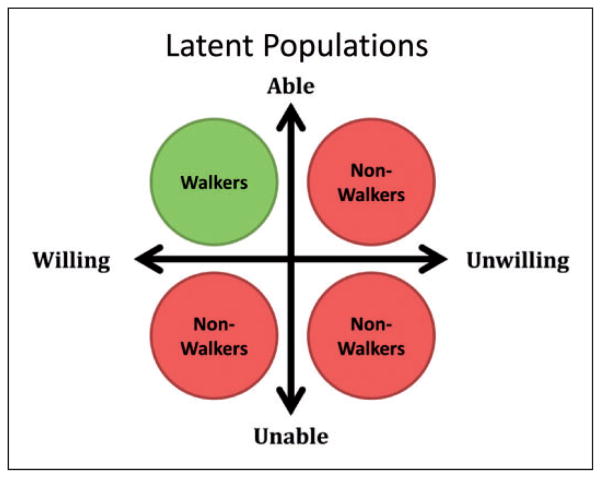
The analysis of walking behavior in a physical activity intervention is considered. A Bayesian latent structure modeling approach is proposed whereby the ability and willingness of participants is modeled via latent effects. The dropout process is jointly modeled via a linked survival model. Computational issues are addressed via posterior sampling and a simulated evaluation of the longitudinal model's ability to recover latent structure and predictor effects is considered. We evaluate the effect of a variety of socio-psychological and spatial neighborhood predictors on the propensity to walk and the estimation of latent ability and willingness in the full study.
Keywords: Bayesian; Latent structure; intervention; joint model; longitudinal data; physical activity.
© The Author(s) 2014.
Conflict of interest statement
The author(s) declared no potential conflicts of interest with respect to the research, authorship, and/or publication of this article.
Figures
References
-
- Committee PAGA. Physical activities guidelines advisory committee report. Washington, DC: Department of Health and Human Services; 2008.
-
- Carlson SA, Fulton JE, Schoenborn CA, et al. Trend and prevalence estimates based on the 2008 physical activity guidelines for Americans. Am J Prev Med. 2010;39:305–313. - PubMed
-
- Ogden CL, Carrol MD. Prevalence of overweight, obesity, and extreme obesity among adults: United States, trends 1976–1980 through 2007–2008. Hyattsville, MD: NCHS Health E-Stat; 2010.
-
- Bronfenbrenner U. Making human beings human: Bioecological perspectives on human development. Thousand Oaks, CA: Sage; 2005.
MeSH terms
Grants and funding
LinkOut - more resources
Full Text Sources
Other Literature Sources
Medical
