. 2014 Apr 16;34(16):5649-57.
doi: 10.1523/JNEUROSCI.4564-13.2014.

Synaptic glutamate spillover due to impaired glutamate uptake mediates heroin relapse

Affiliations

Synaptic glutamate spillover due to impaired glutamate uptake mediates heroin relapse

Hao-wei Shen et al. J Neurosci. .

Abstract

Reducing the enduring vulnerability to relapse is a therapeutic goal in treating drug addiction. Studies with animal models of drug addiction show a marked increase in extrasynaptic glutamate in the core subcompartment of the nucleus accumbens (NAcore) during reinstated drug seeking. However, the synaptic mechanisms linking drug-induced changes in extrasynaptic glutamate to relapse are poorly understood. Here, we discovered impaired glutamate elimination in rats extinguished from heroin self-administration that leads to spillover of synaptically released glutamate into the nonsynaptic extracellular space in NAcore and investigated whether restoration of glutamate transport prevented reinstated heroin seeking. Through multiple functional assays of glutamate uptake and analyzing NMDA receptor-mediated currents, we show that heroin self-administration produced long-lasting downregulation of glutamate uptake and surface expression of the transporter GLT-1. This downregulation was associated with spillover of synaptic glutamate to extrasynaptic NMDA receptors within the NAcore. Ceftriaxone restored glutamate uptake and prevented synaptic glutamate spillover and cue-induced heroin seeking. Ceftriaxone-induced inhibition of reinstated heroin seeking was blocked by morpholino-antisense targeting GLT-1 synthesis. These data reveal that the synaptic glutamate spillover in the NAcore results from reduced glutamate transport and is a critical pathophysiological mechanism underling reinstated drug seeking in rats extinguished from heroin self-administration.

Keywords: extrasynaptic glutamate receptor; glutamate spillover; glutamate uptake; heroin self-administration; nucleus accumbens; relapse.


Figures
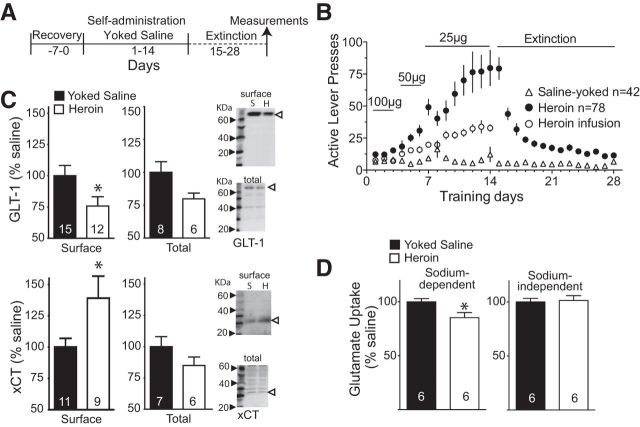
Figure 1.
Figure 1.
Heroin self-administration induces an enduring decrease in glutamate uptake. A, Training protocol for heroin self-administration and yoked-saline control. All measurements were performed after 2 weeks of extinction training. B, Self-administration and extinction active lever pressing of all yoked-saline and heroin-trained rats used in all data shown in Figures 1, 2, 3, and 4. C, Decreased surface expression of GLT-1 (normalized to saline optical density) and increased surface expression of xCT without changes in total protein from whole-cell lysate. Representative Western blots for GLT-1 and xCT are shown on the right. S, Yoked-saline; H, heroin-trained. Open arrowhead refers to the band quantified. D, Na+-dependent [3H]-glutamate uptake (normalized to saline CPM) in NAcore tissue slices is reduced in heroin compared with yoked-saline animals, whereas Na+-independent 3H-glutamate uptake did not differ between the two treatment groups. The number of determinations is shown in the bar. *p < 0.05 comparing heroin with yoked saline.
Figure 2.
Figure 2.
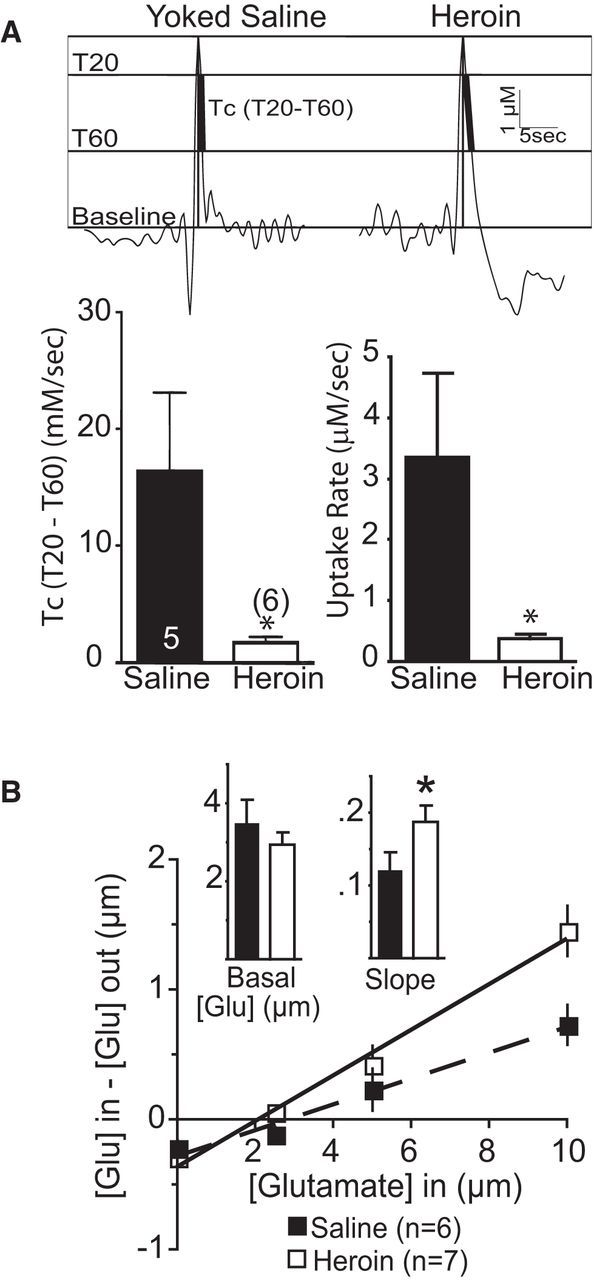
Slower rate of in vivo glutamate uptake in heroin rats. A, Top, Representative traces of K+-induced glutamate release showing where measurements were made at 20% and 60% of peak value. Bottom, Comparison between heroin and yoked-saline using two different estimates of glutamate uptake. B, No-net-flux microdialysis in the NAcore shows no difference in basal glutamate, but greater slope, indicating altered glutamate elimination. *p < 0.05 comparing heroin with yoked saline.
Figure 3.
Figure 3.
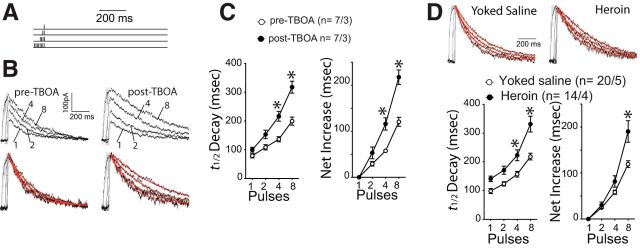
Heroin self-administration increases spillover of synaptic glutamate. A, Stimulation protocols used for triggering NMDAR-mediated EPSC when NAcore spiny neurons were at +40 mV holding voltage. The interpulse and interburst intervals were 10 ms and 30 s, respectively. B, Representative original and normalized traces of evoked NMDA EPSC (1, 2, 4, and 8 pulses measured after AMPA current blockade) before and after TBOA incubation. The red line indicates the decay kinetics fit to a regression exponential curve. N is shown as #cells/#rats. C, Averaged t1/2 decay of NMDA EPSC and net increase of t1/2 decay of NMDA EPSC evoked by incremental pulse number was increased by blocking glutamate uptake with TBOA (10 μm). N is shown as #cells/#rats. D, Decay of NMDA EPSCs triggered by burst stimuli was slower in heroin compared with saline-yoked rats. Top, Example normalized traces of NMDA EPSCs. Bottom, Averaged t1/2 decay of NMDA EPSC and net increase of t1/2 decay. *p < 0.05 comparing heroin with yoked-saline, 2-way ANOVA and Bonferroni's test.
Figure 4.
Figure 4.
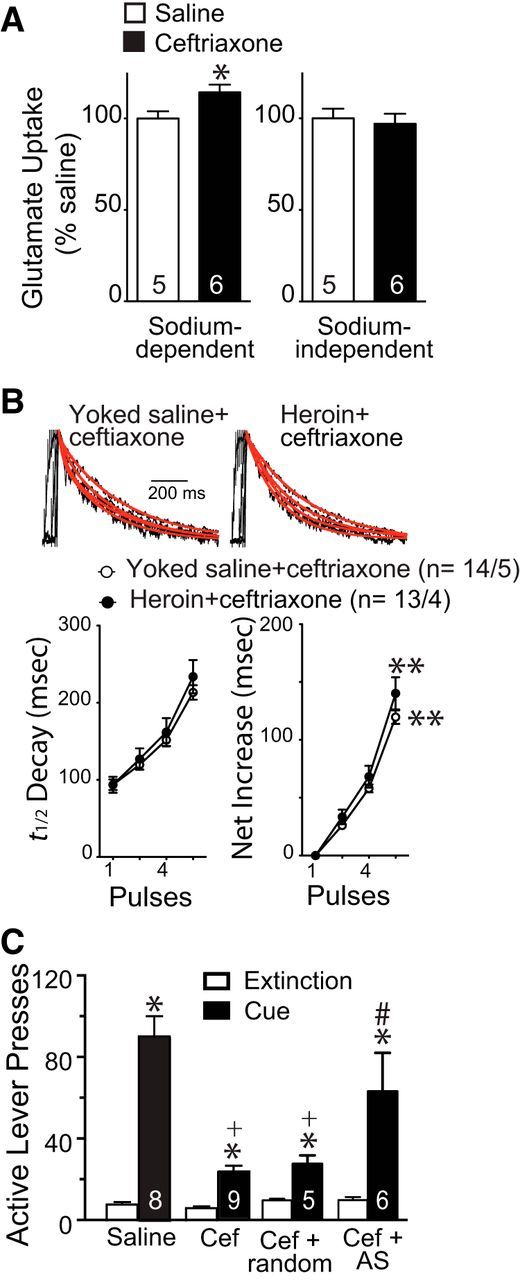
Ceftriaxone restores glutamate uptake and spillover and inhibits cue-induced reinstatement of heroin-seeking. A, Repeated ceftriaxone (7 daily injections of 100 mg/kg, i.p.) during extinction increased Na+-dependent glutamate uptake in heroin-trained rats (normalized to saline CPM). *p < 0.05 comparing ceftriaxone- with saline-treated heroin rats. B, No significant difference in the decay of NMDA EPSCs between yoked saline and heroin rats after ceftriaxone treatment. Top, Representative normalized traces of NMDA EPSCs. Bottom, Averaged t1/2 decay of NMDA EPSC and net increase of t1/2 decay. N is shown as #cells/#rats. **p < 0.05 comparing the heroin data in Figure 3D with the saline data in Figure 3D and the ceftriaxone data in Figure 4B, two-way ANOVA with repeated measures over pulses followed by a Tukey's test for multiple comparisons. C, Ceftriaxone (Cef) prevented cue-induced reinstatement of active lever pressing and antisense (AS) suppression of ceftriaxone-induced increases in GLT-1 prevented ceftriaxone-mediated inhibition of reinstated heroin seeking. *p < 0.05 comparing cue-induced active lever with extinction pressing using a 2-way ANOVA with repeated measures over extinction/cue followed by a Bonferroni's post hoc test; +p < 0.05 comparing Cef with saline; #p < 0.05 comparing Cef + AS with Cef + random.
Figure 5.
Figure 5.
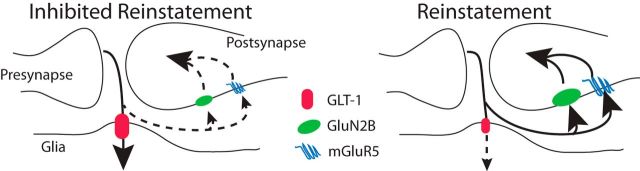
Model of how downregulated GLT-1 promotes reinstated heroin seeking due to increase synaptic glutamate spillover to extrasynaptic glutamate receptors. The size of the symbol indicates increased or reduced stimulation by glutamate (mGluR5 or GluN2B) or glutamate transport (GLT-1). The dashed line and smaller arrowhead signify reduced glutamate relative to the solid line and larger arrowhead in response to the same amount of synaptically released glutamate.

References

    1. Anderson SM, Famous KR, Sadri-Vakili G, Kumaresan V, Schmidt HD, Bass CE, Terwilliger EF, Cha JH, Pierce RC. CaMKII: a biochemical bridge linking accumbens dopamine and glutamate systems in cocaine seeking. Nat Neurosci. 2008;11:344–353. doi: 10.1038/nn2054. - DOI - PubMed
    1. Anwyl R. Metabotropic glutamate receptor-dependent long-term potentiation. Neuropharmacology. 2009;56:735–740. doi: 10.1016/j.neuropharm.2009.01.002. - DOI - PubMed
    1. Arnth-Jensen N, Jabaudon D, Scanziani M. Cooperation between independent hippocampal synapses is controlled by glutamate uptake. Nat Neurosci. 2002;5:325–331. doi: 10.1038/nn825. - DOI - PubMed
    1. Bäckström P, Bachteler D, Koch S, Hyytiä P, Spanagel R. mGluR5 antagonist MPEP reduces ethanol-seeking and relapse behavior. Neuropsychopharmacology. 2004;29:921–928. doi: 10.1038/sj.npp.1300381. - DOI - PubMed
    1. Baker DA, McFarland K, Lake RW, Shen H, Tang XC, Toda S, Kalivas PW. Neuroadaptations in cystine-glutamate exchange underlie cocaine relapse. Nat Neurosci. 2003;6:743–749. doi: 10.1038/nn1069. - DOI - PubMed

Publication types

MeSH terms

LinkOut - more resources