


Longitudinal study of body composition in spinal cord injury patients
- PMID: 24741139
- PMCID: PMC3977373
- DOI: 10.4103/0019-5413.128760
Longitudinal study of body composition in spinal cord injury patients
Abstract
Background: Bone mass loss and muscle atrophy are the frequent complications occurring after spinal cord injury (SCI). The potential risks involved with these changes in the body composition have implications for the health of the SCI individual. Thus, there is a need to quantitate and monitor body composition changes accurately in an individual with SCI. Very few longitudinal studies have been reported in the literature to assess body composition and most include relatively small number of patients. The present prospective study aimed to evaluate the body composition changes longitudinally by DEXA in patients with acute SCI.
Materials and methods: Ninety five patients with acute SCI with neurological deficits were evaluated for bone mineral content (BMC), body composition [lean body mass (LBM) and fat mass] by dual-energy X-ray absorptiometry during the first year of SCI.
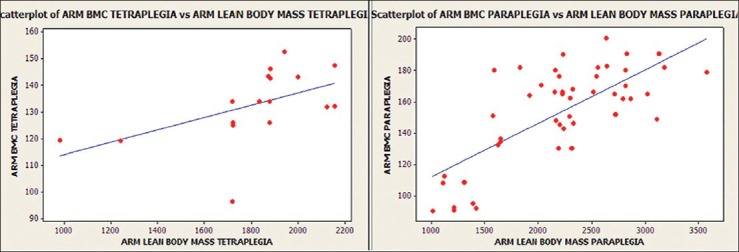
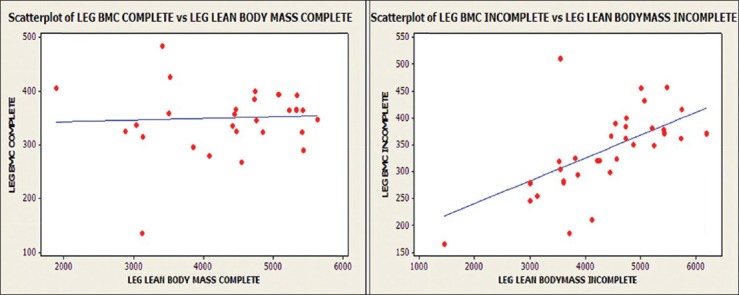
Results: There was a significant decrease in BMC (P < 0.05) and LBM (P < 0.05) and increase in total body fat mass (TBFM) and percentage fat at infra-lesional sites. The average decrease was 14.5% in BMC in lower extremities, 20.5% loss of LBM in legs and 15.1% loss of LBM in trunk, and increase of 0.2% in fat mass in legs and 17.3% increased fat in the lower limbs at 1 year. The tetraplegic patients had significant decrease in arm BMC (P < 0.001), arm LBM (P < 0.01) and fat percentage (P < 0.01) compared to paraplegics. Patients with complete motor injury had higher values of TBFM and fat percentage, but comparable values of BMC and LBM to patients with incomplete motor injury.
Conclusions: Our findings suggest that there is a marked decrease in BMC and LBM with increase in adiposity during the first year of SCI. Although these changes depend on the level and initial severity of lesions, they are also influenced by the neurological recovery after SCI.
Keywords: Body composition; body mass index; dual-energy X-ray absorptiometry; paraplegia; spinal cord injuries; tetraplegia.
Conflict of interest statement
Figures



References
-
- Gordon T, Mao J. Muscle atrophy and procedures for training after spinal cord injury. Phys Ther. 1994;74:50–60. - PubMed
-
- Jiang SD, Jiang LS, Dai LY. Mechanisms of osteoporosis in spinal cord injury. Clin Endocrinol (oxf) 2006;65:555–65. - PubMed
-
- Castro MJ, Apple DF, Hillegass EA, Dudley GA. Influence of complete spinal cord injury on skeletal muscle cross sectional area within the first 6 months of injury. Eur J Appl Physiol Occup Physiol. 1999;80:373–8. - PubMed
-
- Forbes GB. London: Springer-Verlag; 1987. Human body composition: Growth, aging, nutrition and activity; pp. l53–95.
LinkOut - more resources
Full Text Sources
Other Literature Sources