


Neuropharmacological evaluation of a novel 5-HT3 receptor antagonist (6g) on chronic unpredictable mild stress-induced changes in behavioural and brain oxidative stress parameters in mice
- PMID: 24741192
- PMCID: PMC3987189
- DOI: 10.4103/0253-7613.129316
Neuropharmacological evaluation of a novel 5-HT3 receptor antagonist (6g) on chronic unpredictable mild stress-induced changes in behavioural and brain oxidative stress parameters in mice
Abstract
Aim: The aim of the study was to evaluate a novel 5 HT3 receptor antagonist (6g) on chronic stress induced changes in behavioural and brain oxidative stress parameter in mice. A complicated relationship exists among stressful stimuli, body's reaction to stress and the onset of clinical depression. Chronic unpredictable stressors can produce a situation similar to human depression, and such animal models can be used for the preclinical evaluation of antidepressants.
Materials and methods: In the present study, a novel and potential 5-HT3 receptor antagonist (4-benzylpiperazin-1-yl)(3-methoxyquinoxalin-2-yl) methanone (6g) with good Log P (3.08) value and pA 2(7.5) values, synthesized in our laboratory was investigated to study the effects on chronic unpredictable mild stress (CUMS)-induced behavioural and biochemical alterations in mice. Mice were subjected to different stress paradigms daily for a period of 28 days to induce depressive-like behaviour.
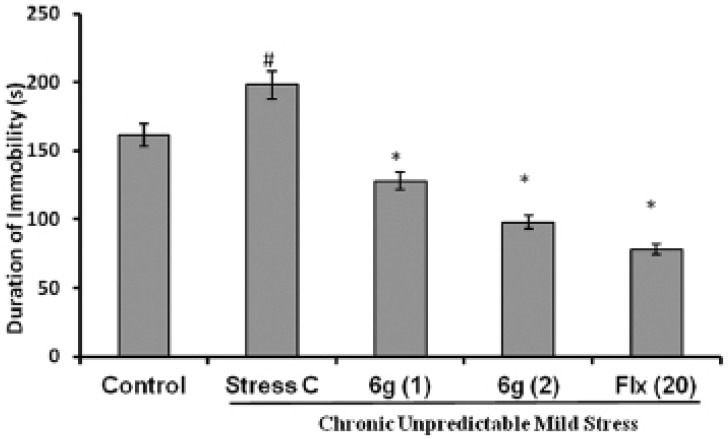
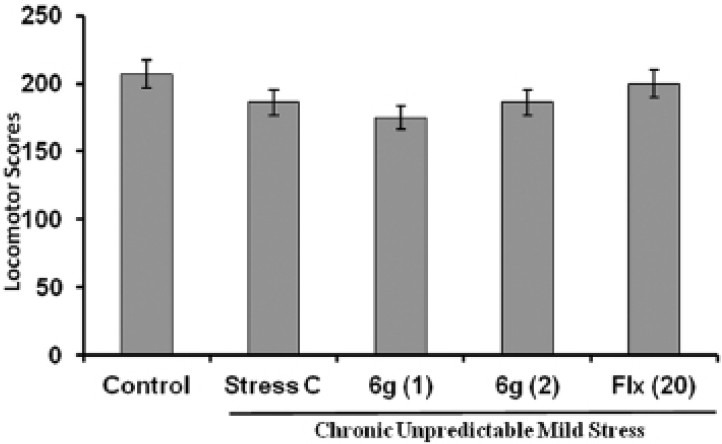
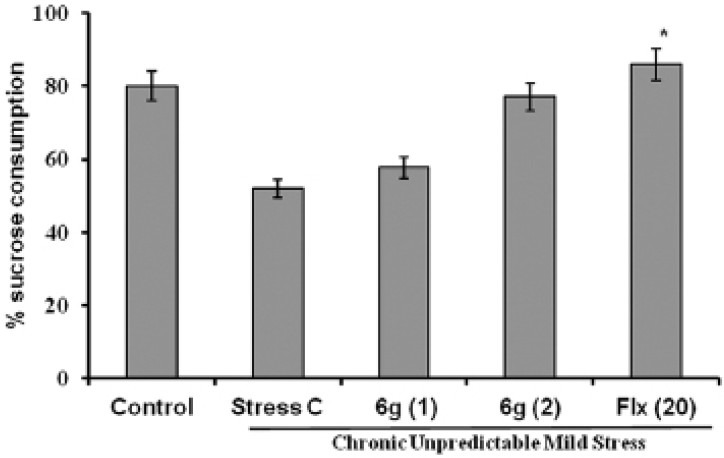
Results: The results showed that CUMS caused depression-like behaviour in mice, as indicated by the significant (P < 0.05) decrease in sucrose consumption and locomotor activity and increase in immobility the forced swim test. In addition, it was found that lipid peroxidation and nitrite levels were significantly (P < 0.05) increased, whereas glutathione levels, superoxide dismutase and catalase activities decreased in brain tissue of CUMS-treated mice. '6g' (1 and 2 mg/kg, p.o., 21 days) and fluoxetine treatment (20 mg/kg, p.o., 21 days) significantly (P < 0.05) reversed the CUMS-induced behavioural (increased immobility period, reduced sucrose preference and decreased locomotor activity) and biochemical (increased lipid peroxidation; decreased glutathione levels, superoxide dismutase and catalase activities). However fluoxetine treatment (20 mg/kg, p.o., 21 days) significantly decreased the nitrite level in the brain while '6g' (1 and 2 mg/kg, p.o., 21 days) did not show significant (P < 0.05) effect on the nitrite levels in brain.
Conclusion: Compound '6g' exerted antidepressant-like effects in behavioural despair paradigm in chronically stressed mice by restoring antioxidant mechanisms.
Keywords: 5-HT3 receptor antagonist; chronic unpredictable mild stress; depression; oxidative stress.
Conflict of interest statement
Figures
References
-
- Kessler RC, Berglund P, Demler O, Jin R, Koretz D, Merikangas KR, et al. The epidemiology of major depressive disorder: Results from the national comorbidity survey replication (NCS-R) JAMA. 2003;289:3095–105. - PubMed
-
- Kendler KS, Thornton LM, Prescott CA. Gender differences in the rates of exposure to stressful life events and sensitivity to their depressogenic effects. Am J Psychiatry. 2001;158:587–93. - PubMed
-
- Nemeroff CB. The burden of severe depression: A review of diagnostic challenges and treatment alternatives. J Psychiatr Res. 2007;41:189–206. - PubMed
-
- Nestler EJ, Barrot M, DiLeone RJ, Eisch AJ, Gold SJ, Monteggia LM. Neurobiology of depression. Neuron. 2002;34:13–25. - PubMed
-
- Garcia LS, Comim CM, Valvassori SS, Réus GZ, Stertz L, Kapczinski F, et al. Ketamine treatment reverses behavioural and physiological alterations induced by chronic mild stress in rats. Prog Neuropsychopharmacol Biol Psychiatry. 2009;33:450–55. - PubMed
MeSH terms
Substances
LinkOut - more resources
Full Text Sources
Other Literature Sources
Medical
