


Efficacy and safety of canagliflozin compared with placebo in older patients with type 2 diabetes mellitus: a pooled analysis of clinical studies
- PMID: 24742013
- PMCID: PMC4021426
- DOI: 10.1186/1472-6823-14-37
Efficacy and safety of canagliflozin compared with placebo in older patients with type 2 diabetes mellitus: a pooled analysis of clinical studies
Abstract
Background: Canagliflozin is a sodium glucose co-transporter 2 inhibitor developed for the treatment of patients with type 2 diabetes mellitus (T2DM). The efficacy and safety of canagliflozin were evaluated in patients with T2DM <65 and ≥65 years of age.
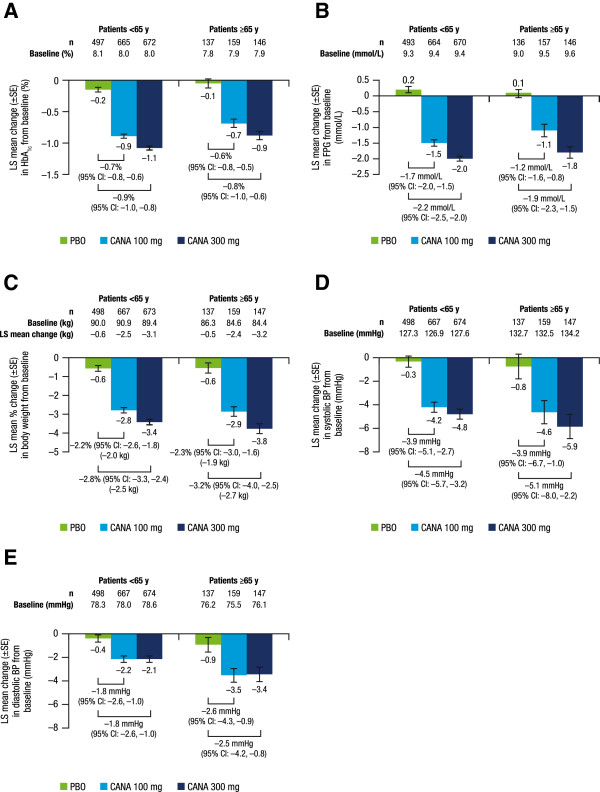
Methods: Pooled data from 4 randomised, placebo-controlled, 26-week, Phase 3 studies (N = 2,313) evaluating canagliflozin 100 and 300 mg were analysed by age: <65 years (n = 1,868; mean age, 52.8 years) or ≥65 years (n = 445; mean age, 69.3 years). Efficacy evaluations included change from baseline in glycaemic parameters and systolic blood pressure (BP), and percent change from baseline in body weight. Assessment of safety/tolerability included adverse event (AE) reports, incidence of documented hypoglycaemia, and percent change from baseline in fasting plasma lipids.
Results: Canagliflozin 100 and 300 mg reduced HbA1c and fasting plasma glucose relative to placebo in patients <65 and ≥65 years of age. Both canagliflozin doses reduced body weight and systolic BP relative to placebo in patients <65 and ≥65 years of age. Incidence of overall AEs was similar across all treatment groups in patients <65 and ≥65 years of age. Incidences of serious AEs and AE-related discontinuations were similar across all treatment groups in patients <65 years of age and higher with canagliflozin 100 mg than other groups in patients ≥65 years of age. As in patients <65 years of age, incidences of genital mycotic infections and osmotic diuresis-related AEs were higher with canagliflozin relative to placebo in those ≥65 years of age. Incidences of urinary tract infections (UTIs), renal-related AEs, AEs related to volume depletion, and documented hypoglycaemia episodes were similar across all treatment groups in patients ≥65 years of age; no notable trends were observed with canagliflozin 100 and 300 mg relative to placebo in these AEs among patients <65 years of age. Changes in lipid parameters with canagliflozin were similar in both age subsets.
Conclusions: Canagliflozin improved glycaemic control, body weight, and systolic BP, and was generally well tolerated in older patients with T2DM.
Trial registration: ClinicalTrials.gov, NCT01081834; NCT01106677; NCT01106625; NCT01106690.
Figures
References
-
- Inzucchi SE, Bergenstal RM, Buse JB, Diamant M, Ferrannini E, Nauck M, Peters AL, Tsapas A, Wender R, Matthews DR. Management of hyperglycaemia in type 2 diabetes: a patient-centered approach. Position statement of the American Diabetes Association (ADA) and the European Association for the Study of Diabetes (EASD) Diabetologia. 2012;55:1577–1596. doi: 10.1007/s00125-012-2534-0. - DOI - PubMed
-
- Canadian Diabetes Association. Clinical Practice Guidelines. [ http://guidelines.diabetes.ca/]
-
- International Diabetes Federation. Global guidelines for type 2 diabetes. [ http://www.idf.org/sites/default/files/IDF-Guideline-for-Type-2-Diabetes...]
-
- Meneilly GS, Knip A, Tessier D. Canadian Diabetes Association 2013 Clinical Practice Guidelines for the Prevention and Management of Diabetes in Canada: diabetes in the elderly. Can J Diabetes. 2013;37(suppl):S184–S190.
Publication types
MeSH terms
Substances
Associated data
LinkOut - more resources
Full Text Sources
Other Literature Sources
Medical
